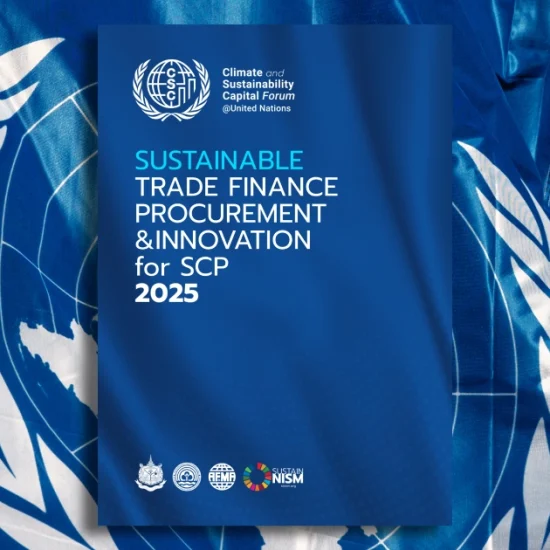
Sustainable Consumption and Production (SCP) has emerged as a central pillar of international sustainability governance, deeply aligned with the United Nations Sustainable Development Goals (SDGs), ESCAP directives, and global ESG investment frameworks. This article reframes SCP not as a cost center but as a differentiated procurement logic—one that is strategically applied where it matters most.
It acknowledges that astute executive leadership does not require uniform action across all markets. In conventional segments, where customers do not prioritize sustainability, existing procurement logic focused on cost and basic quality may remain appropriate. However, for new and expanding markets that are increasingly regulated under ESG, SDG, or climate-trade frameworks, a distinct logic must prevail.
This logic—SCP-first procurement—places sustainability at the forefront of decision-making, followed by product quality, and cost-efficiency as a final factor. This reordering is not only compliant with emerging standards but also positions organizations to access new revenue streams, qualify for ESG-aligned funding, and meet global buyer expectations.
This article further underscores the intelligence and foresight of procurement teams that can differentiate between market requirements and apply the most suitable sourcing strategy. Such capability allows companies to secure supplies from production ecosystems best matched to the expectations of each buyer segment. All supporting frameworks, including ESG indicators, buyer-supplier alignment, and investor engagement, reinforce this core logic. Organizations looking to thrive in sustainable markets must adopt this SCP-first approach—not universally, but selectively and strategically—if they are to lead in the emerging green economy.
1. Reframing Procurement as a Strategic Differentiator
Sustainability-aligned procurement is no longer an ideological preference—it is a form of commercial literacy. The ability to navigate between conventional cost-centric markets and ESG-regulated arenas is a core business competency. This bifocal approach demands that procurement leaders identify where SCP adds value and where it is mission-critical.
In essence, the challenge is not whether SCP should be applied across all operations, but rather how to distinguish between:
- Legacy markets, where low-cost, high-volume strategies remain viable; and
- Emergent sustainable markets, where regulatory compliance, traceability, and ethical sourcing are prerequisites for market access.
This dual-strategy mindset elevates procurement from a tactical function to a business intelligence hub, responsible not only for purchasing but for enabling market participation, protecting corporate reputation, and unlocking ESG-related revenue channels.
2. SCP as Market Access Infrastructure
In many advanced economies, SCP criteria are embedded in trade agreements, public procurement guidelines, and product labeling schemes. Buyers increasingly request documentation of sustainability practices, and regulators impose disclosure requirements under instruments such as the EU Supply Chain Law, U.S. Forced Labor Prevention Act, and Asia-Pacific regional climate compacts.
Consequently, SCP becomes not just a preferred method—but a required infrastructure for:
- Participating in green and social procurement channels
- Qualifying for environmental and social investment instruments
- Maintaining eligibility in supply chains governed by global buyers and multilateral agencies
SSA-verified suppliers offer an advantage by default, as their practices conform to these evolving requirements, and their credentials are recognized through the CSCAP@UN platform.
3. Tactical Advantages of SCP-First Procurement
Procurement teams who adopt SCP-first logic gain:
- Higher resilience in times of regulatory or reputational shock
- Lower lifecycle costs by avoiding ESG liabilities and embedded inefficiencies
- Stronger supplier partnerships through shared commitments to continuous improvement
- Preferential status with institutional buyers that score vendors on ESG criteria
Rather than creating new work, SCP strategies consolidate compliance, risk, and innovation into a unified procurement model. This reduces internal duplication while elevating the strategic value of sourcing functions.
4. Recommendations for Implementation
Organizations seeking to operationalize this shift should:
- Map procurement categories against market ESG expectations
- Segment suppliers by risk exposure and sustainability capability
- Align internal KPIs to reward procurement teams for ESG-compliant performance
- Join SSA to access pre-qualified suppliers and receive CSCAP-recognized procurement verification
- Embed SCP logic into board-level ESG governance as required by global frameworks
5. Conclusion: A Smarter Path to Sustainable Market Leadership
In summary, SCP-first procurement is not a blanket requirement, but a strategic choice for organizations aiming to grow in future-oriented markets. Wise leadership does not apply a one-size-fits-all model to all suppliers, products, or customer segments. Instead, it calibrates sourcing strategies to align with varying levels of risk, regulation, and revenue opportunity in each market.
This is not merely about compliance—it is about sustainable competitiveness. And in this regard, procurement professionals play a far more critical role than budget management or price negotiation.
Modern procurement is about enabling both growth and resilience. Today’s procurement leaders not only support sales performance, but also attract sustainable investment capital—by making buying decisions based on the lowest risk, not just the lowest price. In today’s global economy, ESG-related risks—ranging from legal exposure to reputational harm or exclusion from key export markets—can cause losses that far outweigh the savings gained from aggressive cost-cutting.
Simply put, unmanaged risk is far more expensive than a low quote on paper.
Procurement teams that understand this logic—and can flexibly adapt their approach to suit different markets—will define the next generation of global supply leadership. In an era where ESG shapes access to capital, trade, and trust, SCP-first procurement is not a limitation; it is a mark of intelligent, forward-looking business.
References
- ESCAP (2021). “SCP and Green Economy in Asia-Pacific.” UNESCAP.
- FTSE Russell (2024). “ESG Data Model Methodology.”
- STNSM.org (2026). “SSA Framework.”
- UN SDG Knowledge Platform. Sustainable Development Goals.
- OECD (2020). “Due Diligence Guidance for Responsible Business Conduct.”