Sustainability Supply Alliance for Responsible Buyer Mechanism for Sustainable Consumption and Production
Introduction
On 27 October 2025, the SSAB for SCP — Sustainability Supply Alliance for Responsible Buyer Mechanism for Sustainable Consumption and Production was formally introduced at the CSCAP forum held at the United Nations Conference Centre, Bangkok, as a voluntary mechanism to support the transition of businesses towards more responsible production, procurement and supply chains. Its broader purpose is to connect sustainability with tangible economic opportunities, market access and finance.
SSAB was developed in response to a practical challenge confronting many businesses, particularly SMEs, small-scale producers, cooperatives and enterprises operating within supply chains. In many cases, these enterprises do not lack commitment to sustainability. Rather, a gap remains between what they are already doing and what buyers, investors, financial institutions and sustainability frameworks increasingly require in the form of policies, data, evidence, traceability and credible, demonstrable outcomes.
At the same time, buyers and large corporations worldwide are increasingly seeking information relating to ESG performance, supply-chain due diligence, climate change, human rights, governance and responsible procurement. These expectations are progressively transmitted through supply chains to producers and business partners in different countries, including across Asia and the Pacific. Enterprises that are unable to organise and present the necessary information and evidence may therefore face reduced market opportunities, even where their products, quality and production capabilities remain competitive.
SSAB for SCP was therefore not developed to create a new standard to replace existing standards. It is intended to serve as a transition and readiness mechanism, enabling organisations to begin with the policies, information and evidence they already possess, organise them within a common structure, identify remaining gaps, and progressively advance towards higher levels of readiness in accordance with their risks, capabilities, buyer expectations and relevant market requirements.
The mechanism is structured around a progressive pathway:
Policy → Evidence → Traceability → Buyer Readiness → Market Outcomes → Verification
Organisations are not expected to have all elements fully developed from the outset. Areas that are not yet in place are treated as development gaps that can be addressed through a structured improvement pathway. At the same time, fundamental safeguards relating to labour rights, human rights, health and safety, environmental protection, anti-corruption and the integrity of information remain essential and cannot be disregarded.
The central purpose of SSAB is therefore not simply to determine whether an organisation has “passed” or “failed”. Rather, it is to help an organisation answer three practical questions:
Where are we today?
What is still missing?
What additional opportunities may become available as we progress to the next stage?
To support this progression, SSAB establishes five development levels: BLUE, BRONZE, SILVER, GOLD and GREEN. These levels reflect an organisation’s progression from initial commitments and policies towards structured evidence, stronger information systems, increased buyer readiness and, ultimately, measurable and communicable outcomes. Each level should therefore be understood not merely as a “status”, but as a stage in the development of business capability, progressively strengthening the organisation’s readiness to engage with buyers, markets, finance and relevant standards.
From a broader perspective, SSAB for SCP seeks to contribute to the development of a sustainability-based economy, in which environmental, social and governance responsibility is not confined to corporate policies or sustainability reports, but increasingly informs procurement decisions, investment, lending, supplier development and the allocation of economic resources.
This report has therefore been prepared to explain what SSAB for SCP is, why such a mechanism is needed, how each level supports business development, what participating organisations may gain from progressing through the mechanism, and how SSAB can help transmit economic value from producers to buyers, large enterprises, capital markets and investors. It also sets out a proposed five-year direction for advancing SSAB from a business-readiness mechanism towards a regional enabling infrastructure for responsible procurement, sustainable investment and inclusive economic growth across Asia and the Pacific.
SSAB as a “Transition-to-Standard” Mechanism
A Transition Pathway, Not Another Standard
A defining feature of SSAB is that businesses are not expected to be fully prepared from the outset.
This principle is consistent with the logic of risk-based due diligence, which recognises that enterprises operate under different conditions, levels of exposure and degrees of preparedness. The objective is therefore not to require every organisation to address every sustainability issue at the same level and at the same time, but to ensure that material risks and impacts are identified, prioritised and progressively managed through credible improvement.
SSAB applies this principle directly to business development.
What an organisation already has becomes the starting point. What is not yet in place is identified as a Development Gap. What should be strengthened next is translated into a practical pathway towards the next level of readiness.
In this way, a gap does not automatically mean failure. It may instead represent the next step in an organisation’s development journey.
This staged approach is particularly important for SMEs and other enterprises that may already have relevant policies, records, operational practices or supplier information, but do not yet have the resources or systems required to meet more advanced buyer, regulatory or certification requirements. SSAB enables such enterprises to organise existing evidence, identify priority gaps and progress systematically rather than being excluded at the first stage of assessment.
Flexibility, however, does not mean lowering fundamental responsibilities.
SSAB maintains Critical Safeguards for serious issues including child labour and forced labour, severe human-rights impacts, occupational health and safety risks, serious environmental harm, corruption, falsification of information and unsupported sustainability claims. These safeguards cannot be offset by commercial success, investment, buyer relationships or a higher recognition level.
This is the central meaning of SSAB as a “transition-to-standard” mechanism.
SSAB does not lower existing standards to make participation easier, nor does it seek to create a competing standard. Its role is to reduce the distance between where a business stands today and the level of readiness expected by tomorrow’s markets.
The pathway can be expressed simply as:
Start with what exists — identify what is missing — improve step by step — strengthen buyer readiness — progress towards the standards required by the market.
Strategically, SSAB therefore serves as a bridge between SMEs and standards, evidence and buyers, and sustainability and economic opportunity.
Its purpose is not merely to determine whether an enterprise is compliant today, but to create a credible and structured pathway through which enterprises can become progressively more capable of meeting the expectations of buyers, markets, finance and internationally recognised sustainability frameworks.
How the SSAB Mechanism Works
From Sustainability Commitment to Business Readiness and Market Outcomes
SSAB for SCP is designed as a progressive business development pathway, rather than a one-time assessment that simply determines whether an organisation “passes” or “fails”. The mechanism begins by organising what an organisation already has—policies, management systems, operational data, ESG information, product information, supplier records and supply-chain evidence—within a common structure so that the organisation can clearly understand:
What is already in place — What remains missing — What should be strengthened next to increase opportunities for business partnership.
A central principle of SSAB is that enterprises are not expected to have every element fully developed from the outset. Instead, they may begin at a level appropriate to their current capacity and progressively advance from:
Commitment → Evidence → Credibility → Buyer Readiness → Business Outcomes
The SSAB pathway therefore consists of two principal stages:
Pre-BLUE — preparing the organisation to enter the SSAB pathway; and
BLUE–GREEN — progressively strengthening the organisation from policy commitments towards buyer readiness and measurable business outcomes.
Pre-BLUE (Mechanics 1-3) : Preparing an Organisation to Enter the SSAB Pathway
Before entering the formal Recognition pathway, an organisation begins with three foundational steps:
COMMITMENT → REGISTRY → DISCLOSURE
The purpose of Pre-BLUE is to transform sustainability intentions—which may initially be dispersed across different parts of the organisation—into a defined starting point with clear scope, structured information and a basis for further development.
| Mechanics | Key Action | Business Significance |
|---|---|---|
| 1. COMMITMENT | Declare sustainability intentions and relevant policy commitments. | Establishes management direction and organisational responsibility. |
| 2. REGISTRY | Define the organisation, products, services, facilities and role within the supply chain. | Establishes a clear identity and scope for future review and engagement. |
| 3. DISCLOSURE | Organise and disclose available policies, operational information and supporting evidence. | Identifies what is already available, what remains missing and what should be developed before entering Recognition. |
COMMITMENT — Establishing Responsibility
SSAB does not require an organisation to begin by producing a large volume of new documentation. The first requirement is to establish a meaningful and accountable starting point.
The organisation should be able to identify which sustainability issues are relevant to its business, who is responsible for addressing them and how the organisation intends to make progress.
A Commitment therefore does not signify that the organisation has already achieved sustainability. Rather, it demonstrates that the organisation has recognised its responsibilities and established a direction for improvement.
This is the point at which intention begins to become institutional responsibility.
REGISTRY — Establishing a Clear Business Scope

The Registry stage defines precisely what is being brought into the SSAB pathway, including the relevant legal entity, facility, product or service, and the organisation’s role within the supply chain.
This distinction is important because a broad statement that a company is “sustainable” is not sufficiently precise for business decision-making. Buyers need to understand which products, services, operations and organisational boundaries are covered by the information presented.
The Registry therefore establishes a Business Sustainability Identity through which the organisation can be identified, understood and considered within a clearly defined scope.
Registration itself does not constitute certification or verification of sustainability performance.
DISCLOSURE — Turning Existing Practices into Usable Information
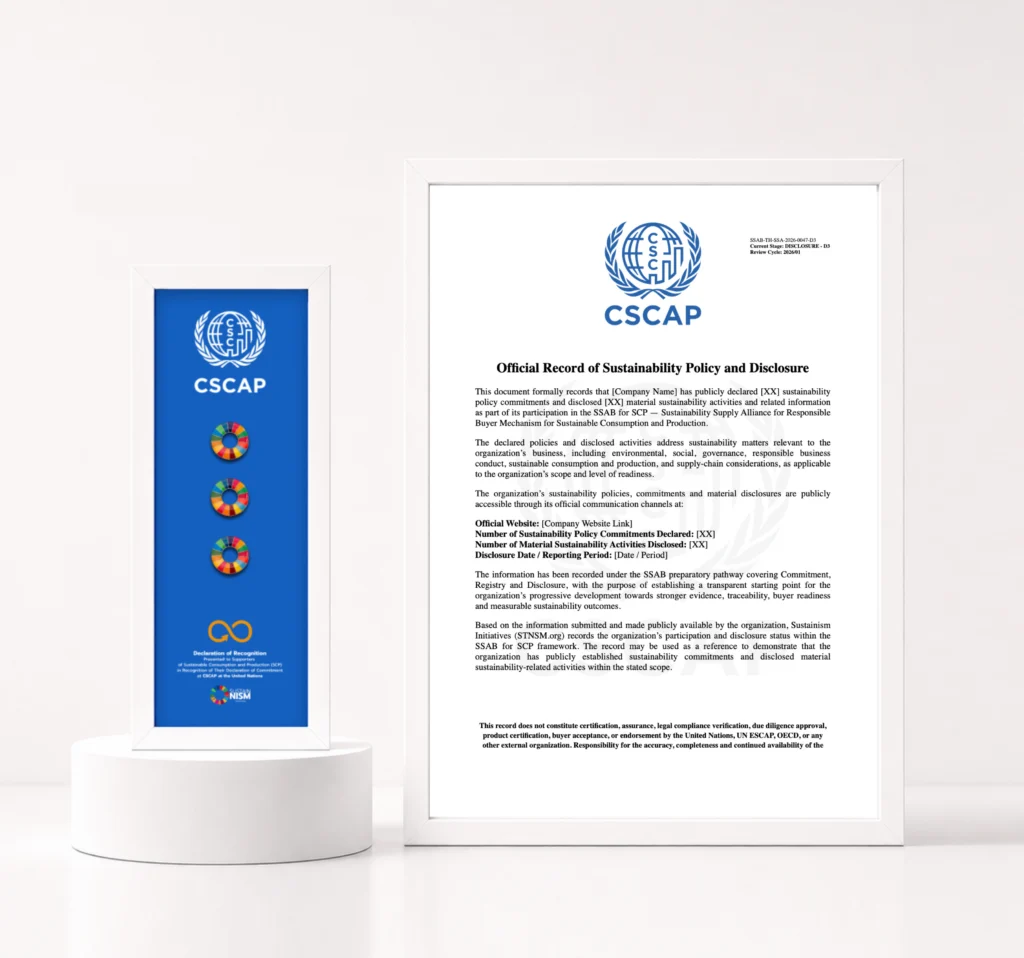
Disclosure is the stage at which an organisation begins to make practical use of what it already has.
This may include policies, operating procedures, KPIs, energy and resource data, waste information, labour records, health and safety information, supplier documentation, raw-material records, production information and traceability evidence.
The objective is not to maximise the number of documents created. Rather, it is to organise existing information so that the organisation can answer four fundamental questions:
Has the declared policy been implemented?
What evidence supports it?
Where does the information come from?
What gaps remain to be addressed?
Once these elements have been organised, the organisation is better positioned to enter the BLUE–GREEN Recognition pathway.
BLUE–GREEN (Mechanic 4) : From Policy to Business Outcomes and Partnership Opportunities
SSAB establishes five progressive levels:
BLUE → BRONZE → SILVER → GOLD → GREEN
These levels reflect the development of an organisation from policy commitment towards structured evidence, more systematic information, buyer readiness and outcomes that can support trade, investment and market expansion.
The levels should not be understood simply as indications that an organisation possesses more documents. Rather, they indicate the extent to which an organisation is becoming capable of engaging with buyers that apply increasingly sophisticated sustainability requirements.

The overall progression can be expressed as:
Policy → Evidence → Due Diligence Readiness → Buyer Readiness → Business Opportunity → Measurable Outcomes
| Level | Main Transition | What It Signals to Buyers | Business Value |
|---|---|---|---|
| BLUE | From intention to policy and direction | The organisation has begun to establish structured responsibility. | Creates a credible starting point for supplier development. |
| BRONZE | From policy to evidence | Initial evidence demonstrates that commitments are being translated into action. | Strengthens credibility and readiness for supplier screening. |
| SILVER | From evidence to systems | Information is increasingly structured and usable for assessment and due diligence. | Improves readiness for more substantive buyer engagement. |
| GOLD | From systems to procurement readiness | Evidence is sufficiently developed to support sustainable procurement and buyer collaboration. | Strengthens opportunities for commercial trials and strategic buyer relationships. |
| GREEN | From systems to measurable outcomes | The organisation can demonstrate performance, trends and appropriately supported outcomes. | Supports market expansion, access to finance, investment and longer-term business relationships. |
BLUE — From Intention to a Credible Starting Point
BLUE marks the transition from general interest or isolated sustainability activities towards clear policies, responsibilities and a defined direction for development.
From a buyer perspective, BLUE indicates that the organisation has begun to establish a structured approach to sustainability and is prepared to continue developing its systems.
The value of BLUE therefore lies not in declaring that the organisation is already “sustainable”, but in demonstrating that it has started in a credible direction and has a pathway for further improvement.
BRONZE — From Policy Statements to Evidence
BRONZE marks an important transition. The central question begins to move from:
“Does the company have a policy?”
to:
“Can the company provide evidence that the policy is being implemented?”
For example, a labour policy should begin to be supported by employment-related information. An environmental policy should begin to be supported by relevant data on resources, waste or operational controls.
BRONZE therefore begins to distinguish between an organisation that makes a commitment and an organisation that can begin to demonstrate implementation.
At this stage, supplier information becomes increasingly useful for initial screening and supplier-development processes.
SILVER — From Fragmented Evidence to Buyer-Usable Information
At SILVER, the objective is no longer simply to accumulate additional evidence. The priority is to make information systematic, connected and reusable.
The organisation should increasingly be able to explain where information originates, who is responsible for it, the period it covers, its limitations, and how issues are monitored and corrected.
The relationship therefore becomes:
Policy → Risk → Action → Evidence → Follow-up
This structure is particularly relevant to buyer due diligence.
SILVER represents the point at which sustainability information begins to move from being internal organisational information towards becoming information that buyers can use to support supplier assessment and due diligence.
GOLD — From Information Readiness to Business Partnership Readiness
GOLD represents a higher level of evidence coverage and organisational readiness, enabling ESG, traceability and due diligence information to be more effectively connected with procurement processes.
At this level, an organisation should be better prepared to participate in processes such as:
Supplier Qualification
Due Diligence
Sustainable Procurement
Supplier Development
Product or Commercial Trials
Buyer Collaboration
The commercial significance of GOLD is not that purchase orders are guaranteed. Rather, it indicates that the organisation is better prepared to enter procurement and partnership processes with buyers that apply more advanced sustainability requirements.
At this stage, sustainability increasingly becomes a component of competitiveness as a business partner.
GREEN — From Readiness to Measurable and Usable Outcomes
GREEN changes the central question from: “Does the organisation have a system?”
to: “What outcomes has that system produced?”
The organisation should be able to demonstrate performance data, trends and measurable outcomes, together with an appropriate level of validation or verification according to the significance and risk of the information concerned.
For example, having a waste-reduction policy is no longer sufficient by itself; the organisation should increasingly be able to demonstrate how waste volumes have changed. Similarly, climate-related commitments should progressively be supported by defined boundaries, methodologies, data, targets and performance information before quantitative claims are made.
GREEN therefore represents the stage at which sustainability information has greater potential to support:
Buyer Confidence
Market Expansion
Finance
Investment
Long-term Business Partnerships
International Reference Architecture
SSAB for SCP is founded on the principle that businesses should not be required to develop sustainability systems in isolation from the language, expectations and decision-making frameworks already used by buyers, investors, capital markets and international policy institutions. Accordingly, the mechanism is conceptually aligned with four principal reference areas: ESG Materiality, OECD Responsible Business Conduct, the Sustainable Development Goals and Sustainable Consumption and Production, and the UN Sustainable Stock Exchanges Initiative and capital markets.
ESG Materiality — Focusing on What Matters Most
SSAB applies the concept of ESG Materiality to avoid treating all sustainability issues as equally significant for every enterprise. Instead, relevance is considered in relation to the nature of the business, its risks, impacts and position within the value chain.
This approach is consistent with capital-market methodologies such as those applied by FTSE Russell, which organise ESG considerations across the three pillars of Environmental, Social and Governance, with relevance assessed according to the exposure and materiality of individual companies and sectors. LSEG has similarly advanced sustainability ratings and data methodologies that incorporate materiality assessment to identify ESG issues of greatest relevance to particular businesses and industries.
SSAB draws on these principles as a reference architecture for identifying material ESG issues. It does not apply FTSE Russell or LSEG scores, nor should such references be interpreted as recognition, endorsement or approval of SSAB by either organisation.
OECD Responsible Business Conduct — From Policy to Due Diligence
The OECD Guidelines for Multinational Enterprises on Responsible Business Conduct address a broad range of responsible business issues, including human rights, employment and labour relations, the environment, anti-corruption, disclosure, consumer interests, competition and taxation. Central to this framework is the application of risk-based due diligence across business operations, products, services and business relationships.
The OECD due diligence process includes embedding responsible business conduct into policies and management systems; identifying and assessing actual and potential adverse impacts; preventing or mitigating such impacts; tracking implementation and results; communicating how impacts are addressed; and providing for or cooperating in remediation where appropriate.
SSAB therefore uses the OECD framework as a process reference to support the progression of enterprises from policy commitments towards more systematic responsibility, risk management and evidence that can better support due diligence processes.
This alignment does not constitute certification or confirmation that an organisation has fully complied with the OECD Guidelines.
SDGs and SCP — Connecting Enterprise Action with Systemic Economic Transition
Sustainable Consumption and Production (SCP) is central to SDG 12 and is directly connected to resource efficiency, waste reduction, responsible production, corporate sustainability disclosure and sustainable procurement.
ESCAP has emphasised the need for Asia and the Pacific to accelerate the transformation of production and consumption patterns, reduce resource intensity and strengthen cooperation among governments, businesses and consumers in order to advance sustainable consumption and production across the region.
Within this context, SSAB seeks to connect enterprise-level policies and evidence with production practices, procurement decisions and measurable outcomes that may support progress towards SCP and the Sustainable Development Goals.
References to the SDGs are therefore framed in terms such as “contributes to”, “supports” and “advances progress towards”, and should not be interpreted as certification or confirmation that an organisation has achieved the SDGs.
UN SSE and Capital Markets — Connecting ESG Information with Capital-Market Decision-Making
The United Nations Sustainable Stock Exchanges Initiative (UN SSE) works with stock exchanges, investors, securities regulators and companies to advance ESG transparency, sustainable finance and the quality of sustainability information available to capital markets.
As listed companies strengthen their management and disclosure of ESG-related risks and impacts, information requirements increasingly extend beyond the reporting entity itself to its suppliers and broader value chains.
SSAB operates at this critical interface by helping producers and SMEs organise sustainability information and evidence in a more structured and decision-useful manner, supporting a potential flow of information from:
Enterprise Evidence → Corporate Supply Chain → Capital-Market Information → Sustainable Investment
In this way, SSAB seeks to strengthen the information infrastructure connecting responsible production with responsible procurement and sustainable capital.
References to UN SSE, ESCAP, OECD, FTSE Russell or LSEG are made solely for purposes of methodological and policy reference. They do not imply endorsement, approval, certification or institutional recognition of SSAB by any of these organisations.
Policy Conclusion
The central challenge in advancing sustainability across the economy is not the absence of standards. It is the persistent gap between producers, buyers and sources of capital that do not yet operate on sufficiently connected information to support efficient decision-making. Producers may have strong capabilities but lack evidence that markets can use. Buyers may seek responsible suppliers but face high costs in assessing them. Financial institutions and investors may be willing to provide capital, yet remain unable to connect that capital with enterprises that demonstrate both credible readiness and real market demand.
From this perspective, sustainability is not only a question of compliance. It is also a question of information gaps, transaction costs and coordination failures. When information is fragmented or difficult to verify, buyers become more cautious, producers hesitate to invest, and capital is less able to flow towards transition opportunities, even when the long-term interests of all parties are broadly aligned.
SSAB for SCP is designed to address this gap by creating a pathway through which commitment can be translated into evidence, evidence into confidence, confidence into procurement, and procurement into revenue that can support further investment in business improvement. When this cycle is repeated, sustainability can move beyond being perceived solely as a cost of compliance and become part of a broader economic mechanism for generating revenue, reducing risk and improving the allocation of capital.
The value of SSAB therefore lies not in introducing another set of requirements, but in creating an enabling architecture between what markets increasingly expect and what enterprises can realistically develop over time. Businesses are not required to move from a starting point directly to advanced standards in a single step. They can progress gradually, identify their most important gaps, and prioritise investment accordingly, while buyers and providers of capital gain greater visibility into levels of readiness and progress.
If this mechanism functions effectively, its most meaningful outcome will not be the number of organisations receiving Recognition. It will be a change in the behaviour of the economic system itself: buyers are better able to identify and engage responsible suppliers; producers have clearer incentives to invest in sustainability; and capital can move more confidently towards enterprises that demonstrate evidence, market relevance and growth potential.
Over time, this is the point at which sustainability can shift from being an external requirement to becoming an internal market mechanism—where better information supports better decisions, better decisions improve the allocation of capital, and better capital allocation strengthens incentives for continuous improvement across the economy.
SSAB does not create another standard. It creates the economic pathway towards standards, markets and sustainable capital.
In a deeper sense, SSAB does not attempt to determine who is already “sustainable”. Its purpose is to help create an economic system in which progress towards sustainability becomes rational, investable and commercially meaningful for all actors involved.
Contact at Sustainism Secretariat
Sustainism Initiatives
+66 8298 96869
secretariat@stnsm.org