

STNSM.org is a multisectoral collaborative platform supported by the Agricultural and Food Marketing Association for Asia and the Pacific (AFMA) to advance the practical implementation of the United Nations Sustainable Development Goals through sustainability knowledge, expert engagement, Sustainable Consumption and Production, responsible procurement, evidence development, sustainable finance, and market collaboration.
In its letter dated 1 March 2025, AFMA stated that it had facilitated collaboration in sustainability knowledge and sustainable finance to strengthen the Sustainism Initiative as a multisectoral platform connecting stakeholders from business, government, civil society, and expert networks.
The Sustainable Development Goals of the United Nations cannot be achieved by state authority alone, nor can they be entrusted to market forces without governance. SDG 17 was therefore designed not as a supporting goal, but as the structural backbone of the entire SDGs framework. In the UN context, partnership means the deliberate allocation of roles, authority, and accountability among governments, the private sector, and civil society within a single, verifiable system. Today’s global risks—climate change, supply chain disruption, financial instability, and social insecurity—are systemic, transboundary, and beyond the capacity of any single nation-state. SDG 17 transforms the SDGs from a policy framework into a global operating system, providing the foundation upon which institutional authority, market mechanisms, and societal participation are integrated. This principle underpins the design of STNSM.org as an international mechanism that aligns public power, market dynamics, and civic engagement into one coherent system for sustainable development.

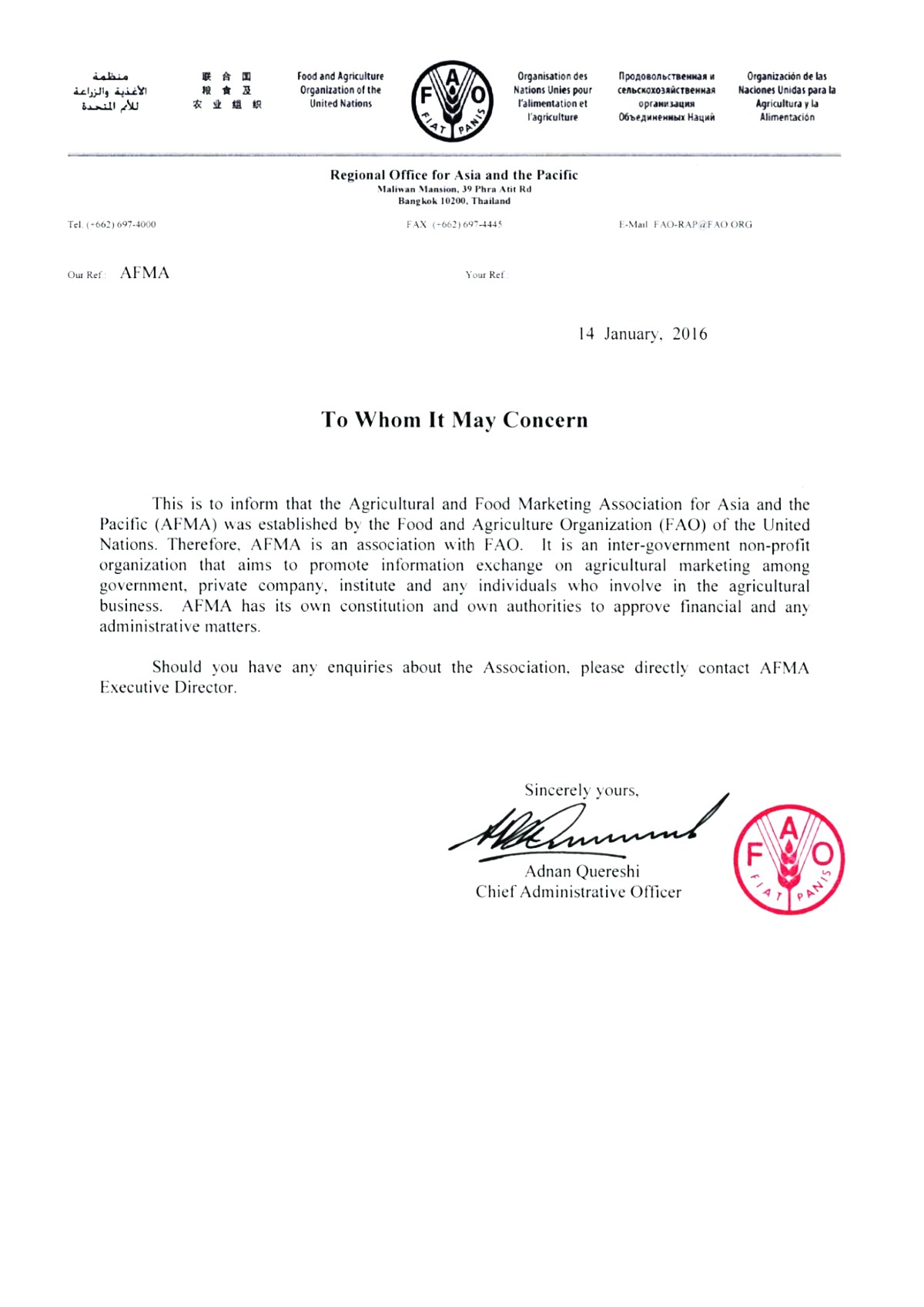
The Agricultural and Food Marketing Association for Asia and the Pacific (AFMA) was established by the Food and Agriculture Organization of the United Nations in 1983. An official letter issued by the FAO Regional Office for Asia and the Pacific on 14 January 2016 describes AFMA as an association with FAO and an inter-government non-profit organization.
AFMA operates autonomously under its own constitution and governance arrangements, with authority over its financial and administrative matters. Its role includes promoting information exchange, economic and technical cooperation, institutional collaboration, and market development in agriculture and food across Asia and the Pacific.
AFMA’s establishment followed an FAO-sponsored regional consultation. The proposal to establish the association was recommended by government and food-marketing institutions from 12 countries, with the participation of a representative of ESCAP. This historical participation does not mean that AFMA is a subsidiary body of ESCAP.
AFMA officially identifies Mr. Pej Prapakittikun as Director, Climate and Sustainability of AFMA and Director of Sustainism Initiatives. He also serves as a Strategic Partner of AFMA, supporting the development of sustainability knowledge, climate action, sustainable finance, stakeholder collaboration, and the practical implementation of SDG- and SCP-aligned initiatives.
Under this institutional role, the Director leads the development and coordination of STNSM.org programmes, partnerships, technical initiatives, and market-engagement activities in cooperation with AFMA and participating stakeholders. STNSM.org operates under its own internal governance, administrative, and financial arrangements.
The Director’s regional role is exercised through institutional cooperation, voluntary participation, programme governance, and agreements with relevant organizations. It does not constitute regulatory or governmental authority over organizations or countries in Asia and the Pacific.


STNSM.org advances this mission through CSCAP, an international multi-stakeholder platform that connects governments, policy authorities, businesses, buyers, financial institutions, experts, and civil society. As the driving organization and secretariat of CSCAP, STNSM.org coordinates the agenda, technical consultations, stakeholder engagement, partnerships, and follow-up actions required to transform sustainability dialogue into practical cooperation and measurable economic outcomes.
Through CSCAP, STNSM.org initiates and supports programmes that advance Sustainable Consumption and Production, including responsible procurement, sustainable supply chains, standards alignment, common evidence systems, sustainable finance, and cross-border market collaboration. By connecting policy, markets, finance, and implementation, STNSM.org helps transform sustainability from a recurring compliance cost into stronger competitiveness, buyer confidence, investment readiness, and new opportunities for sustainable trade.
CSCAP is an international SCP-based platform that brings together governments, policy authorities, standard-setting bodies, major buyers, investors, businesses, and civil society to translate sustainability commitments into measurable outcomes and institutional cooperation. It facilitates direct engagement and structured negotiations toward sustainable trade cooperation, standards alignment, mutual-recognition pathways, and responsible procurement frameworks, while formal agreements remain subject to approval by the relevant authorities and standard owners.
CSCAP also works to reduce duplicated sustainability requirements, assessments, and audits by promoting common evidence and standards alignment—supporting the ambition to “Do sustainability once, and access multiple markets.” This means enabling credible evidence to be reused, adapted, and recognized more efficiently across participating markets, rather than guaranteeing automatic acceptance in every jurisdiction.


In the transition toward sustainable economies, the central challenge is not the absence of ESG ambition, but the gap between suppliers seeking to improve their sustainability performance and buyers requiring credible information to procure responsibly. SSAB for SCP, developed under STNSM.org in coordination with AFMA, is designed as a voluntary transition and buyer-readiness mechanism rather than a certification or product label. It provides a structured pathway for suppliers to organize and disclose their sustainability readiness, while enabling buyers to screen risks, support supplier development, and initiate responsible procurement based on proportionate and verifiable information.
SSAB for SCP places suppliers and buyers on a shared pathway toward Sustainable Consumption and Production. Suppliers can demonstrate their policies, governance arrangements, evidence, traceability, material impacts, risk-management processes, and improvement plans. Buyers, in turn, gain access to structured information, Buyer Readiness Criteria, Impact Notes, due-diligence support, and clear boundaries for sustainability claims. This approach helps reduce duplication and market friction, strengthens responsible procurement, and allows commercial engagement to begin before every supplier has reached full standard readiness—without reducing Critical Safeguards or responsibility for serious impacts.
SSAB for SCP also provides a preparatory pathway toward the AFMA CS Standard. It supports organizations in progressing from sustainability commitments to governance, targets, indicators, evidence systems, traceability, risk management, performance monitoring, structured disclosure, and appropriate verification. This pathway is intended to strengthen readiness for future assessment against the AFMA CS Standard; it does not constitute certification, equivalence, automatic acceptance, or confirmation of compliance with the Standard. SSAB for SCP is therefore not the endpoint of standardization, but a transition bridge that enables suppliers, buyers, and markets to advance together toward greater credibility, transparency, and sustainability performance.
In the UN system, reporting is not communication—it is governance infrastructure. What is not recorded cannot be assessed, compared, or used to guide policy, trade, or investment decisions. CSCAP Publication functions as an official record of sustainability outcomes, with STNSM.org acting as an SDGs Custodian Support Mechanism by collecting, verifying, structuring, and translating real-world actions into SDGs-aligned evidence.
CSCAP Publication records buyer identities, sustainable procurement activities, verified outcomes, and identified supply-chain risks. This information may be referenced by buyers, investors, and international institutions upon request. Through this mechanism, SDGs are directly linked to market decisions, capital allocation, and procurement systems—ensuring that sustainability operates as an economic, trade, and investment mechanism, not merely an aspirational framework.

The United Nations holds global legitimacy in defining the direction of development, trade, and sustainability. SCP is the system-level engine recognized by the UN for integrating production, consumption, trade, finance, and public policy into a unified framework. STNSM.org places SCP at the center of SDGs implementation, transforming sustainability from a perceived burden into the structural foundation of the modern global economy, shaping competitiveness, market access, and capital flows.
Within this framework, STNSM.org serves as a regional support mechanism for the UN, translating global SDGs into actionable systems across the Asia-Pacific through cooperation with AFMA and the CSCAP mechanism. These are not short-term projects, but permanent structures linking the UN with governments, markets, and the private sector. Working with STNSM.org therefore means more than joining a sustainability initiative—it means standing as a global partner, sharing responsibility for the future of the world economy and contributing directly to the realization of the SDGs at scale.
If you wish to become a partner with us, please contact the Secretariat at:
secretariat@stnsm.org