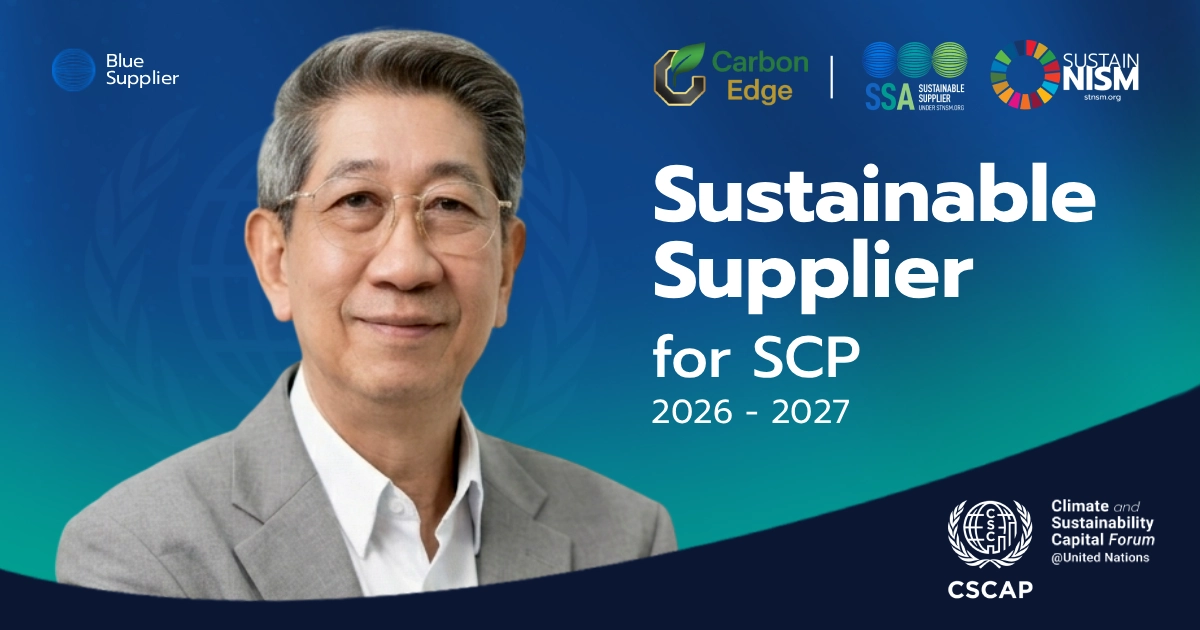


Official Recognition of Carbon Edge Co., Ltd. as a Sustainable Supplier under the CSCAP–SSA Framework 2026-2027
Dimension 1: Policy
Introduction
Carbon Edge Co., Ltd. was established with the vision of becoming an integrated carbon and ESG platform that supports the transition toward a low-carbon economy through the convergence of climate science, carbon innovation, digital monitoring systems, sustainability intelligence, and practical climate solutions.
The Company recognizes that climate change represents one of the most significant global challenges affecting economic systems, industrial competitiveness, environmental security, and long-term societal resilience. As international markets increasingly adopt carbon-related regulations, sustainability disclosure frameworks, and science-based climate targets, organizations are under growing pressure to strengthen their capacity to measure, manage, reduce, and transparently communicate greenhouse gas emissions across their operations and supply chains.
In response to this transition, Carbon Edge positions itself not merely as a carbon service provider, but as a “Climate Technology and Carbon Capability Platform” that integrates:
- carbon advisory services,
- greenhouse gas management systems,
- carbon footprint assessment,
- MRV (Monitoring, Reporting and Verification),
- AI/IoT-enabled carbon intelligence,
- carbon workforce development,
- sustainability training,
- and Carbon Removal innovation.
The Company further recognizes that effective climate action requires more than policy commitments alone. It requires practical implementation, scientific credibility, technological infrastructure, and the development of human capabilities capable of supporting long-term sustainability transformation.
One of the Company’s core operational pillars is the advancement of Biochar and Durable Carbon Removal innovation through the transformation of agricultural residues, particularly rubberwood biomass waste, into high-value biochar and long-term carbon storage solutions. This approach supports the reduction of open-field burning, mitigation of PM2.5 pollution, development of circular carbon economies, and generation of high-integrity Carbon Dioxide Removal Credits (CORCs) aligned with international methodologies.
The Company applies Continuous Pyrolysis technology integrated with Smart MRV systems, AI/IoT infrastructure, and real-time operational monitoring in order to strengthen transparency, traceability, and verification capability throughout the carbon management process.
Carbon Edge believes that future economic resilience will increasingly depend on the ability of organizations and supply chains to establish credible climate governance systems supported by science-based carbon management, transparent reporting mechanisms, and measurable sustainability outcomes.
Accordingly, the Company is committed to contributing toward:
- climate workforce development,
- sustainable supply chain transformation,
- carbon transparency,
- responsible carbon governance,
- Circular Carbon Economy development,
- and the advancement of practical Net Zero transition pathways within Thailand and the wider Asia-Pacific region.
Company Sustainability Policy and Mission Statement
Carbon Edge Co., Ltd. is committed to conducting business under integrated Environmental, Social, and Governance (ESG) principles, guided by the core values of Transparency, Traceability, and Accountability across all operational, advisory, technological, and sustainability-related activities.
The Company’s sustainability policy is founded upon the following strategic commitments:
Commitment to Climate Knowledge and Carbon Capability Development
Carbon Edge believes that the transition toward a sustainable and low-carbon economy requires substantial investment in climate literacy, professional competencies, and organizational capability development.
The Company therefore supports the development of practical carbon knowledge ecosystems through:
- professional carbon training,
- climate-related education,
- greenhouse gas accounting competency,
- ESG and sustainability learning,
- MRV capacity development,
- and workforce preparedness for emerging Net Zero economies.
Carbon Edge seeks to strengthen carbon management capabilities across organizations, industrial sectors, educational institutions, and supply chains through science-based learning and applied sustainability practices.
Commitment to Science-Based Carbon Management
The Company promotes science-based approaches to greenhouse gas management, sustainability implementation, and climate-related decision-making.
Carbon Edge conducts and supports:
- Greenhouse Gas Inventory development,
- Carbon Footprint for Organization (CFO),
- Carbon Footprint for Product (CFP),
- ESG risk analysis,
- Science-Based Targets (SBTi) alignment,
- and Net Zero roadmap development in accordance with internationally recognized standards including GHG Protocol and ISO 14064.
The Company further commits to pursuing Net Zero Emissions pathways aligned with Thailand’s national climate targets, the Paris Agreement, and internationally recognized climate transition frameworks.
Commitment to Carbon Removal Innovation and Circular Carbon Economy
Carbon Edge recognizes the importance of Carbon Dioxide Removal (CDR) technologies as part of long-term climate mitigation strategies.
Through its investment and operational collaboration in biochar production systems, the Company supports the conversion of agricultural residues into durable carbon storage solutions using Continuous Pyrolysis technology aligned with international carbon methodologies.
The Company’s Biochar and Carbon Removal initiatives aim to:
- reduce biomass waste burning,
- mitigate PM2.5 pollution,
- support sustainable agricultural residue management,
- generate high-integrity carbon removal credits,
- strengthen Circular Economy systems,
- and promote resource-efficient industrial transformation.
Carbon Edge applies a strict No Deforestation Policy and utilizes only agricultural residues and biomass waste as feedstock sources.
The Company further integrates research collaboration and scientific validation mechanisms involving material science, pyrolysis optimization, carbon stability assessment, and industrial-grade biochar quality analysis to support long-term environmental credibility and sustainability performance.
Commitment to Transparency, MRV, and Digital Carbon Governance
Carbon Edge recognizes that transparency and traceability are fundamental requirements for the integrity of future carbon economies and sustainable finance systems.
The Company therefore develops Smart MRV (Monitoring, Reporting and Verification) systems supported by AI/IoT technologies and Industrial IoT infrastructure capable of real-time operational monitoring across production and carbon management processes.
These systems support:
- feedstock traceability,
- operational monitoring,
- carbon storage calculation,
- energy consumption monitoring,
- greenhouse gas data management,
- and third-party verification readiness.
Carbon Edge supports transparent reporting and verification processes under internationally recognized frameworks and independent validation systems, including alignment approaches associated with Puro.earth and related carbon market standards.
Commitment to Sustainable Consumption and Production (SCP)
The Company supports the principles of Sustainable Consumption and Production (SCP) through operational approaches that promote resource efficiency, waste-to-value innovation, circular material utilization, and low-carbon industrial transformation.
Carbon Edge believes that agricultural residues, biomass waste, and underutilized carbon resources can become strategic climate assets when supported by science-based technologies, transparent governance systems, and responsible sustainability implementation.
Through this approach, the Company seeks to contribute toward more sustainable production systems, climate-resilient value chains, and long-term environmental stewardship.
Mission Statement
Carbon Edge’s mission is to strengthen climate capability, carbon intelligence, and practical sustainability implementation through science-based carbon management, professional development, climate technology innovation, and transparent carbon governance systems that support organizations and society in transitioning toward a sustainable and low-carbon future.
The Company aspires to become a leading platform for climate technology, carbon capability development, and practical Net Zero transition support by connecting scientific innovation, digital infrastructure, sustainability knowledge, and responsible carbon management within emerging sustainable economies across Thailand and the Asia-Pacific region.
Dimension 2: Goals
Recognized Products or Services
Carbon Edge Co., Ltd. operates as an integrated Climate Technology and Carbon Management Platform providing products, services, and operational solutions designed to support greenhouse gas reduction, carbon removal, sustainability transition, and Net Zero implementation across industrial and supply chain ecosystems.
The Company’s recognized products and services are categorized into the following strategic areas:
Premium Rubberwood Biochar
Carbon Edge produces high-quality biochar derived from 100% rubberwood agricultural residue through Continuous Pyrolysis technology operating at temperatures between 500–600°C. The process produces stable-carbon biochar with high porosity, low contamination risk, and long-term carbon sequestration capability.
The Company utilizes Beston BST-50 Continuous Carbonization Technology capable of processing approximately 10–15 tons of biomass feedstock per hour under continuous industrial-scale operation.
The biochar production process is designed as a closed-loop system utilizing recovered Syngas energy generated during pyrolysis as internal fuel, thereby reducing external energy consumption and minimizing atmospheric emissions.
Scientific testing and technical validation indicate that the produced biochar demonstrates:
- Fixed Carbon content exceeding 62.1%
- Elemental Carbon content approximately 71%
- H/C Ratio below 0.7
- Industrial-grade carbon stability suitable for long-term carbon sequestration exceeding 100 years.
The Company’s biochar products are designed for applications including:
- soil improvement,
- carbon sequestration,
- sustainable agriculture,
- biomass utilization,
- livestock odor management,
- and low-carbon industrial applications.
Carbon Dioxide Removal Credits (CDR Credits / CORCs)
Carbon Edge supports the generation of Carbon Dioxide Removal Credits (CORCs) associated with durable carbon storage through biochar systems aligned with international carbon methodologies and carbon market frameworks.
The Company’s Carbon Removal approach focuses on:
- long-term carbon sequestration,
- measurable and reportable carbon storage,
- traceable biomass utilization,
- and high-integrity carbon management systems.
The operational model aims to support:
- corporate climate transition,
- Scope 3 reduction strategies,
- carbon neutrality pathways,
- and Net Zero implementation within supply chains and industrial sectors.
Carbon Footprint and Greenhouse Gas Management Services
Carbon Edge provides integrated carbon management services designed to support organizations in measuring, managing, and reducing greenhouse gas emissions in accordance with international standards.
Services include:
- Carbon Footprint for Organization (CFO),
- Carbon Footprint for Product (CFP),
- GHG Inventory development,
- greenhouse gas accounting,
- Scope 1, Scope 2, and Scope 3 assessment,
- ESG risk analysis,
- Science-Based Targets (SBTi) planning,
- and Net Zero roadmap development.
Smart MRV and AI/IoT Carbon Monitoring Systems
Carbon Edge develops Smart MRV (Monitoring, Reporting and Verification) systems supported by Industrial IoT and AI-enabled data infrastructure to improve transparency, traceability, and verification capability within carbon management operations.
The platform supports:
- real-time feedstock monitoring,
- operational temperature tracking,
- carbon storage calculation,
- energy consumption monitoring,
- production data recording,
- and carbon traceability systems.
The Company aims to strengthen digital carbon governance and improve readiness for third-party verification and sustainability disclosure systems.
Carbon Knowledge, Professional Training, and Climate Workforce Development
Carbon Edge supports climate workforce development through professional training, sustainability education, and practical carbon management learning systems.
Training areas include:
- Carbon Footprint assessment,
- GHG management,
- MRV systems,
- ESG integration,
- carbon markets,
- carbon credit mechanisms,
- and Net Zero implementation.
The Company aims to strengthen organizational and workforce readiness for emerging low-carbon economies and climate-related regulatory frameworks.
Alignment with the Sustainable Development Goals (SDGs)
Carbon Edge’s operational framework demonstrates alignment with multiple United Nations Sustainable Development Goals (SDGs), particularly those related to climate action, responsible production systems, innovation, sustainable industry transformation, and environmental restoration.
SDG 7 – Affordable and Clean Energy
The Company promotes resource-efficient energy utilization through Syngas Energy Recovery systems integrated within the pyrolysis process, enabling partial self-sustaining operational energy use and reducing dependency on conventional fossil fuel energy systems.
SDG 9 – Industry, Innovation and Infrastructure
Carbon Edge contributes toward sustainable industrial innovation through:
- Continuous Pyrolysis technology,
- Smart MRV systems,
- AI/IoT-enabled carbon monitoring,
- and science-based carbon infrastructure development.
The Company further integrates research collaboration involving MTEC and NSTDA to strengthen industrial-grade biochar quality and carbon permanence validation.
SDG 12 – Responsible Consumption and Production
The Company supports Sustainable Consumption and Production (SCP) by transforming agricultural residues and biomass waste into high-value carbon products and long-term carbon storage solutions.
Carbon Edge promotes:
- biomass value recovery,
- waste-to-value innovation,
- circular carbon economy development,
- sustainable agricultural residue management,
- and reduced open-field burning practices.
SDG 13 – Climate Action
Climate mitigation represents a core operational objective of the Company.
Carbon Edge supports:
- greenhouse gas reduction,
- Carbon Dioxide Removal (CDR),
- durable carbon sequestration,
- Net Zero implementation,
- and science-based carbon management pathways.
The Company further aligns its operational direction with Thailand’s Carbon Neutrality and Net Zero targets as well as broader climate transition frameworks associated with the Paris Agreement.
SDG 15 – Life on Land
Through the utilization of agricultural residues and biochar applications for soil systems, Carbon Edge contributes toward:
- sustainable land management,
- reduced environmental degradation,
- improved soil quality,
- and reduced pressure associated with biomass waste disposal and open burning.
Quantitative and Qualitative Impact Outcomes
Carbon Edge’s operational and technological framework is designed to generate measurable environmental, climate, industrial, and socio-economic outcomes associated with Carbon Removal and sustainable biomass utilization systems.
| SDG Goal | Target | Indicator | Relevance to Carbon Edge | Measured Outcome (Estimated / Operational Basis) |
|---|---|---|---|---|
| SDG 7 – Affordable and Clean Energy | 7.2 Increase substantially the share of renewable energy | 7.2.1 Renewable energy share in the total final energy consumption | Carbon Edge utilizes Syngas Energy Recovery from the pyrolysis process as part of a closed-loop operational system to reduce external fossil fuel dependency. | Continuous Pyrolysis system designed for energy recovery and partial self-sustaining operation through Syngas reuse. |
| SDG 9 – Industry, Innovation and Infrastructure | 9.4 Upgrade infrastructure and industries for sustainability | 9.4.1 CO₂ emission per unit of value added | Carbon Edge applies Continuous Pyrolysis, Smart MRV, AI/IoT monitoring systems, and industrial carbon technologies to support sustainable industrial transformation. | Industrial-scale biomass processing capacity approximately 10–15 tons/hour using Beston BST-50 technology. |
| SDG 12 – Responsible Consumption and Production | 12.2 Sustainable management and efficient use of natural resources | 12.2.1 Material footprint, material footprint per capita, and material footprint per GDP | Carbon Edge converts agricultural residues and rubberwood waste into premium-grade biochar and carbon removal products. | Supports reduction of open-field biomass burning and promotes Circular Carbon Economy systems. |
| SDG 12 – Responsible Consumption and Production | 12.5 Substantially reduce waste generation | 12.5.1 National recycling rate, tons of material recycled | Agricultural residues previously treated as disposal waste are transformed into long-term climate assets and industrial carbon products. | Reduced biomass waste disposal burden and improved biomass resource utilization efficiency. |
| SDG 13 – Climate Action | 13.2 Integrate climate measures into policies and planning | 13.2.2 Total greenhouse gas emissions per year | Carbon Edge develops durable carbon storage systems and supports Net Zero transition pathways through Carbon Removal innovation. | Biochar demonstrates Fixed Carbon content of 62.1%, Elemental Carbon 71%, and H/C Ratio below 0.7 supporting carbon sequestration exceeding 100 years. |
| SDG 13 – Climate Action | 13.3 Improve education and awareness on climate change | 13.3.1 Extent to which education for sustainable development and global citizenship education are mainstreamed | Carbon Edge provides professional training and carbon knowledge systems related to Carbon Footprint, GHG Inventory, ESG, and Net Zero implementation. | Development of climate workforce readiness and organizational carbon management capability. |
| SDG 15 – Life on Land | 15.3 Combat land degradation and restore degraded land | 15.3.1 Proportion of land that is degraded over total land area | Biochar applications contribute toward soil improvement, nutrient retention, water retention, and long-term carbon stability in soil systems. | Biochar contains beneficial mineral nutrients including Calcium, Potassium, and Magnesium supporting soil restoration potential. |
| SDG 15 – Life on Land | 15.2 Promote sustainable forest management | 15.2.1 Progress towards sustainable forest management | Carbon Edge applies a No Deforestation Policy and utilizes only agricultural residues and biomass waste feedstock. | Reduced pressure on open burning and unsustainable biomass disposal practices. |
Dimension 3: Sustainability Delivery Process
Operational and Sustainability Implementation Process
Carbon Edge Co., Ltd. implements an integrated Climate Technology and Sustainability Delivery framework designed to support low-carbon industrial transformation, durable carbon removal, transparent carbon governance, and circular biomass utilization through science-based operational systems.
The Company’s operational model combines:
- sustainable feedstock sourcing,
- industrial-scale pyrolysis technology,
- carbon monitoring infrastructure,
- AI/IoT-enabled MRV systems,
- scientific validation,
- and ESG-oriented operational governance.
This framework is intended to ensure that climate-related outcomes are measurable, traceable, operationally scalable, and aligned with internationally recognized sustainability approaches.
Sustainable Feedstock Management and Agricultural Residue Utilization
Carbon Edge applies a resource recovery approach by utilizing agricultural residues and rubberwood biomass waste as the primary feedstock for biochar production systems.
The operational model is designed to:
- reduce open-field burning,
- decrease biomass disposal burdens,
- mitigate PM2.5 pollution,
- and convert low-value agricultural waste into long-term carbon assets.
The Company operates under a strict:
“No Deforestation Policy”
where only agricultural residues and surplus biomass materials are utilized within the carbon production process.
This approach supports:
- sustainable biomass management,
- circular carbon economy development,
- and responsible raw material sourcing aligned with sustainability objectives.
Industrial-Scale Continuous Pyrolysis System
Carbon Edge utilizes Beston BST-50 Continuous Carbonization Technology as the core operational infrastructure for industrial biochar production.
The system supports:
- continuous industrial-scale operation,
- biomass processing capacity approximately 10–15 tons/hour,
- 24-hour operational continuity,
- and large-scale commercial biochar production capability.
The pyrolysis system converts biomass feedstock into stable-carbon biochar under controlled thermal conditions ranging approximately 500–600°C.
Operational objectives include:
- maximizing carbon stability,
- reducing volatile emissions,
- improving fixed carbon concentration,
- and generating durable carbon storage suitable for Carbon Removal applications.
The Company further applies:
Closed-loop Energy Recovery Systems
where Syngas generated during pyrolysis is recovered and reused internally as operational fuel. This process:
- reduces external energy dependency,
- improves energy efficiency,
- minimizes atmospheric emissions,
- and supports low-carbon operational performance.
Scientific Validation and Biochar Quality Assurance
Carbon Edge integrates scientific validation and material analysis processes to strengthen the environmental credibility and industrial quality of produced biochar.
The Company references technical testing and analytical approaches associated with:
- SGS laboratory testing,
- EBC (European Biochar Certificate),
- IBI (International Biochar Initiative),
- carbon stability assessment,
- and industrial-grade biochar evaluation methodologies.
Technical validation results demonstrate:
- Fixed Carbon approximately 62.1%
- Elemental Carbon approximately 71%
- H/C Ratio approximately 0.59
- carbon permanence capability exceeding 100 years.
Additional testing areas include:
- heavy metals,
- PAHs,
- PCBs,
- sulfur content,
- nutrient composition,
- moisture,
- ash content,
- and agricultural suitability parameters.
This approach strengthens:
- product integrity,
- carbon permanence credibility,
- agricultural application suitability,
- and readiness for international carbon market frameworks.
Smart MRV and AI/IoT Operational Monitoring
Carbon Edge recognizes that transparency and traceability are fundamental to the integrity of carbon management systems and Carbon Removal markets.
The Company therefore integrates:
- Industrial IoT infrastructure,
- AI-enabled monitoring systems,
- Smart MRV platforms,
- and real-time operational data logging systems across production processes.
The system monitors:
- biomass feedstock input,
- operational temperature consistency,
- carbon storage performance,
- energy utilization,
- and production process stability.
Operational data supports:
- carbon accounting,
- sustainability disclosure,
- traceability systems,
- third-party verification readiness,
- and transparent reporting processes aligned with climate governance expectations.
The Company further supports annual third-party verification readiness under internationally recognized carbon market and carbon accounting approaches.
ESG Relevance and Supply Chain Integration
Carbon Edge recognizes that climate change, carbon governance, and sustainability performance are increasingly becoming material issues within procurement systems, industrial supply chains, ESG reporting frameworks, and international trade mechanisms.
The Company therefore integrates ESG principles into operational management, biomass sourcing, carbon governance systems, and sustainability implementation processes to support long-term supply chain resilience and low-carbon economic transition.
Environmental Relevance
Carbon Edge’s operational framework contributes toward multiple environmental objectives including:
- greenhouse gas reduction,
- durable carbon sequestration,
- reduction of biomass waste burning,
- PM2.5 mitigation,
- circular resource utilization,
- and low-carbon industrial transformation.
The Company’s Carbon Removal systems support:
- long-term carbon storage,
- traceable carbon management,
- and high-integrity climate mitigation approaches.
Biochar systems are further designed to support:
- soil restoration,
- nutrient retention,
- moisture retention,
- and sustainable agricultural systems.
Social Relevance
Carbon Edge’s operational model contributes toward local economic participation and agricultural value enhancement through the utilization of agricultural residues previously treated as low-value waste materials.
The operational framework supports:
- agricultural residue value creation,
- reduced environmental burden on rural communities,
- climate workforce development,
- and sustainability knowledge expansion.
The Company also contributes toward professional development through:
- carbon training,
- climate education,
- and ESG-related workforce capability development.
Governance Relevance
Carbon Edge emphasizes:
- transparency,
- traceability,
- accountability,
- and science-based operational governance
as core principles within all carbon-related activities.
The Company’s governance-oriented operational systems include:
- Smart MRV infrastructure,
- operational monitoring systems,
- real-time production data logging,
- carbon traceability systems,
- and verification readiness frameworks.
These systems are intended to support:
- sustainability disclosure,
- ESG reporting,
- carbon market participation,
- and responsible climate governance implementation.
Sustainable Supply Chain Integration
Carbon Edge supports the transition toward more climate-resilient and sustainability-oriented supply chains through:
- carbon footprint management,
- Net Zero strategy support,
- Carbon Removal integration,
- and science-based carbon governance systems.
The Company’s operational framework is designed to support organizations seeking:
- Scope 3 reduction pathways,
- low-carbon procurement systems,
- sustainable sourcing approaches,
- carbon transparency,
- and ESG-aligned industrial transformation.
Carbon Edge further recognizes the growing impact of:
- CBAM,
- climate disclosure expectations,
- sustainable procurement frameworks,
- and investor-driven climate governance systems
on future industrial competitiveness and international market access.
Through this integrated approach, the Company aims to strengthen practical climate implementation capability across industrial ecosystems, sustainability-oriented supply chains, and emerging low-carbon economic systems.
Dimension 4: for Buyer
Purchaser Impact Note Process (4 Steps)
- Purchase: Complete your purchase of Carbon Edge Co., Ltd. products or services through an authorized distributor.
- Submit Proof: After receiving the goods or services in full, send the required documents to impactnote@stnsm.org.
- Review and Record: The CSCAP–SSA Secretariat reviews all submitted information for completeness and records the purchase in the Sustainism Registry.
- Receive Impact Note: The purchaser receives a unique Impact Note ID (e.g. SSA-IN-2026-XXXX), confirming that the transaction has been officially documented within the CSCAP–SSA system.
Purchaser Submission Requirements
Include a concise table summarizing the documents required for submission:
| Item | Details Required |
|---|---|
| Purchase invoice or receipt | Show product quantity and date of purchase |
| Delivery confirmation | Proof of goods or service completion (delivery note or photo) |
| Purchaser contact information | Full name, position, phone number, and e-mail address of the purchaser |
Claimable Outcomes (Organized by ESG Materiality Themes)
Carbon Edge Co., Ltd.’s operational systems, Carbon Removal activities, biochar production infrastructure, Smart MRV implementation, and sustainability-oriented climate solutions may contribute toward multiple environmental, social, governance, and sustainable supply chain outcomes relevant to ESG disclosure, sustainability reporting, climate transition strategies, and responsible procurement systems.
| Material Theme | Impact Description | Example Reference Outcome | Relevant SDGs & Targets |
|---|---|---|---|
| Energy Management | Recovery and reuse of Syngas generated during the pyrolysis process to improve energy efficiency and reduce reliance on external fossil fuels. | Closed-loop energy recovery system utilizing recovered Syngas from Continuous Pyrolysis operations. | SDG 7 – Affordable and Clean Energy | Target 7.2 |
| Innovation | Deployment of industrial climate technologies, Continuous Pyrolysis, Smart MRV, AI/IoT monitoring, and digital carbon management systems supporting sustainable industrial transformation. | Integration of Continuous Pyrolysis systems, Smart MRV platforms, Industrial IoT infrastructure, and carbon monitoring technologies. | SDG 9 – Industry, Innovation and Infrastructure | Targets 9.4, 9.5 |
| Resource Use & Circular Economy | Conversion of agricultural residues and biomass waste into premium biochar and long-term carbon assets through circular production systems. | Utilization of rubberwood biomass residues through industrial carbonization aligned with Circular Carbon Economy principles. | SDG 12 – Responsible Consumption and Production | Targets 12.2, 12.5, 12.6 |
| Climate Change | Support for greenhouse gas reduction and durable carbon sequestration through biochar-based Carbon Removal systems and science-based carbon management. | Biochar with Fixed Carbon approximately 62.1%, Elemental Carbon approximately 71%, and H/C Ratio below 0.7 supporting long-term carbon storage exceeding 100 years. | SDG 13 – Climate Action | Targets 13.2, 13.3 |
| Biodiversity | Sustainable utilization of agricultural residues and biochar applications supporting soil restoration, land productivity, and reduced pressure on natural ecosystems. | Biochar applications contributing to improved soil quality, nutrient retention, water retention, and reduced environmental degradation associated with agricultural residue burning. | SDG 15 – Life on Land | Targets 15.2, 15.3 |
Impact Note Claim Period
Impact Notes may be requested and recorded within 30 days from the date the purchaser has received the goods or services in full. Submissions received after this period may be reviewed in the following reporting cycle under the CSCAP–SSA Mechanism.
Important Disclaimer
This document is issued under the SDG Custodian Support Mechanism for the purpose of sustainability reference and transparency. It does not constitute an official endorsement or certification by the United Nations (UN).
The information contained herein is based on data publicly disclosed by the company and has not been independently verified or certified by Sustainism. Accordingly, it carries no legal effect or binding recognition under any formal certification system.
Any concerns regarding inaccuracies, misrepresentation, or conduct that may constitute SDG or Greenwashing violations should be reported confidentially via: whistleblower@stnsm.org
Contact at Sustainism Secretariat
Sustainism Initiatives
+66 8298 96869
secretariat@stnsm.org