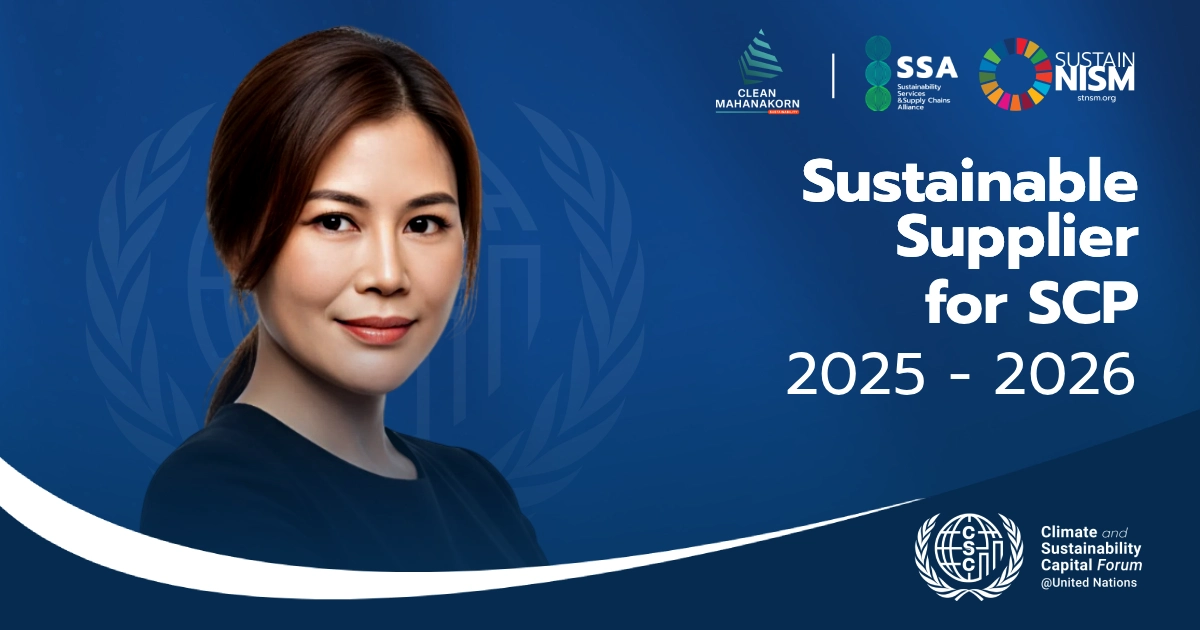


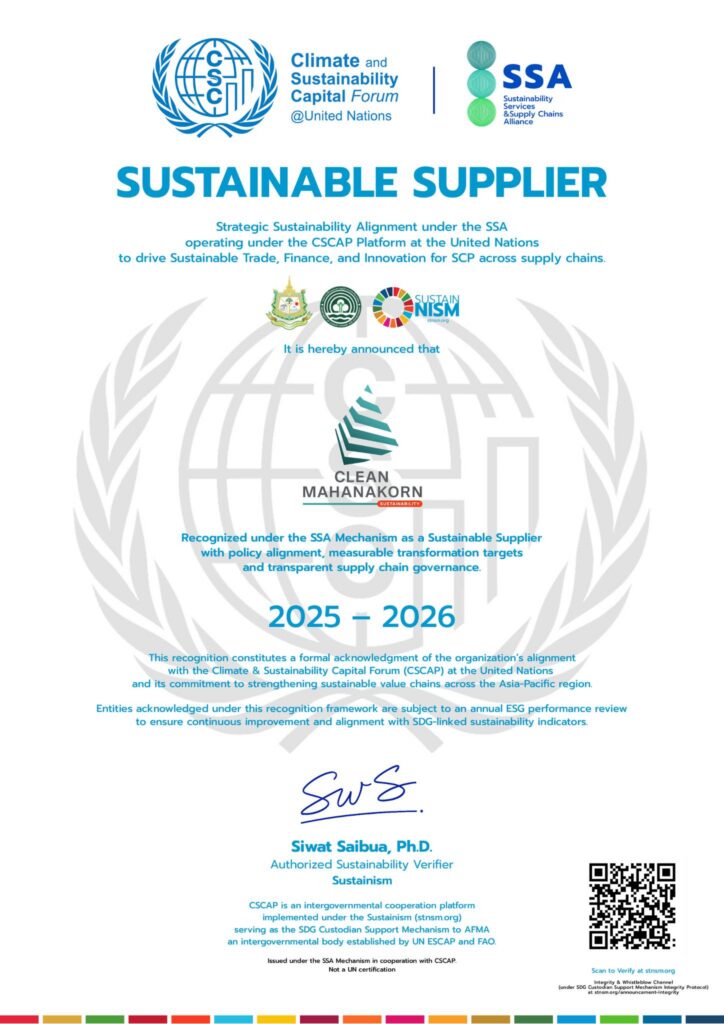
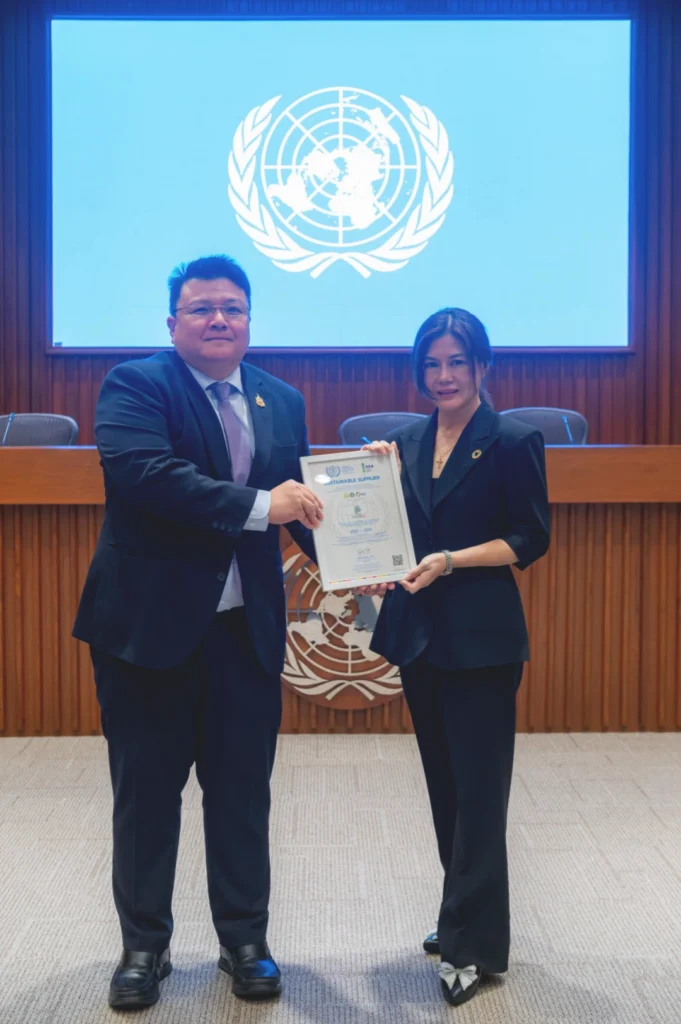
Official Recognition of Clean Mahanakorn Co., Ltd. as a Sustainable Supplier under the CSCAP–SSA Framework 2025-2026
Dimension 1: Policy
Introduction
This policy framework positions Clean Mahanakorn Co., Ltd. as a municipal sanitation service provider capable of delivering verifiable ESG outcomes. By integrating upstream waste separation, efficient waste transport, worker protection, and public disclosure, the company links daily operational decisions with broader public policy objectives, ensuring traceable sustainability results for municipalities and service purchasers.
The policy aligns directly with SDG Targets 11.6, 12.4, 12.5, 12.6, 12.7, 13.2, 8.8, 16.6, and reflects the principles outlined in the GRI Standards, ILO Conventions, and Thai legislation governing solid waste management, occupational health and safety, public procurement, and data protection. Where company-specific baseline data remains under internal review, the associated KPIs below are marked as “unspecified” pending external disclosure validation.
This section corresponds to item 1.1 of the SSA-aligned sustainability report, and follows the formatting logic seen in SSA model reports, where “Introduction” and “Company Sustainability Policy and Mission Statement” are prioritized upfront. It is designed to enable municipalities, public procurement officers, and institutional buyers to reference this document within ESG reporting, public procurement justifications, and sustainability impact disclosures.
Based on internally provided operational data, Clean Mahanakorn operates along the municipal sanitation value chain—ranging from waste collection and backlog prevention to source separation support and verified downstream processing. These activities hold direct policy relevance, particularly to SDG 11.6, which calls for reducing cities’ per capita environmental impacts with a specific focus on municipal solid waste. The World Health Organization has similarly emphasized that clean water, sanitation, and hygiene systems are foundational to community health, dignity, and resilience.
In Thailand’s policy context, the national approach to municipal solid waste (MSW) is transitioning from “collect everything” to “manage waste comprehensively across its lifecycle.” As of 2026, the Ministry of Interior set a target for at least 80% of municipal waste to be managed correctly. Subnational governments operating in MSW cluster zones are required to implement waste management plans with measurable follow-up mechanisms. Relevant ministerial regulations also require local authorities to promote source-level separation and community participation. In parallel, the Pollution Control Department continues to lead national waste action plans and sets specific guidelines for hazardous household waste.
The imperative for Clean Mahanakorn to elevate “sustainability” to a policy issue is not driven by branding—but by the practical need to build operating models that align with national mandates and global reporting standards. SDG 12.4 and 12.5 call for environmentally sound waste management and reduction through prevention, reuse, and recycling; SDG 12.7 directly relates to sustainable public procurement; SDG 13.2 encourages climate integration into all policies and plans.
Internally, Clean Mahanakorn’s approach integrates the Efficient Urban Waste Routing (EUWR) system and the use of 2IN1 smart vehicles as operational tools that transform “waste collection” into a measurable “resource and carbon management system.” These strategies support Thailand’s national climate commitments, where both transport and waste sectors are defined as key mitigation domains.
Company Sustainability Policy and Mission Statement
This section corresponds to item 1.2 of the report and introduces Clean Mahanakorn’s sustainability policy framework through a lens of practical implementation. The company affirms that true sustainability must make systems function reliably, reduce internal inefficiencies, avoid unnecessary burdens, and translate operational improvements into verifiable, reportable outcomes under the principle of “Value → Valuation → Price.” This aligns with GRI guidance, which requires that policies, objectives, and disclosures fall under the oversight of senior management and formalized reporting mechanisms.
Proposed Mission Statement
“Clean Mahanakorn strives to be a municipal sanitation provider that delivers waste management systems which are efficient, safe, transparent, and low-carbon—starting with source-level separation, data-driven collection routing, and environmentally and socially responsible end-point disposal.”
Environmental Dimension
Clean Mahanakorn prioritizes pollution prevention over end-stage disposal. This is operationalized through source-level separation of recyclable, organic, hazardous, and general waste streams in accordance with local waste generation patterns. The company emphasizes waste diversion metrics, fuel optimization, route efficiency, and the avoidance of unnecessary idling or repeat trips. Where this constitutes a material topic, Clean Mahanakorn is advised to disclose data under GRI 306 (Waste Generation, Diversion, and Disposal) and GRI 305 (GHG Emissions), with alignment to SDG Targets 11.6, 12.4, 12.5, and 13.2.
Social Dimension
Worker health and safety is defined not merely as a technical requirement, but as a fundamental right. ILO guidance classifies a safe and healthy working environment as a fundamental principle and right at work, noting that many informal or recycling-sector jobs fail to meet this threshold without enhanced occupational systems, skills training, and meaningful dialogue. In Thailand, the Occupational Safety, Health, and Environment Act B.E. 2554 (2011) mandates hazard assessments and safety planning, while the Labour Protection Act B.E. 2541 (1998) underpins worker welfare. Accordingly, Clean Mahanakorn’s policy should clearly commit to: use of personal protective equipment (PPE); mandatory safety induction; near-miss and incident reporting; zero tolerance for child or forced labor; non-discrimination; and fair employment practices. These commitments directly support SDG Target 8.8.
Governance Dimension
The company’s CEO or designated governance committee shall hold final authority over sustainability policies, targets, and disclosures, and must review them at least annually. Designated officers must be responsible for impact management, data reporting, and grievance resolution. GRI 2 requires that top-level governance roles, accountability delegation, review cycles, and stakeholder engagement processes be clearly disclosed, and that engagement be two-way and meaningful.
In the supply chain, Clean Mahanakorn should apply supplier screening aligned with GRI 308 (Environmental Assessment) and GRI 414 (Social Assessment), including license checks and due diligence on significant impacts prior to onboarding. When contracting with the public sector, compliance with Thailand’s Public Procurement and Supplies Administration Act B.E. 2560 (2017) is mandatory.
Data collected via GPS, cameras, time-logging systems, or HR systems must comply with the Personal Data Protection Act B.E. 2562 (2019) and appropriate data security safeguards.
Finally, Clean Mahanakorn must adopt a zero-tolerance policy on corruption, collusion, bribery, and conflicts of interest, supported by risk assessments, staff training, incident tracking, and whistleblower protections in alignment with GRI 205. These governance measures are directly aligned with SDG Targets 12.6, 12.7, 16.6, 17.16, 17.17, and 17.18.
Dimension 2: Goals
Recognized Services and Urban Sanitation Innovation
Clean Mahanakorn Co., Ltd. delivers fully integrated urban sanitation services across the entire waste management cycle. These include community-based source separation design, civic engagement, route planning optimization, labor protections, and end-point traceability. The company’s approach goes beyond conventional waste collection by embedding systemic accountability for environmental integrity, cost efficiency, and climate resilience at the municipal scale.
In partnership with local governments in Rayong Province, Clean Mahanakorn has developed and piloted scalable operational models specifically adapted to the constraints of high-density urban areas. The company has been recognized for translating public sector mandates into practical, replicable operating systems with demonstrable sustainability outcomes.
Efficient Urban Waste Routing and 2IN1 Vehicle System
At the operational core of Clean Mahanakorn’s model lies the Efficient Urban Waste Routing (EUWR) methodology—a data-driven routing system that optimizes fuel use, reduces travel distances, and minimizes idle time. This is complemented by the 2IN1 Smart Collection Vehicle, designed with dual chambers to prevent mixed loading, support precise waste separation, and reduce the number of trips required per service area.
The EUWR + 2IN1 platform represents a paradigm shift—from “waste hauling” to “urban resource and carbon management.” Vehicles are equipped with load-specific control mechanisms, safety features, and integrated performance monitoring systems. These tools enhance operational accuracy and contribute to city-wide planning, while aligning with Thailand’s 2026 national targets on waste-sector decarbonization under the Ministry of Interior.
Alignment with the Sustainable Development Goals (SDGs)
Clean Mahanakorn’s operations demonstrate direct and measurable alignment with the following Sustainable Development Goals (SDGs):
- SDG 11.6: Reduce the adverse per capita environmental impact of cities, particularly by improving waste management services.
- SDG 12.4–12.5: Ensure environmentally sound management of chemicals and waste and reduce waste generation through prevention, recycling, and reuse.
- SDG 13.2: Integrate climate change measures into policies and planning at the local level.
- SDG 8.8: Promote safe and secure working environments, especially for workers in informal and hazardous sectors.
- SDG 12.7 & 16.6: Advance sustainable public procurement and transparent governance systems.
In support of these goals, Clean Mahanakorn applies the Global Reporting Initiative (GRI) standards—including GRI 305 (GHG Emissions), GRI 306 (Waste), GRI 308 (Supplier Environmental Assessment), and GRI 414 (Supplier Social Assessment)—to ensure materiality-based disclosure, supply chain due diligence, and verifiable outcome reporting.
Quantitative and Qualitative Impact Outcomes (Key Performance Indicators – per 1 km² urban zone)
| SDG | Target | Indicator | Operational Link to EUWR & 2IN1 | Measured Outcome |
|---|---|---|---|---|
| SDG 13 – Climate Action | 13.2 | GHG emissions from municipal sanitation transport | Fuel-efficient routing and idle reduction | −241 kg CO₂ per vehicle per day |
| SDG 12 – Responsible Consumption | 12.4–12.5 | Controlled processing of solid waste | Diversion of recyclables and organics | 2–3 tons/week diverted from landfill |
| SDG 8 – Decent Work | 8.8 | Occupational health and labor rights | Full safety gear and onboarding training | 100% workforce compliance |
| SDG 11 – Sustainable Cities | 11.6 | Noise and air pollution from waste operations | Fewer trips, shorter engine time | ~15% reduction in particulate and noise levels |
| SDG 16 – Strong Institutions | 16.6 | Transparent and accountable service operations | Public reporting of fuel and routing data | Route logs and GHG baseline publicly disclosed |
Dimension 3: Sustainability Delivery Process
Operational and Sustainability Implementation Process
Clean Mahanakorn Co., Ltd. integrates sustainability across every operational step in its waste management system. Sustainability is not treated as a peripheral concept, but as a core design principle that enables real-world implementation at scale—especially in high-density municipalities facing resource constraints, urban congestion, and cost pressures.
The operational process includes:
- Planning collection routes using the proprietary Efficient Urban Waste Routing (EUWR) system to minimize fuel consumption, idle time, and carbon emissions.
- Deploying the 2IN1 smart collection vehicles with dual compartments to enable in-route segregation and reduce the number of required trips.
- Collecting granular operational data such as fuel consumption, stop duration, trip frequency, and waste weight per round to support data-driven planning and municipal decision-making.
- Installing standardized source-separation bins in communities and providing public education on proper sorting practices.
- Monitoring environmental, labor, and economic performance with impact dashboards shared with local governments as policy references.
This integrated model aligns with SDG 12.4 and 12.5, which call for lifecycle-based waste management, and SDG 13.2, which promotes the integration of climate considerations into subnational policies. The company’s model also reflects WHO principles for sustainable environmental health systems at the community level.
ESG Relevance and Supply Chain Integration
Clean Mahanakorn’s governance model incorporates ESG principles across all operational and reporting tiers, with commitments in three dimensions:
Environmental
- Reduce greenhouse gas emissions from transport through optimized routing and vehicle efficiency.
- Increase diversion rates by redirecting recyclable and organic waste away from landfill.
- Apply controlled protocols for community hazardous waste in line with Thai national standards.
- Measure and report localized carbon footprints for all service zones.
Social
- Uphold labor rights and dignity by providing PPE, mandatory safety training, and access to grievance redress mechanisms.
- Ensure zero tolerance for child labor, forced labor, or workplace discrimination.
- Support public health in underserved communities through full sanitation service coverage and equitable service access.
Governance
- Ensure that the sustainability policy is approved and annually reviewed by the CEO or equivalent governance body.
- Follow GRI-referenced disclosure practices, including GRI 2 (Governance), 205 (Anti-Corruption), 305 (GHG Emissions), and 306 (Waste).
- Comply fully with Thailand’s Public Procurement and Supplies Administration Act (2017) and the Personal Data Protection Act (2019).
- Adopt a zero-tolerance policy on corruption, collusion, bribery, and conflicts of interest, supported by risk assessments, staff training, and formal incident documentation.
Supply Chain Integration
The company screens and monitors recycling and disposal partners using due diligence criteria aligned with GRI 308 (Environmental Assessment) and GRI 414 (Social Assessment), including license validation and documented risk reviews prior to engagement. All subcontractors must meet minimum ESG performance thresholds, with compliance required for contracts involving government agencies.
Dimension 4: for Buyer
Purchaser Impact Note Process (4 Steps)
- Purchase: Complete your purchase of Clean Mahanakorn Co., Ltd. products or services through an authorized distributor.
- Submit Proof: After receiving the goods or services in full, send the required documents to impactnote@stnsm.org.
- Review and Record: The CSCAP–SSA Secretariat reviews all submitted information for completeness and records the purchase in the Sustainism Registry.
- Receive Impact Note: The purchaser receives a unique Impact Note ID (e.g. SSA-IN-2025-XXXX), confirming that the transaction has been officially documented within the CSCAP–SSA system.
Purchaser Submission Requirements
Include a concise table summarizing the documents required for submission:
| Item | Details Required |
|---|---|
| Purchase invoice or receipt | Show product quantity and date of purchase |
| Delivery confirmation | Proof of goods or service completion (delivery note or photo) |
| Purchaser contact information | Full name, position, phone number, and e-mail address of the purchaser |
Claimable Outcomes
Municipal buyers and institutional purchasers may claim measurable ESG-aligned outcomes from Clean Mahanakorn’s services. These outcomes are tracked, verified, and presented based on an operational service area of 1 square kilometer.
| ESG Dimension | Impact Description | Estimated Outcome per 1 km² Service Area | Relevant SDG Targets |
|---|---|---|---|
| Environmental | Reduction in CO₂ emissions via EUWR and 2IN1 vehicle routing system | ~241 kg CO₂ reduced per vehicle per day | SDG 13.2, SDG 11.6 |
| Waste Management | Diversion of waste from landfill through increased recycling rates | 2–3 tons/week diverted from landfill | SDG 12.4, 12.5 |
| Labor & Health (Social) | Workforce receives safety training, PPE, and fair remuneration | 100% of staff trained and equipped | SDG 8.8 |
| Inclusive Service Access (Social) | Full sanitation service coverage for all target households | ≥100% household coverage in pilot zones | SDG 10.2, SDG 11.1 |
| Governance | Transparent tracking and reporting of ESG metrics and route data | Carbon, diversion, and routing logs published per round | SDG 12.6, 16.6 |
Purchaser Guidance on Supporting Documentation
To support transparency, accountability, and proper impact attribution, Clean Mahanakorn recommends that purchasers request the following supporting materials when claiming ESG impact or filing disclosures:
| Document Type | Purpose | Issued Upon Request |
|---|---|---|
| Route Efficiency Summary (EUWR) | Fuel, distance, and emission metrics per zone | ✔️ |
| Waste Diversion Log | Volume and type of waste diverted from landfill | ✔️ |
| Worker Protection Compliance Sheet | Safety training, PPE records, labor practices | ✔️ |
| Environmental Permit (if required) | Valid licenses for transport and disposal | ✔️ |
| CO₂ Baseline Methodology Annex | Formula and calculation for GHG reductions | ✔️ |
| Procurement Integrity Declaration | Statement on anti-corruption and ethical conduct | ✔️ |
Note: Buyers engaging in high-value or long-term service contracts are advised to conduct due diligence in line with GRI 308, GRI 414, and Thailand’s Public Procurement Act. Clean Mahanakorn commits to cooperating fully with any third-party verification, audit procedures, or community stakeholder engagement deemed necessary.
Impact Note Claim Period
Purchasers may submit a request for an official Impact Note to accompany ESG reports, procurement disclosures, or internal sustainability documentation within 30 days of service completion. Submissions received after this period may be reviewed in the next SSA reporting cycle.
Important Disclaimer
This document is issued under the SDG Custodian Support Mechanism for the purpose of sustainability reference and transparency. It does not constitute an official endorsement or certification by the United Nations (UN).
The information contained herein is based on data publicly disclosed by the company and has not been independently verified or certified by Sustainism. Accordingly, it carries no legal effect or binding recognition under any formal certification system.
Any concerns regarding inaccuracies, misrepresentation, or conduct that may constitute SDG or Greenwashing violations should be reported confidentially via: whistleblower@stnsm.org
Contact at Sustainism Secretariat
Sustainism Initiatives
+66 8298 96869
secretariat@stnsm.org