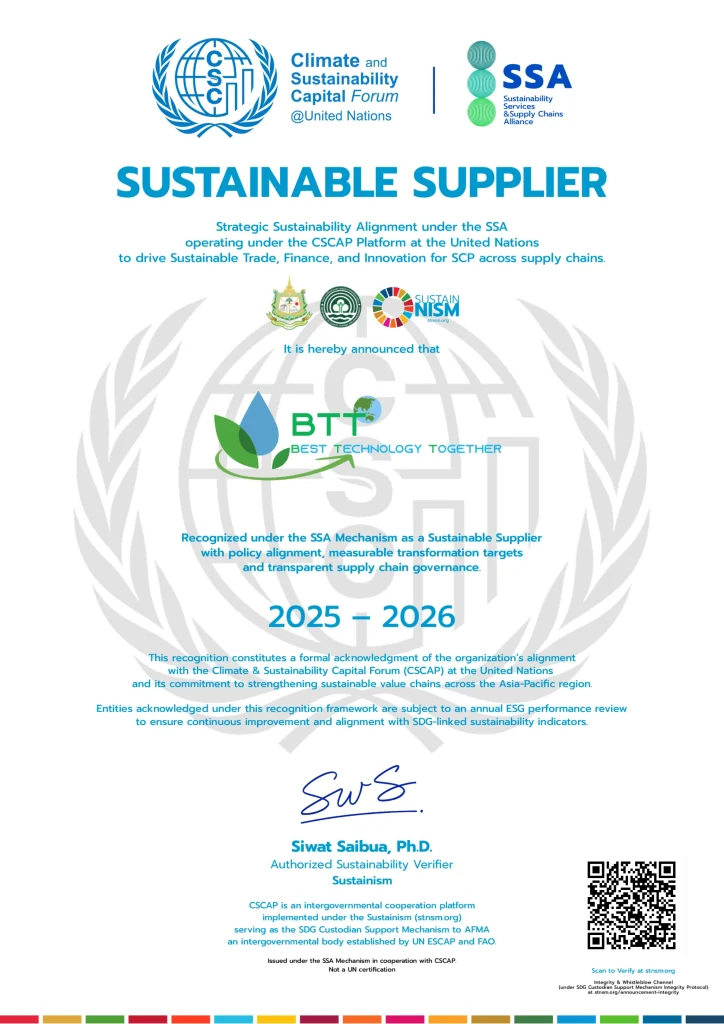
Official Recognition of Ball Technic (Thailand) Co., Ltd. as a Sustainable Supplier under the CSCAP–SSA Framework 2025-2026
Dimension 1: Policy
Introduction
Ball Technic (Thailand) Co., Ltd. has been officially recognized under the 2025–2026 cycle of the CSCAP–SSA (Sustainability Services & Supply Chains Alliance) – a regional platform convened in collaboration with UN ESCAP – for its contributions to sustainable supply chain practices. This recognition is part of a multi-stakeholder mechanism (the Sustainism Initiative, in coordination with AFMA under UN ESCAP and FAO) aimed at enabling inclusive, resilient, and transparent procurement ecosystems in Asia–Pacific. As an innovator in energy efficiency technology, Ball Technic’s core mission is to help large organizations reduce energy consumption and minimize environmental impact through cutting-edge engineering solutions.
The company’s business model is designed to create shared value across environmental and social dimensions, delivering tangible cost savings for customers while advancing climate and sustainability goals. Ball Technic’s leadership in clean technology has been nationally recognized – for example, it earned both the Thailand Energy Award and the ASEAN Energy Award in 2024 for its pioneering energy-saving systems.

Company Sustainability Policy and Mission Statement
Ball Technic reaffirms its commitment to driving sustainable development in harmony with business innovation and environmental stewardship across all aspects of its operations. The company operates under the vision “Energy Efficiency for a Greener Tomorrow.”
Through this vision, Ball Technic strives to leverage engineering innovation to achieve significant reductions in energy use and greenhouse gas emissions for its clients, ensuring that each solution contributes positively to both the customer’s performance and the broader environment. To uphold this mission, the company has established a comprehensive sustainability policy with the following key pillars:
1. Energy Efficiency & Climate Commitment
Ball Technic is dedicated to developing and deploying technologies that dramatically improve energy efficiency in industrial and commercial systems. Its flagship automatic tube-cleaning solutions for chiller systems typically cut electricity consumption by double-digit percentages, directly reducing carbon emissions for clients. The company measures and monitors these energy and emissions savings in line with international standards (e.g. the GHG Protocol), and aligns its impact with national climate strategies and the Paris Agreement targets. Ball Technic actively supports Thailand’s goal of carbon neutrality by 2050, ensuring its innovations contribute to global climate mitigation efforts.
2. Environmental Management & Resource Use
Environmental responsibility is integrated into every aspect of Ball Technic’s operations. The company systematically controls waste and emissions in its manufacturing and installation processes, aiming to prevent pollution at the source. Product design and operational practices emphasize efficient use of resources – for example, optimizing materials and energy so that each installation yields maximum energy savings with minimal environmental footprint. Hazardous substances are strictly managed or eliminated; by reducing the need for chemical cleaning agents in HVAC maintenance, Ball Technic’s solutions help avoid harmful effluents and waste. Biodiversity and ecosystem impacts are also considered, ensuring that the company’s activities do not negatively affect local environments.
3. Social Responsibility & Human Capital
Ball Technic conducts its business with a strong commitment to labor standards, safety, and community well-being. The company upholds international human rights and fair labor practices throughout its supply chain, providing a safe, inclusive, and dignified workplace for all employees. Worker safety is paramount – its automated cleaning technology reduces the need for manual cleaning in confined spaces, thereby protecting technicians from hazardous tasks. The company invests in employee training and skills development, empowering its team with knowledge of sustainable practices and technical expertise. It also engages with local communities through job creation and knowledge-sharing initiatives, reflecting the principle that sustainability is a shared responsibility of all stakeholders.
4. Innovation & Collaboration
Continuous innovation is at the heart of Ball Technic’s sustainability approach. The company allocates significant R&D resources to improve the efficacy and environmental performance of its products, fostering a culture of eco-efficient technological advancement. Ball Technic actively collaborates with industry partners, government agencies, and sustainability networks to amplify its impact. By participating in multi-stakeholder collaborations like the CSCAP–SSA platform, the company contributes to broader sustainable development initiatives beyond its immediate business interests. These partnerships enable knowledge transfer and scaling up of green technology solutions, positioning Ball Technic as a key player in the transition to a low-carbon, energy-efficient economy.
5. Governance & Transparency
Sustainability is embedded in Ball Technic’s corporate governance. The company adheres to strict ethical standards, anti-corruption policies, and regulatory compliance as a foundation of its operations. Oversight mechanisms ensure accountability for ESG (Environmental, Social, Governance) performance at the highest management levels. Ball Technic is committed to transparent disclosure of its sustainability outcomes: it tracks and publicly reports data on energy savings, emissions reductions, and other material impacts of its products. For instance, the company’s greenhouse gas reduction achievements are verified under programs such as Thailand’s Low Emission Support Scheme (LESS), under which it received certification in 2025. By publishing these results (through platforms like the SSA Impact Note registry and sustainability reports), Ball Technic enables customers and partners to confidently reference its contributions in their own ESG disclosures, strengthening trust and accountability across the supply chain.
Dimension 2: Goals
Recognized Products and Services
Ball Technic delivers innovative engineering solutions that enable large-scale energy savings and operational efficiency improvements for its clients. Each product or service is designed not only to meet customer needs but also to generate measurable environmental benefits, aligning industrial performance with climate action. By integrating advanced technology with sustainability principles, Ball Technic’s offerings exemplify how core business services can be transformed into drivers of SDG progress.
Ball Technic Automatic Tube Cleaning System (ATCS)
The Ball Technic System is an automatic chiller tube-cleaning technology (Automatic Tube Cleaning System) that continuously keeps heat exchanger tubes free of fouling and scale. This innovation uses recirculating sponge balls to scrub the interior of condenser tubes in real-time, preventing the buildup of biofilms and mineral scale that typically reduce HVAC efficiency. By maintaining optimal heat transfer in chiller systems, the ATCS ensures that chillers operate at peak efficiency at all times. Customers deploying this system benefit from significant reductions in electricity consumption (often 15–20% less energy use for cooling), extended equipment lifespan due to reduced strain, and lower maintenance needs (since manual chemical cleaning is dramatically reduced). This translates into cost savings and a smaller carbon footprint for facilities ranging from hospitals and factories to shopping malls and office buildings. By enabling substantial energy and emissions cuts in the energy-intensive cooling sector, Ball Technic’s ATCS contributes directly to climate change mitigation efforts and showcases how industrial innovation can advance environmental sustainability.
Alignment with the Sustainable Development Goals (SDGs)
Ball Technic’s solutions strategically advance several of the United Nations SDGs. In particular, the company’s focus on energy efficiency and clean technology supports goals in affordable clean energy and climate action, while its ethical business practices and collaboration efforts align with broader sustainability targets. Key alignments include:
- SDG 7 – Affordable and Clean Energy (Target 7.3: Double the global rate of improvement in energy efficiency) – Ball Technic addresses this target by delivering technologies that significantly improve energy efficiency in cooling systems. By reducing electricity consumption in HVAC operations, the company helps lower the overall energy intensity (Indicator 7.3.1) of commercial and industrial activities, contributing to more sustainable energy use at scale. Each implementation of the Ball Technic ATCS directly accelerates progress toward the 7.3 goal by cutting power demand for climate control without sacrificing service quality.
- SDG 9 – Industry, Innovation and Infrastructure (Target 9.4: Upgrade infrastructure and retrofit industries for sustainability) – Ball Technic’s core business of retrofitting existing chiller systems with automatic tube-cleaning technology exemplifies the upgrading of infrastructure with cleaner and more efficient technology. This supports Indicator 9.4.1 (reduction of CO₂ emissions per unit of industrial output) by lowering the carbon intensity of building and industrial operations. The company’s emphasis on domestic R&D and engineering capacity also reflects SDG 9.5, as it nurtures innovation and skilled employment in the clean technology sector, thereby strengthening sustainable industrial development.
- SDG 12 – Responsible Consumption and Production (Target 12.6: Encourage companies to adopt sustainable practices and reporting) – By integrating ESG considerations into its operations and transparently reporting its impact (e.g. through the SSA Impact Note mechanism), Ball Technic aligns with Indicator 12.6.1 (number of companies publishing sustainability reports). The company’s commitment to sustainable production processes (minimizing waste and pollution) and its public disclosures of energy and emissions savings serve as a model of corporate responsibility, encouraging other firms in the engineering sector to follow suit in sustainability practices.
- SDG 13 – Climate Action (Target 13.2: Integrate climate change measures into policies and planning) – Ball Technic contributes to climate action by enabling measurable greenhouse gas reductions through energy efficiency. Its solutions help integrate climate change measures at the enterprise level: clients adopting the ATCS are effectively incorporating emissions reduction into their operational planning. This supports Indicator 13.2.1 (existence of integrated climate strategies) indirectly, as Ball Technic’s technology offers a practical tool for organizations to achieve their climate targets. Moreover, the company’s alignment with national climate policies (including Thailand’s NDC commitments) exemplifies private-sector initiative in advancing climate action.
All of these alignments are realized through Ball Technic’s product deployments and corporate initiatives, ensuring that the company’s growth is directly linked with progress on global sustainability objectives. By focusing on energy efficiency and transparent impact tracking, Ball Technic plays a pivotal role in bridging industrial performance with the SDG agenda.
Quantitative and Qualitative Impact Outcomes (Key Performance Indicators)
The following table outlines Ball Technic’s measurable sustainability outcomes, highlighting contributions toward key SDGs. The impacts are calculated on a per-installation, per year basis for a typical large chiller system, based on pilot data and standard operating scenarios. These indicators demonstrate the dual benefits of Ball Technic’s solutions in terms of energy savings and associated environmental and social gains:
| SDG Goal | Target | Indicator | Relevance to Ball Technic Solutions | Measured Outcome (per 1 installation per year) |
|---|---|---|---|---|
| SDG 7 – Affordable and Clean Energy | 7.3 – By 2030, double the global rate of improvement in energy efficiency. | 7.3.1 – Energy intensity (MJ per GDP). | Continuous tube cleaning maintains optimal HVAC performance, significantly reducing electricity consumption in cooling systems. | ≈ 18% improvement in chiller energy efficiency; ≈ 300 MWh of electricity saved annually per installation (relative to baseline). |
| SDG 9 – Industry, Innovation and Infrastructure | 9.4 – By 2030, upgrade infrastructure and retrofit industries to make them sustainable, with increased resource-use efficiency and clean technologies. | 9.4.1 – CO₂ emission per unit of value added. | Retrofits with Ball Technic’s ATCS lower the carbon intensity of building operations by cutting energy-related emissions. | ≈ 150 tCO₂ emissions avoided per year (per system), due to reduced power consumption (using national grid emissions factor). |
| SDG 12 – Responsible Consumption & Production | 12.4 – By 2020, achieve the environmentally sound management of chemicals and all wastes throughout their life cycle. | 12.4.2 – Hazardous waste generated and treated. | Automated cleaning minimizes the use of chemical descalants and cleaning agents in chiller maintenance, preventing chemical waste and water pollution. | ≈ 90% reduction in chemical cleaning solution usage; 0 untreated hazardous effluents – all maintenance waste (filters, debris) handled under proper protocols. |
| SDG 8 – Decent Work and Economic Growth | 8.8 – Protect labor rights and promote safe working environments for all workers. | 8.8.1 – Frequency rates of fatal and non-fatal occupational injuries. | The ATCS reduces the need for manual tube cleaning in confined spaces, improving safety for maintenance personnel (no exposure to harmful chemicals or physical hazards of manual cleaning). | 100% elimination of routine hazardous manual cleaning tasks per installation; 0 chemical exposure incidents among staff (in tasks replaced by the automated system). |
| SDG 13 – Climate Action | 13.2 – Integrate climate change measures into national policies, strategies, and planning. | 13.2.1 – Institutional measures integrating climate mitigation. | Ball Technic’s energy-saving projects contribute to national GHG reduction targets and corporate climate strategies by delivering verified emission cuts. (Supports organizations in implementing climate measures.) | 1 verified GHG reduction report (Impact Note) issued per installation, documenting emission savings for incorporation into the purchaser’s climate action reporting each year. |
Reference Notes: All impact figures are derived from Ball Technic’s internal data and pilot installation results (2024–2025), verified under the CSCAP–SSA pre-assessment. Energy savings and emissions reductions assume a large commercial chiller plant operating ~6,000 hours/year with a baseline efficiency decline of ~10–15% from fouling (absent the ATCS). Emissions calculations use Thailand’s grid emission factor (~0.5 tCO₂/MWh). Occupational safety improvements assume monthly manual cleaning cycles avoided. These estimates will be refined with ongoing monitoring of live client installations.
Dimension 3: Sustainability Delivery Process
Operational and Sustainability Implementation Process
The deployment of the Ball Technic System (BTT) follows an operational framework designed to maximize energy performance while ensuring full alignment with sustainability objectives. The process reflects an evidence-based and risk-informed approach consistent with internationally recognized practices.
1. Baseline Assessment and Diagnostic Analysis
Prior to installation, a comprehensive assessment is undertaken to determine the operational status of the cooling system, including energy consumption patterns, fouling conditions, maintenance history, and implications for production or building operations. This baseline serves as the reference point for quantifying energy savings, greenhouse gas (GHG) reductions, and operational improvements, allowing for transparent monitoring over time.
2. Engineering Design and Installation
BTT is custom-engineered for each facility to ensure compatibility with existing chiller systems and site constraints. Installation is executed with minimal disruption to operations, adhering strictly to occupational safety standards. The system integrates seamlessly with existing infrastructure, enabling a rapid transition to continuous cleaning and energy-efficient operation.
3. Automated and Continuous Operation
The system operates through a programmable logic controller (PLC), which releases sponge balls into condenser tubes at predetermined intervals, preventing fouling before it occurs.
Balls are automatically collected, cleaned, and re-circulated within a closed loop—requiring no chemical agents and no shutdown of the chiller. This ensures consistent heat-exchange efficiency and sustained energy performance.
4. Data-Driven Monitoring and Verification
Where IoT functions are deployed, real-time monitoring dashboards provide data on electricity consumption, temperature and pressure conditions, heat-exchange efficiency, and operational anomalies. These datasets form the empirical basis for verifying energy savings, emission reductions, and performance improvements, supporting compliance with ESG disclosure standards, SDG reporting, and carbon accounting frameworks.
5. Risk and Impact Management
Because the system uses no chemical cleaning agents, risks related to water contamination, hazardous waste, and worker chemical exposure are eliminated. Tasks traditionally requiring confined-space entry or handling of corrosive substances are significantly reduced, thereby improving workplace safety in accordance with international labour and human-rights standards.
6. Continuous Improvement and Adaptive Management
Operational data, user feedback, and engineering reviews are regularly incorporated into system refinements. This adaptive approach ensures the technology’s long-term contribution to organizational climate strategies, resource-efficiency targets, and Net Zero pathways.
Collectively, these processes demonstrate that BTT is not merely a technical solution but a strategic intervention that enables organizations to integrate sustainability into core operational systems in line with UN development principles.
ESG Relevance and Supply Chain Integration
The Ball Technic System (BTT) generates verifiable environmental and social value that extends beyond facility-level operations and contributes directly to sustainable supply-chain transformation.
1. Environmental (E): Climate and Resource Efficiency
- Reduced electricity consumption yields measurable decreases in Scope 2 GHG emissions, supporting Science-based Targets and Net Zero commitments.
- The elimination of chemical cleaning agents aligns with pollution-prevention principles and strengthens water-resource stewardship.
These outcomes directly support SDG 7 (energy efficiency), SDG 12 (responsible consumption and production), and SDG 13 (climate action).
2. Social (S): Worker Safety and Decent Work
- Automation of tube-cleaning processes significantly reduces occupational hazards, eliminating the need for confined-space entry or corrosive chemical handling.
- Improved working conditions contribute to SDG 3 (good health and well-being) and SDG 8 (decent work and safe working environments).
3. Governance (G): Transparency and Responsible Procurement
- Each installation can be accompanied by a formally issued Sustainability Impact Note under the SSA framework, enabling traceable, indicator-based reporting.
- This mechanism mitigates risks of greenwashing and strengthens governance within procurement systems—aligned with SDG 12.6 (corporate sustainability reporting) and SDG 17 (effective multistakeholder partnerships).
4. Integration into Supply-Chain and Scope 3 Emissions
- Buyers can incorporate BTT-related energy and emissions reductions into their Scope 3 value-chain reporting, consistent with global ESG and disclosure standards.
- Adoption of BTT by large industrial buyers stimulates broader decarbonization across upstream and downstream supply chains, reinforcing responsible-sourcing practices.
5. Enabling Sustainable Trade and Finance
- As a recognized Sustainable Supplier under the CSCAP–SSA mechanism, BTT installations strengthen eligibility for green procurement, sustainability-linked finance, and investor-oriented ESG assessments.
- Buyers gain demonstrable, verifiable environmental performance outcomes that align with climate-finance requirements and due-diligence expectations.
Through these ESG linkages, the adoption of BTT supports not only organizational sustainability goals but also enhances transparency, resilience, and climate alignment across the supply chain in accordance with UN sustainable-development frameworks.
Dimension 4: for Buyers
Purchaser Impact Note Process (4 Steps)
Add a clear four-step process to guide purchasers on how to request their Impact Note, including contact and reference details:
- Purchase
Complete your purchase of Ball Technic (Thailand) Co., Ltd. or related services through an authorized distributor. - Submit Proof
After receiving goods or services in full, send the required documents to impactnote@stnsm.org. - Review and Record
The CSCAP–SSA Secretariat reviews all submitted information for completeness and records the purchase in the SSA Registry. - Receive Impact Note
The purchaser receives a unique Impact Note ID (e.g. SSA-IN-2025-XXXX), confirming that the transaction has been officially documented within the CSCAP–SSA system.
Purchaser Submission Requirements
Include a concise table summarizing the documents required for submission:
| Item | Details Required |
|---|---|
| Purchase invoice or receipt | Show product quantity and date of purchase |
| Delivery confirmation | Proof of goods or service completion (delivery note or photo) |
| Purchaser contact information | Full name, position, phone number, and e-mail address of the purchaser |
Claimable Outcomes (Organized by ESG Materiality Themes)
Reorganize the quantitative impact data into five ESG material themes for easier disclosure alignment with major sustainability frameworks:
| MATERIAL THEME | IMPACT DESCRIPTION | ESTIMATED OUTCOME (Per System) | RELEVANT SDGs |
|---|---|---|---|
| Climate Change & Energy Efficiency | Reduces electricity consumption in cooling systems, contributing to climate change mitigation | ~150 tons CO₂ avoided annually ≈ 300 MWh/year electricity saved | SDG 7.3.1 SDG 9.4.1 SDG 13.2.1 |
| Resource Use & Pollution Management | Minimizes resource waste and avoids pollution by eliminating chemical use in condenser tube cleaning | ~90% reduction in chemical usage Zero hazardous wastewater discharge | SDG 12.4.2 |
| Occupational Health & Safety | Eliminates risky cleaning tasks in confined spaces and chemical exposure for maintenance workers | 100% of tube-cleaning operations automated Zero chemical exposure in maintenance tasks | SDG 8.8.1 |
| Social Impact & Local Employment | Supports local clean-tech employment and workforce upskilling in Thailand | Dozens of skilled jobs sustained or expanded Ongoing training for green job capacity | SDG 8.5.1 |
Impact Note Claim Period
Impact Notes may be requested and recorded within 30 days from the date the purchaser has received the goods or services in full. Submissions received after this period may be reviewed in the following reporting cycle under the CSCAP–SSA Mechanism.
Important Disclaimer
This document is issued under the SDG Custodian Support Mechanism for the purpose of sustainability reference and transparency. It does not constitute an official endorsement or certification by the United Nations (UN).
The information contained herein is based on data publicly disclosed by the company and has not been independently verified or certified by Sustainism. Accordingly, it carries no legal effect or binding recognition under any formal certification system.
Any concerns regarding inaccuracies, misrepresentation, or conduct that may constitute SDG or Greenwashing violations should be reported confidentially via: whistleblower@stnsm.org
Contact at Sustainism Secretariat
Sustainism Initiatives
Ms. Kaninchita Wonganawat
Assistant Director of the Secretariat
+66 8298 96869
secretariat@stnsm.org