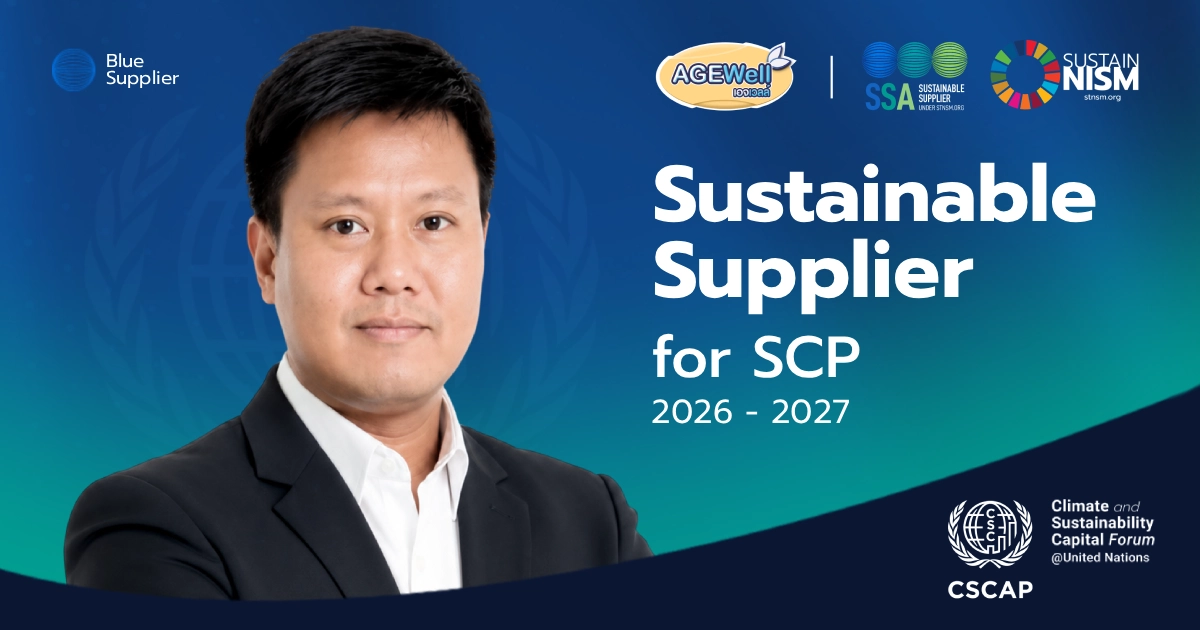


Official Recognition of AGEWell Living (Thailand) Co., Ltd. as a Sustainable Supplier under the CSCAP–SSA Framework 2026-2027
Dimension 1: Policy
Introduction
This document has been prepared as a sustainability reference framework for purchasers, hospitals, distributors, healthcare institutions, and organizations seeking environmentally and socially responsible hygiene and healthcare products. It provides an overview of the business direction, innovation approach, and ESG-related commitments of AGEWell Living (Thailand) Co., Ltd. to support sustainable procurement evaluation, ESG disclosure, sustainability reporting, and voluntary sustainability communication under the CSCAP–SSA framework.
AGEWell Living (Thailand) Co., Ltd. has established its business and innovation direction around the principle that healthcare and hygiene products should simultaneously enhance human well-being and reduce long-term environmental impacts. The company recognizes that disposable hygiene waste—particularly products heavily dependent on petrochemical plastics and synthetic absorbent polymers—is becoming an increasingly significant burden on ecosystems, communities, and waste management systems worldwide.
In response to these challenges, AGEWell is committed to advancing alternative material solutions and absorbent technologies that reduce reliance on petrochemical-based synthetic absorbent systems. The company places strong emphasis on the integration of natural-material concepts and biodegradable components, while maintaining high standards of product performance, safety, comfort, and hygiene for users across diverse age groups and healthcare contexts.
AGEWell’s innovation approach is not limited solely to elderly care products. Rather, the company recognizes the broader societal reliance on absorbent hygiene products across multiple demographic groups and stages of life. Its sustainability-oriented product direction therefore extends to:
- Elderly individuals, both male and female
- Patients and individuals requiring long-term care support
- Women with menstrual hygiene needs
- Infants, toddlers, and children across various age groups utilizing disposable diaper products
- Users within home-care, rehabilitation, and long-term care systems
The company believes that hygiene products should not be viewed merely as consumer goods, but as an integral component of healthcare systems, quality of life, human dignity, and equitable access to essential daily care. This perspective is particularly important in societies transitioning into aging populations, where demand for disposable hygiene products is expected to increase substantially over the coming decades.
One of the company’s key strategic directions is the continuation and expansion of research collaboration with the National Science and Technology Development Agency (NSTDA) to support the development of hygiene products that help reduce accumulated waste burdens, promote Circular Economy principles, and advance Sustainable Consumption and Production (SCP).
AGEWell’s operational philosophy extends beyond product functionality alone. The company seeks to address broader environmental, social, and quality-of-life considerations throughout the product lifecycle—from material selection and product design to waste reduction and the strengthening of healthcare and care-support systems for people of all ages.
AGEWell believes that caring for people with dignity must go hand in hand with responsibility toward society and the environment. Through this approach, the company aims to contribute toward a balanced future in which human well-being, societal quality of life, and the long-term sustainability of natural resources can coexist together.
Company Sustainability Policy and Mission Statement
AGEWell Living (Thailand) Co., Ltd. operates under the principle that “healthcare innovation should create value for both people and the planet.” The company is committed to developing hygiene and healthcare products that enhance quality of life across diverse age groups and life contexts, while simultaneously reducing the environmental impacts associated with disposable hygiene products.
The company recognizes that the future of hygiene and absorbent healthcare products should not rely solely on petrochemical-based materials, particularly Synthetic Super Absorbent Polymer (SAP) systems that may contribute to long-term waste accumulation and environmental persistence. AGEWell therefore focuses on advancing alternative material approaches and absorbent technologies utilizing natural-material concepts and environmentally responsible components to support the transition toward more sustainable consumption and production systems.
AGEWell’s sustainability philosophy may be summarized through the following principle:
“Enhancing Human Quality of Life While Reducing Environmental Burden.”
The company’s operational approach seeks to create balance across three core dimensions:
- Promoting health, dignity, comfort, and quality of life for users across all age groups, including elderly individuals, women, children, and people requiring specialized hygiene and long-term care support
- Reducing waste impacts and dependency on petrochemical-based materials within disposable hygiene product systems
- Advancing responsible innovation through collaboration with scientific, research, and technology institutions
AGEWell integrates knowledge relating to biodegradable materials and absorbent innovation into product development processes to help reduce long-term waste impacts associated with disposable hygiene products. Certain products have demonstrated biodegradability-related performance under testing conditions, reflecting the company’s continued efforts to develop environmentally responsible healthcare and hygiene solutions.
The company also places strong emphasis on safety standards, product quality, and transparency in business operations. AGEWell collaborates with scientific, research, and testing organizations, including NSTDA and testing processes aligned with SGS-related standards, in order to strengthen consumer confidence, product reliability, and stakeholder trust.
From an ESG perspective, the company places importance on the following dimensions:
Environmental
Reducing waste generation and lowering dependency on petrochemical-based materials through environmentally responsible hygiene product innovation.
Social
Enhancing quality of life, hygiene accessibility, comfort, and dignity for diverse user groups, including elderly individuals, women, children, caregivers, and populations requiring daily hygiene support.
Governance
Operating with transparency, supporting research collaboration, and promoting product quality standards and innovation processes that can be reasonably verified and communicated to stakeholders.
This sustainability direction also aligns with several United Nations Sustainable Development Goals (SDGs), particularly:
- SDG 3: Good Health and Well-being
- SDG 9: Industry, Innovation and Infrastructure
- SDG 12: Responsible Consumption and Production
- SDG 13: Climate Action
- SDG 15: Life on Land
Note: References to ESG, SDGs, SCP, biodegradability, or sustainability-related approaches in this document are intended solely for voluntary sustainability communication and disclosure purposes. Such references do not constitute legal certification, environmental certification, regulatory approval, or endorsement by the United Nations or affiliated organizations.
Dimension 2: Goals
Recognized Products or Services
AGEWell Living (Thailand) Co., Ltd. has developed hygiene and healthcare products designed to address both “human quality of life” and “environmental responsibility” simultaneously. The company’s innovation and product approach seeks to support hygiene care and well-being across diverse population groups, including elderly individuals—both male and female—women, infants, toddlers, children across different age groups, and individuals requiring long-term care support, while also helping reduce the long-term environmental burden associated with disposable hygiene waste.
Recognized products and sustainability-oriented innovation approaches include absorbent underpads, hygiene products, and various absorbent-care solutions related to elderly care, women’s hygiene, and child-care applications. These products incorporate natural absorbent concepts aimed at reducing reliance on petrochemical-based Synthetic Super Absorbent Polymer (SAP) systems, while supporting the development of more environmentally responsible material solutions.
The company’s products are intended to support quality of life, hygiene, comfort, safety, and human dignity for users across all age groups, including elderly individuals, caregivers, women, children, and families, as well as hospitals, elderly-care centers, home-care systems, and residential care environments. At the same time, the company seeks to encourage more sustainable healthcare and hygiene consumption practices.
AGEWell’s product development approach places emphasis on:
- Reducing long-term accumulated waste burdens associated with disposable hygiene products
- Lowering dependency on petrochemical-based materials
- Enhancing user comfort, hygiene performance, and skin safety
- Supporting Circular Economy principles and Sustainable Consumption and Production (SCP) approaches
- Advancing research-driven innovation designed to address practical, real-world healthcare and hygiene needs across multiple generations and care contexts
Alignment with the Sustainable Development Goals (SDGs)
AGEWell’s sustainability approach demonstrates strong alignment with multiple United Nations Sustainable Development Goals (SDGs), particularly in the areas of health and well-being, sustainable consumption and production, waste reduction, and innovation for healthcare and long-term care systems.
The company’s operational and product development direction is closely connected with the following key SDGs:
SDG 3 – Good Health and Well-being
AGEWell products are designed to enhance quality of life, hygiene, comfort, safety, and human dignity for users and individuals requiring long-term care support. The company emphasizes accessible, practical, and safe hygiene solutions that contribute to daily well-being across diverse population groups and life stages.
SDG 9 – Industry, Innovation and Infrastructure
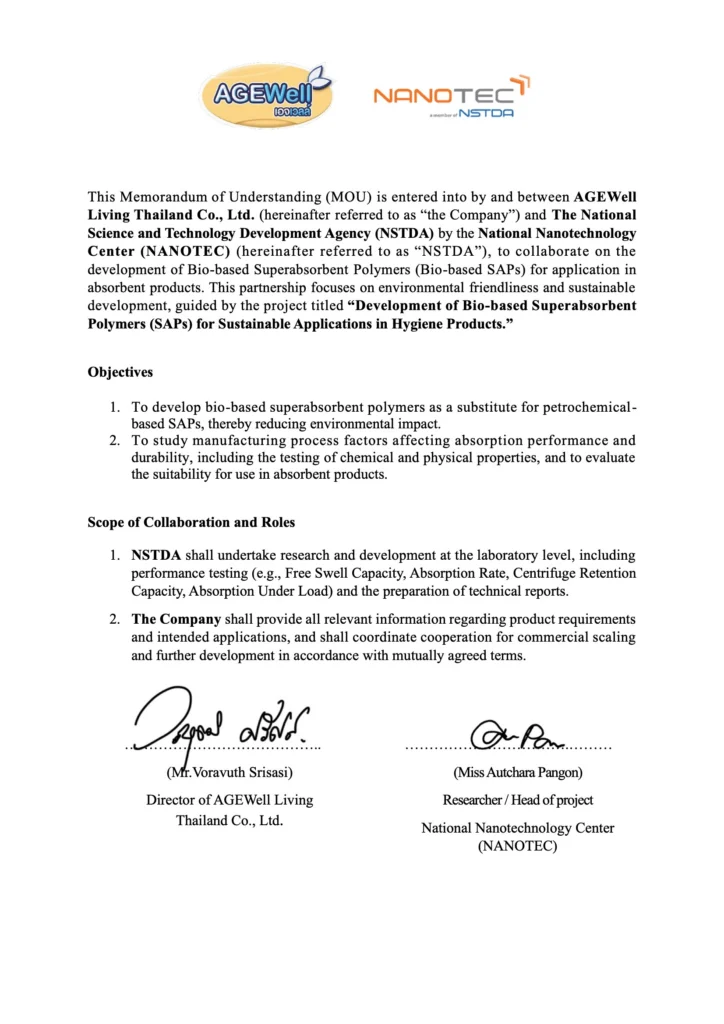
AGEWell supports scientific research, technological innovation, and the advancement of sustainable healthcare material development through collaboration with research institutions and science-based innovation processes. The company’s efforts to develop alternative absorbent materials, biodegradable components, and environmentally responsible hygiene solutions contribute to strengthening innovation capacity within the healthcare and hygiene sector, particularly in response to the growing needs of ageing societies, long-term care systems, and sustainable healthcare supply chains.
Through research collaboration and innovation-driven product development, AGEWell aims to support the transition toward more resilient, responsible, and sustainability-oriented healthcare and hygiene infrastructure.
SDG 12 – Responsible Consumption and Production
The company promotes more sustainable healthcare and hygiene consumption practices through the development of products incorporating biodegradable components and alternative material approaches intended to reduce the long-term waste burden associated with disposable hygiene products.
SDG 13 – Climate Action
By reducing dependency on petrochemical-based materials and advancing environmentally responsible product innovation, AGEWell contributes toward reducing pressure on resource-intensive and fossil-fuel-dependent production systems.
SDG 15 – Life on Land
The promotion of biodegradable material concepts and the reduction of long-term persistent plastic waste may help mitigate impacts on terrestrial ecosystems and reduce accumulated waste burdens within communities and landfill systems.
Through these sustainability-oriented approaches, AGEWell seeks to contribute toward a future in which healthcare, hygiene accessibility, environmental responsibility, and quality of life can progress together in a more balanced and sustainable manner.
Quantitative and Qualitative Impact Outcomes
(Key Performance Indicators – per 1 user per year)
AGEWell’s biodegradable hygiene product innovation is intended to help reduce the long-term environmental burden associated with disposable hygiene and absorbent-care products across multiple user groups and healthcare contexts. This includes products designed for elderly individuals—both male and female—women with menstrual hygiene needs, infants, toddlers, children across various age groups, and individuals requiring long-term care support.
Based on estimated average usage patterns of approximately 2–4 pieces per day, the following table presents illustrative sustainability-related indicators and reference outcomes per individual user annually.
| SDG Goal | Target | Indicator | Relevance to AGEWell | Measured Outcome (per 1 user / year) |
|---|---|---|---|---|
| SDG 3 – Good Health and Well-being | 3.4 – Promote health and quality of life for all age groups | Support for health and quality of life | AGEWell products support hygiene, comfort, and dignity for elderly individuals and people requiring long-term care | Supports approximately 730–1,460 hygiene care cycles annually per user |
| SDG 3 – Good Health and Well-being | 3.8 – Support access to quality healthcare systems | Access to healthcare support systems | Products are designed to support elderly care, caregivers, and healthcare systems | Supports continuous hygiene care and quality of life in daily living |
| SDG 9 – Industry, Innovation and Infrastructure | 9.5 – Promote scientific research, technological development, and innovation capacity | Research and development (R&D) support and innovation integration | AGEWell collaborates with scientific and research institutions to develop alternative absorbent materials and biodegradable healthcare innovations | Supports healthcare innovation ecosystems and research-driven sustainable product development |
| SDG 12 – Responsible Consumption and Production | 12.5 – Substantially reduce waste generation through reduction, reuse, and recycling | Waste reduction and sustainable material transition | Incorporates biodegradable material concepts and reduces dependency on petrochemical-based materials | Potentially reduces long-term disposable hygiene waste burden by approximately 55–180 kilograms annually per user context |
| SDG 12 – Responsible Consumption and Production | 12.2 – Achieve sustainable management and efficient use of natural resources | Sustainable material utilization | Supports the transition toward alternative absorbent materials and biodegradable components | Reduces dependency on conventional fossil-based disposable hygiene materials |
| SDG 13 – Climate Action | 13.2 – Integrate climate measures into operational systems | Transition toward sustainable operations | Supports environmentally responsible product approaches within healthcare systems | Encourages environmentally conscious healthcare consumption and procurement practices |
| SDG 15 – Life on Land | 15.1 – Reduce impacts on terrestrial ecosystems | Relevance to ecosystem protection | Biodegradable materials may help reduce long-term accumulation of landfill waste | Reduces long-term waste persistence compared with conventional diaper systems |
The outcomes presented above are intended to support sustainability communication, ESG-related evaluation, and disclosure discussions within Sustainable Consumption and Production (SCP) contexts. Quantitative figures and illustrative outcomes are reference-based estimates only and may vary depending on usage behavior, waste management systems, operational environments, disposal conditions, and product application contexts.
Note: References to SDGs, ESG alignment, biodegradability, or environmental impact within this document are provided solely for voluntary sustainability disclosure and communication purposes. Such references should not be interpreted as environmental certification, legal certification, regulatory approval, or a guarantee of environmental performance under all disposal or operational conditions.
Dimension 3: Sustainability Delivery Process
Operational and Sustainability Implementation Process
AGEWell Living (Thailand) Co., Ltd. integrates sustainability principles throughout both its product development processes and operational activities, with the objective of enhancing quality of life, hygiene, comfort, and well-being for users across diverse age groups and healthcare contexts. This includes elderly individuals—both male and female—women, infants, toddlers, children across various age groups, and individuals requiring long-term care support, while simultaneously reducing the environmental burden associated with disposable hygiene products.
The company’s sustainability implementation approach is founded on the principle that “healthcare innovation” should address not only product performance, but also user comfort, hygiene safety, environmental responsibility, and broader social impacts throughout the product lifecycle. This approach extends across absorbent-care and hygiene products associated with elderly care, women’s hygiene, childcare, and daily healthcare support systems.
AGEWell’s operational sustainability framework generally consists of the following key components:
Research and Innovation Integration
The company collaborates with scientific organizations and research institutions, including NSTDA, to study and develop alternative material approaches, natural absorbent technologies, and biodegradable components for hygiene and elderly-care products.
This process generally includes:
- Evaluation of alternative material pathways
- Development of absorbent performance and practical usability
- Consideration of environmental impacts associated with disposable product systems
- Translation of scientific research into commercially applicable healthcare and hygiene solutions
Through this research-driven approach, AGEWell seeks to strengthen environmentally responsible innovation while maintaining functionality, hygiene standards, and user comfort across multiple healthcare and daily-life applications.
Product Quality Control and Safety Management
AGEWell places strong emphasis on product quality, safety, hygiene performance, and user comfort through testing and quality assurance processes aligned with relevant healthcare and product-related standards.
Key operational priorities include:
- Improving absorbent efficiency and leakage reduction performance
- Enhancing user comfort and hygiene reliability
- Supporting product consistency and operational safety standards
- Collaborating with testing and quality assurance organizations to strengthen stakeholder and consumer confidence
The company recognizes that trust, safety, and product reliability are essential components of sustainable healthcare and hygiene systems.
Sustainable Materials and Waste Consideration
One of AGEWell’s key sustainability priorities is reducing reliance on petrochemical-based materials commonly used in conventional disposable hygiene products.
The company therefore supports:
- The exploration and development of biodegradable material concepts
- Research into natural absorbent systems and alternative material pathways
- Reduction of long-term accumulated waste burdens associated with disposable hygiene products
- More sustainable healthcare and hygiene consumption models
AGEWell recognizes the growing global challenge associated with disposable healthcare waste and seeks to contribute toward more environmentally responsible healthcare product systems over the long term.
Through these approaches, the company aims to support the transition toward healthcare and hygiene solutions that are more aligned with Circular Economy principles and Sustainable Consumption and Production (SCP) frameworks.
Accessibility and Social Impact
AGEWell’s operational approach also places strong emphasis on “accessibility” and “quality of life” for users across diverse age groups and healthcare conditions, including elderly individuals—both male and female—women, infants, toddlers, children, caregivers, and healthcare support systems.
The company seeks to support:
- Reduction of caregiver burden
- Access to appropriate hygiene and healthcare-support products
- User comfort, dignity, and daily well-being
- Long-term care systems and home-care support
- Daily hygiene support across diverse population groups and life stages
AGEWell believes that these social dimensions are fundamental components of sustainable healthcare systems and long-term societal well-being, particularly within rapidly aging societies and healthcare systems facing increasing demand for hygiene and long-term care support.
Through this integrated sustainability approach, the company aims to contribute toward a future in which healthcare accessibility, human dignity, environmental responsibility, and quality of life can advance together in a balanced and sustainable manner.
ESG Relevance and Supply Chain Integration
AGEWell’s operational and sustainability approach demonstrates increasing alignment with ESG-oriented procurement systems and sustainable supply chain concepts, particularly within the healthcare sector, elderly-care systems, childcare services, women’s hygiene support systems, and hygiene and absorbent-care product industries serving users across diverse age groups and life stages.
Through these approaches, the company seeks to support organizations aiming to align procurement decisions with long-term environmental objectives, social responsibility commitments, quality-of-life considerations, and more sustainable healthcare systems.
Environmental (E) Relevance
From an environmental perspective, AGEWell’s sustainability approach is associated with:
- Reducing dependency on petrochemical-based materials
- Supporting the transition toward more sustainable material systems within healthcare and hygiene products
- Reducing waste burdens and long-term pressure on landfill systems
- Promoting biodegradable material concepts and alternative absorbent technologies
- Advancing Sustainable Consumption and Production (SCP) principles
These approaches may be particularly relevant for organizations and purchasers seeking healthcare and hygiene product alternatives that place greater emphasis on environmental responsibility and long-term waste reduction considerations.
Social (S) Relevance
From a social perspective, AGEWell’s products and operational approach are connected with:
- Health, comfort, hygiene, confidence, and dignity for users across all age groups, including elderly individuals—both male and female—women, infants, toddlers, and children across multiple life stages
- Access to appropriate hygiene and healthcare-support products in daily life
- Support for elderly-care systems, childcare support systems, and long-term care services
- Reduction of burdens placed on caregivers, families, and public healthcare systems
- Supporting preparedness for aging societies and the growing hygiene-related needs of increasingly diverse populations
- Enhancing quality of life, hygiene accessibility, and confidence for individuals requiring absorbent-care and hygiene-support products across various healthcare and daily-life contexts
The company believes that sustainable healthcare extends beyond environmental considerations alone. It also encompasses quality of life, equitable access to essential care, human dignity, and support for vulnerable or care-dependent populations requiring daily hygiene assistance.
Governance (G) Relevance
From a governance perspective, AGEWell places importance on:
- Collaboration with scientific and research institutions
- Product testing, quality assurance, and verification processes
- Transparency in sustainability communication and disclosure
- Responsible innovation and research-driven product development
The company supports sustainability communication approaches that help strengthen transparency and trust among manufacturers, hospitals, healthcare organizations, distributors, and ESG-oriented purchasers.
Supply Chain Integration Perspective
AGEWell’s sustainability-oriented product approach may be relevant to:
- Hospitals and healthcare procurement systems
- Elderly-care centers and long-term care facilities
- Childcare centers, childcare systems, and families utilizing hygiene products for children
- Women’s hygiene support systems and daily hygiene product applications
- ESG-oriented distributors and procurement networks
- Sustainable procurement initiatives and responsible purchasing programs
- Organizations seeking healthcare and hygiene product alternatives with lower long-term environmental impacts
The company’s operational approach supports the concept of more sustainable healthcare and hygiene supply chains, particularly within the context of aging societies, the expansion of home-care systems, and the increasing demand for disposable hygiene products among children, women, and populations requiring specialized care support.
AGEWell recognizes that waste associated with disposable healthcare and absorbent-care products is expected to continue increasing globally in the coming decades. Through the integration of sustainability principles into healthcare and hygiene product innovation, the company aims to contribute toward the transition from linear consumption systems to more responsible, resilient, and sustainability-oriented healthcare supply chains.
Through these efforts, AGEWell seeks to support a future in which healthcare accessibility, hygiene support, environmental responsibility, and human well-being can advance together within more sustainable healthcare ecosystems.
Dimension 4: for Buyers
Purchaser Impact Note Process (4 Steps)
Add a clear four-step process to guide purchasers on how to request their Impact Note, including contact and reference details:
- Purchase
Complete your purchase of AGEWell Living (Thailand) Co., Ltd. or related services through an authorized distributor. - Submit Proof
After receiving goods or services in full, send the required documents to impactnote@stnsm.org. - Review and Record
The CSCAP–SSA Secretariat reviews all submitted information for completeness and records the purchase in the SSA Registry. - Receive Impact Note
The purchaser receives a unique Impact Note ID (e.g. SSA-IN-2026-XXXX), confirming that the transaction has been officially documented within the CSCAP–SSA system.
Purchaser Submission Requirements
Include a concise table summarizing the documents required for submission:
| Item | Details Required |
|---|---|
| Purchase invoice or receipt | Show product quantity and date of purchase |
| Delivery confirmation | Proof of goods or service completion (delivery note or photo) |
| Purchaser contact information | Full name, position, phone number, and e-mail address of the purchaser |
Claimable Outcomes
The following table presents illustrative sustainability-related outcomes that purchasing organizations, hospitals, healthcare institutions, distributors, and entities utilizing products from AGEWell Living (Thailand) Co., Ltd. may reference in ESG disclosures, sustainability reports, sustainable procurement communication, or broader sustainability-related reporting contexts.
| Material Theme | Impact Description | Example Reference Outcome | Relevant SDGs & Targets |
|---|---|---|---|
| Sustainable Healthcare Consumption | Supports the transition toward more environmentally responsible healthcare and hygiene products | Increased adoption of products incorporating biodegradable components and reduced reliance on petrochemical-based materials | SDG 12.2 / 12.5 / 12.6 / SDG 13.2 |
| Elderly Well-being and Dignity | Supports the health, quality of life, comfort, and dignity of elderly populations | Elderly individuals gain improved access to safe, practical, and user-friendly hygiene products | SDG 3.4 / 3.8 |
| Waste Reduction and Environmental Burden Awareness | Helps reduce the long-term waste burden associated with disposable hygiene products | Reduced dependency on conventional petrochemical-based disposable material systems | SDG 12.5 / SDG 15.1 |
| Sustainable Procurement and ESG Integration | Supports the integration of ESG considerations into healthcare procurement systems | Hospitals and organizations may reference Sustainable Procurement approaches within procurement and ESG disclosure frameworks | SDG 12.6 |
| Research and Innovation Collaboration | Supports Thailand’s innovation and scientific research ecosystem | Collaboration between the private sector and research institutions to advance healthcare and hygiene innovation | SDG 9.5 |
| Circular Economy Transition | Supports Circular Economy approaches within healthcare and hygiene systems | Increased awareness of alternative materials and more responsible consumption practices | SDG 12.2 / 12.5 |
| Community and Care System Support | Supports elderly-care systems and caregiver support within aging societies | Helps reduce caregiver burden and strengthen long-term care support systems | SDG 3.8 / SDG 11.3 |
| Sustainable Material Transition | Supports the transition from petrochemical-based materials toward more sustainable alternatives | Increased adoption of natural absorbent concepts and biodegradable material approaches | SDG 12.2 / SDG 13.2 |
| Responsible Healthcare Supply Chains | Supports healthcare supply chains that integrate ESG-related considerations | Purchasers may integrate environmental and social considerations into healthcare procurement systems | SDG 12.6 |
| Healthy Aging Society Support | Supports preparedness for aging societies and long-term demographic transition | Increased access to products that support the quality of life and well-being of elderly populations | SDG 3.4 / 3.8 |
These references are intended to support alignment with relevant United Nations Sustainable Development Goals (SDGs) and associated SDG Targets within healthcare, hygiene, sustainable consumption, and environmental responsibility contexts.
Impact Note Claim Period
Impact Notes may be requested and recorded within 30 days from the date the purchaser has received the goods or services in full. Submissions received after this period may be reviewed in the following reporting cycle under the CSCAP–SSA Mechanism.
Important Disclaimer
This document is issued under the SDG Custodian Support Mechanism for the purpose of sustainability reference and transparency. It does not constitute an official endorsement or certification by the United Nations (UN).
The information contained herein is based on data publicly disclosed by the company and has not been independently verified or certified by Sustainism. Accordingly, it carries no legal effect or binding recognition under any formal certification system.
Any concerns regarding inaccuracies, misrepresentation, or conduct that may constitute SDG or Greenwashing violations should be reported confidentially via: whistleblower@stnsm.org
Contact at Sustainism Secretariat
Sustainism Initiatives
+66 8298 96869
secretariat@stnsm.org