

A Strategic Solution for Enterprises and Public-Sector Institutions through Cooperation with AFMA – stnsm.org
Developing a standard is something that any organization may undertake. However, enabling a standard to gain recognition in international markets requires more than the substance of its requirements. It must be grounded in the credibility of the process, the neutrality of the standard-setting body, transparency in stakeholder engagement, systematic review and improvement, and the formal announcement of its operational status through a credible platform. These elements are essential to ensure that a standard does not remain merely an internal organizational document, but can evolve into a sustainable market standard that buyers, business partners, public-sector institutions, investors, and international markets have sufficient reason to consider, trust, and apply as a common basis for confidence. If successfully implemented, such a standard can become a market-shaping instrument, establishing new rules of competition based on sustainability, transparency, and verifiable evidence, while transforming sustainability from a compliance burden into a source of sustainable competitiveness in global markets.
Against this background, the following section presents a Strategic Pathway for Developing Sustainable Market Standards — a structured approach for enterprises and public-sector institutions to develop sustainability standards that are not only technically prepared, but also credible, stakeholder-informed, internationally interpretable, and capable of supporting market access, buyer confidence, and long-term sustainable competitiveness.
Introduction: EmpCo and the Transition from Sustainability Claims to Market-Based Evidentiary Responsibility
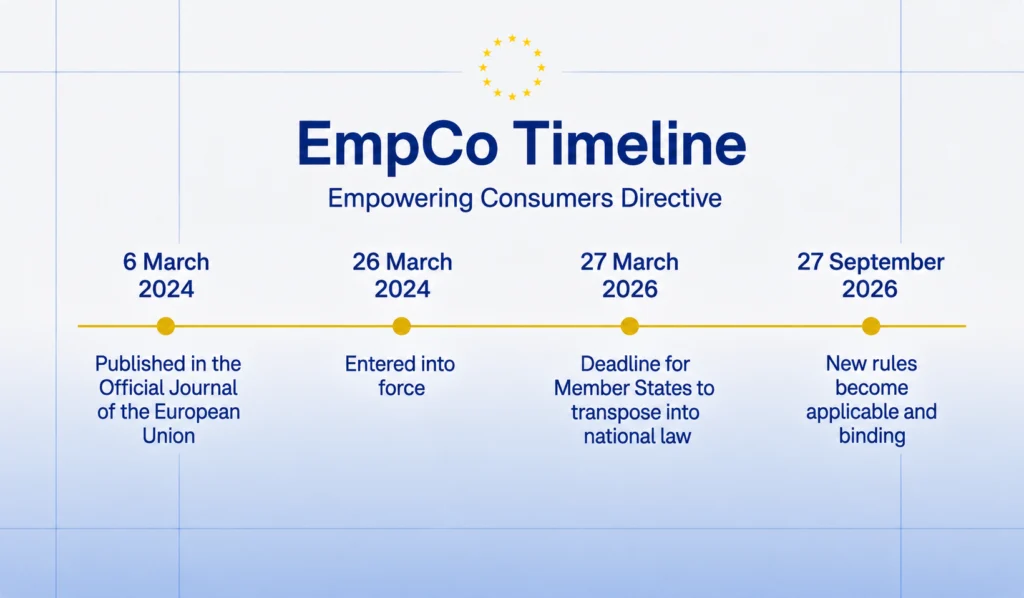
Global markets are entering a new phase of regulatory and commercial scrutiny over sustainability-related claims. This transition is particularly evident in the European Union, where Directive (EU) 2024/825, commonly referred to as the Empowering Consumers for the Green Transition Directive, or EmpCo, has been adopted to strengthen consumer protection against vague, exaggerated, or potentially misleading environmental and sustainability-related information.
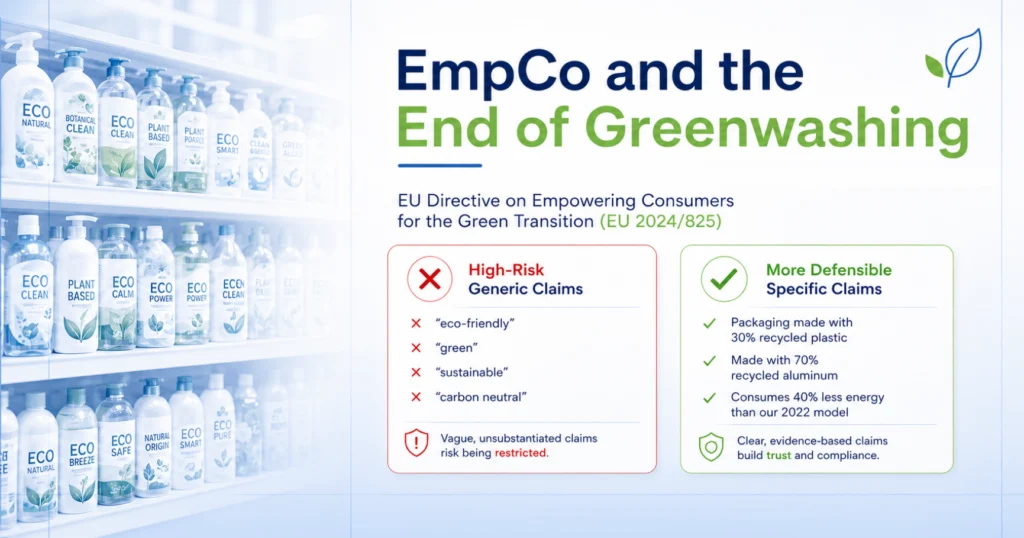
The significance of EmpCo does not lie in discouraging businesses from pursuing sustainability. Rather, it establishes a clearer expectation that sustainability communication must be specific, substantiated, proportionate, and capable of being verified. General expressions such as “green,” “eco-friendly,” “environmentally friendly,” “sustainable,” “carbon neutral,” or “climate neutral” may increasingly create legal and commercial exposure if used without appropriate evidence, clear boundaries, and a reasonable basis for the claim.
For enterprises selling products or services into the European market, the impact is direct. Businesses will need to review whether environmental or sustainability-related statements, labels, certification marks, website content, brochures, corporate reports, product claims, and marketing campaigns are adequately substantiated. They must also determine whether such communications may lead consumers to understand more than what the evidence can reasonably support.
However, the implications of EmpCo are not limited to companies selling directly into Europe. Enterprises that form part of the supply chains of global buyers, brands, importers, distributors, retailers, or international partners may also be affected indirectly. Downstream buyers are likely to increase their scrutiny of supplier information in order to avoid relying on unclear, overstated, or insufficiently evidenced sustainability claims in their own consumer-facing communications, ESG disclosures, procurement processes, or investor communications.
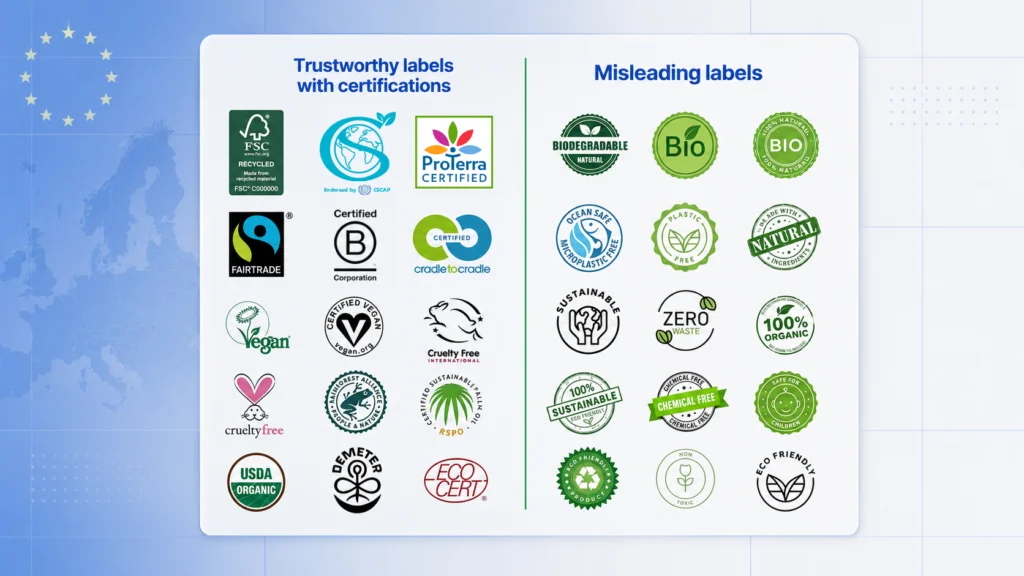
In this respect, EmpCo signals a fundamental shift: sustainability is moving from a matter of marketing language to a matter of market-based evidentiary responsibility. Businesses can no longer rely solely on statements of intent, visual symbols, or reputational messaging. They must be able to demonstrate policies, evidence, scope, methodology, governance, and claim-control mechanisms in a structured and credible manner.
Within this context, the development of sustainable market standards becomes a strategic necessity. It provides a pathway for enterprises and public-sector institutions to move beyond general sustainability communication and toward a structured credibility system that buyers, trading partners, investors, regulators, and international markets can reasonably evaluate and trust.
Lessons from International Cases: Greenwashing Risk Is Not Theoretical
Recent developments in several jurisdictions indicate that greenwashing risk is no longer a theoretical concern. It has become a practical legal, regulatory, reputational, and commercial risk affecting organizations across multiple sectors.
In one European case involving a major international transport-related business, a court considered certain environmental advertising statements and found that some claims may have created a misleading impression or presented an overly positive image of the environmental effect of the measures being promoted. The disputed communications included references to alternative fuels, carbon-offsetting measures, and environmental mitigation initiatives. The case illustrates that even where an organization undertakes environmental measures in practice, communication may still be considered problematic if it leads consumers to understand that the environmental benefit is greater than what can be supported by evidence.
In another case in the aviation sector, a class action was brought in relation to a “carbon-neutral” claim. The claimants alleged that the representation relied heavily on carbon-offset mechanisms in a manner that could lead consumers to believe that the service had no climate impact. While such proceedings must be assessed according to the applicable judicial process, the matter demonstrates that terms such as “carbon neutral” and “climate neutral” are high-risk expressions and require particularly robust evidence, methodology, scope definition, and explanatory disclosure.
In the financial and investment sector, a securities regulator in a foreign jurisdiction issued an administrative order in connection with ESG integration claims and related internal control deficiencies. The organization concerned agreed to a monetary penalty and administrative settlement, without such settlement necessarily constituting an admission of all allegations in the broader public sense. This case demonstrates that greenwashing concerns are not limited to consumer products. They also extend to financial services, investment products, ESG disclosures, and sustainability-related governance representations.
There have also been cases in which advertising regulators reviewed environmental advertising by energy-related businesses and considered whether the communication could give consumers a misleading impression of the scale or significance of low-carbon activities when compared with the overall business. Such cases reinforce an important principle: the existence of certain sustainability initiatives does not automatically permit an organization to communicate that its entire business model is sustainable, transformed, or low-impact beyond what the evidence reasonably supports.
The common lesson from these international developments is clear. Markets and regulators are increasingly examining the gap between what organizations actually do and what organizations claim. Businesses seeking access to sustainable markets must therefore establish claim-control systems, evidentiary records, and standards that can be explained, reviewed, and defended. Sustainability language must be supported by governance, process, and evidence.
Working with an International Organization: The Correct Strategic Question from Day One
In practice, any organization can develop its own sustainability policy, rules, requirements, or standard. However, in international markets, the decisive question is not whether an organization can write a standard. The real question is whether that standard carries sufficient credibility for global buyers, trading partners, investors, public institutions, and markets to rely upon.
This is the distinction between having a standard and having a standard that the market has reason to recognize.
A self-developed internal standard may be useful for organizational management. However, it may not be sufficient to establish confidence in international sustainable markets, particularly at a time when global buyers are increasingly exposed to greenwashing, overclaiming, supply-chain due diligence obligations, consumer-protection rules, and stricter scrutiny of environmental and sustainability-related representations.
Cooperation with an international organization such as AFMA – stnsm.org is therefore strategically important. It enables an organization to begin with a credibility architecture, rather than a promotional narrative; with policy, rather than labels; with evidence, rather than language; and with a process that allows stakeholder input and review, rather than unilateral self-declaration.
The role of AFMA – stnsm.org is not merely technical support. Its strategic value lies in helping enterprises and public-sector institutions position their sustainability standards within a broader credibility pathway. This includes policy alignment, meaningful consultation, international interpretation, evidence requirements, and responsible claim control.
For global buyers, the central concern is assurance that a supplier is not merely claiming to be sustainable, but is building a system that can substantiate its sustainability position. Such a system should include a clear policy, verifiable evidence, appropriate claim boundaries, meaningful stakeholder engagement, and a transparent relationship to international frameworks understood by the market.
For this reason, working with AFMA – stnsm.org is the correct strategic question from the first day of standard development. It helps transform a standard from an internal corporate document into a market-facing credibility mechanism. It also enables buyers, partners, public institutions, and other stakeholders to assess sustainability information with greater confidence, caution, and practical utility.
4 Steps for Developing Sustainable Market Standards
Establish a Sustainability Policy and Commit to Serious ESG Objectives
The development of sustainable market standards must begin with policy, not symbols. An organization must clearly define how sustainability relates to its business model, products, services, supply chain, risks, and market opportunities. Environmental, social, and governance objectives should not remain general statements of aspiration. They must be capable of being translated into operational scope, performance indicators, evidence requirements, monitoring mechanisms, and governance responsibilities.
At this stage, the organization should understand Sustainable Consumption and Production, or SCP, as a framework that connects production, consumption, procurement, supply chains, and market access. Properly designed, SCP can help transform sustainability from a compliance burden into a source of competitiveness. It can strengthen buyer confidence, reduce legal and reputational risk, improve readiness for sustainable procurement, and support access to capital or investment that prioritizes ESG performance.
A sound sustainability policy should address at least five elements: the scope of relevant products, services, or supply chains; ESG objectives; evidence required to support any claim; internal governance and monitoring arrangements; and the boundaries of sustainability-related language that the organization may use responsibly.
Draft the Standard and Conduct Multi-Stakeholder Consultation, Especially with Buyers
Once the policy has been established, the organization may proceed to develop a draft standard, rule, or requirement that can be applied in practice. However, such a standard should not be developed by the organization alone. A standard developed without participation may be perceived as a self-serving instrument rather than a credible market mechanism.
Meaningful consultation is therefore central to market legitimacy. Stakeholders should be invited to provide input before final decisions are made. Relevant participants may include enterprises, buyers, technical experts, public-sector institutions, financial-sector representatives, consumers, communities, affected groups, and other relevant actors. Buyers deserve particular attention because they are the parties most likely to rely on supplier information for procurement decisions, ESG reporting, market communication, and consumer-facing claims.
A credible consultation process should not be limited to a ceremonial hearing. It should be supported by clear documentation, including a concept note, a zero draft, written consultation procedures, stakeholder sessions, a comment-response matrix, and a consultation summary report. These instruments demonstrate that stakeholder comments were recorded, considered, and used to improve the draft standard in a structured manner.
The outcome of this process is that the standard is no longer perceived as the voice of a single organization. It becomes a framework that has been reviewed, tested, and improved through stakeholder input. This is an essential foundation for trust in the eyes of buyers and international markets.
Conduct International Interpretation against Relevant Global Standards and Frameworks
After the draft standard has undergone consultation, the next step is international interpretation. This refers to the transparent interpretation and mapping of the specific standard against relevant international frameworks. The purpose is to allow buyers, partners, investors, and external institutions to understand what principles the standard relates to, what risks it helps address, and what gaps remain for further development.
International interpretation is not a claim that the organization’s standard is automatically equivalent to international standards. Rather, it is a responsible process of explaining how the requirements relate to relevant frameworks such as SCP, the Sustainable Development Goals, ESG disclosure, responsible sourcing, supply-chain due diligence, climate action, circular economy, consumer protection, and anti-greenwashing principles.
The expected outputs should include a standards mapping matrix, gap analysis, evidence requirements, claim-control guidance, and local application guidance. These documents help translate the standard from internal organizational language into a language that international markets can understand. They also enable buyers to assess suppliers based on evidence, rather than on sustainability claims alone.
Announce or Present the Standard through CSCAP at a United Nations Conference Venue
Once the standard has passed through policy formulation, consultation, and international interpretation, the organization may announce, present, or formally introduce the standard through CSCAP at a United Nations conference venue. The purpose is to communicate the organization’s readiness in relation to sustainable market standards to buyers, enterprises, public-sector institutions, and international networks.
This step is strategically important for visibility and credibility. It helps move the standard beyond an internal document and presents it within a setting connected to sustainable development dialogue and international cooperation.
However, all communication at this stage must be carefully worded. The organization should refer to the process as an announcement, presentation, or declaration of readiness through a cooperation platform. It should not represent the standard as approved, certified, endorsed, or formally recognized by the United Nations, unless there is clear documentary evidence and official status to support such a claim.
The value of this step lies in its market signal. It shows that the organization has not developed the standard in isolation, but has undertaken a structured process involving policy, stakeholder consultation, evidence, international interpretation, and responsible claim control.
Alternative Pathway for Organizations Not Yet Ready
Not every organization needs to begin with a full sector-specific or company-specific standard. Where an organization lacks sufficient data, evidence, budget, or internal systems, a more appropriate starting point may be voluntary sustainability measures.
In such cases, the organization may announce voluntary sustainability measures aligned with relevant standards through stnsm.org and connect to the SSA-B pathway. SSA-B can serve as an entry pathway for enterprises that wish to enter sustainable markets progressively without creating disproportionate burdens.
Through SSA-B, an organization may begin with an SCP policy statement, readiness assessment, supplier profile, preliminary evidence collection, and non-overclaiming communication practices. This allows the organization to enter a structured credibility pathway before developing a more comprehensive specific standard in the future.
This pathway is particularly important for SMEs and early-stage enterprises. It enables them to avoid exclusion from sustainable markets merely because they are not yet ready to develop a full standard, while still allowing them to begin building evidence, governance, and market credibility in proportion to their scale, risk profile, and capacity.
Conclusion
EmpCo and the broader global trend toward greenwashing regulation are transforming sustainability from a claim into an evidentiary responsibility. Businesses selling into Europe will face direct implications. Businesses operating within global supply chains will face indirect implications through increased buyer scrutiny, evidence requests, scope clarification, methodology requirements, and credibility expectations.
In this context, developing sustainable market standards through AFMA – stnsm.org is a strategic pathway. It enables organizations to move beyond self-declaration and toward a structured process involving policy, consultation, international interpretation, evidence requirements, and claim control.
The purpose of sustainable market standards is not merely to state that a business is sustainable. It is to create sufficient reason for buyers, partners, investors, public institutions, and international markets to believe that the sustainability position is supported by a credible, transparent, and evidence-based system.
