From Measures to Standards: A Business Pathway toward International Sustainability
SSA-B serves as a voluntary transition pathway for enterprises to disclose, align, and progressively develop toward CS Standard readiness through the CSCAP Sustainable Market Standards Pathway.
Introduction and Overview
As the global economy transitions toward sustainability, businesses can no longer rely solely on declarations of intent or isolated environmental and social activities. Markets, buyers, business partners, investors, and regulators are placing increasing emphasis on data, evidence, transparency, and the ability to demonstrate sustainability outcomes. Sustainability is therefore evolving from a voluntary activity into a market condition directly linked to buyer access, competitiveness, investment, procurement, and public trust.
However, not every organization is immediately ready to develop and implement a full sustainability standard. This is particularly true for small and medium-sized enterprises, as well as organizations that are still developing their data systems, human resources, budget capacity, and understanding of international standards. For this reason, an appropriate transition pathway is required between “measures” and “standards.”
“Measures” refer to a voluntary starting point, provided that they are implemented correctly, with clear scope, appropriate disclosure, and cooperation with a credible organization or cooperation framework. “Standards,” by contrast, represent a higher level of practice, where an organization’s actions are assessed against criteria, requirements, and review processes established under a more credible standard framework. The pathway from measures to standards is therefore a process of incubation, development, and connection, enabling businesses to move from a practical starting point toward a sustainability system that markets can reasonably recognize and use in decision-making.
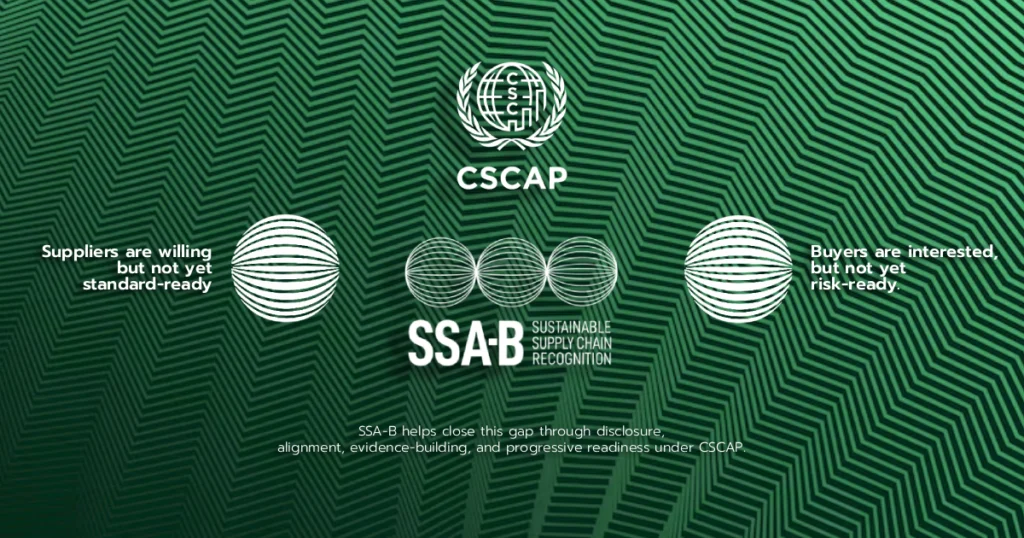
In this context, SSA-B serves as an important transition mechanism. It enables organizations to begin with voluntary measures aligned with the direction of the CS Standard, before progressing toward future compliance with more structured sustainability standards. CSCAP serves as a platform to drive, connect, and create visibility among buyers, public-sector institutions, and sustainable market networks.
Business-Level Necessity
At the business level, sustainability is no longer merely a matter of corporate image. It has become a new factor of competitiveness. Many buyers and business partners increasingly require information on ESG, Sustainable Consumption and Production, traceability, responsible sourcing, carbon, waste, packaging, labour practices, and governance. Businesses that lack data or disclosure systems may lose opportunities to enter supply chains, even when their products or services are of high quality.
SSA-B helps businesses begin to establish a structured “sustainability identity” without waiting until every internal system is fully ready. Organizations may begin by issuing a policy statement, disclosing basic information, presenting their sustainability position, preparing a supplier profile, and collecting initial evidence. This allows buyers to see that the organization is entering a development pathway, rather than merely making unsupported claims.
From a business perspective, the key benefits include reducing the risk of overclaiming, strengthening buyer confidence, creating opportunities for engagement with business partners, and laying the foundation for future progression toward stronger standards.
Economic-Level Necessity
At the economic level, countries seeking to strengthen competitiveness need systems that enable a large number of enterprises to enter sustainable markets together. This cannot be limited only to large corporations with dedicated budgets and specialist teams. If SMEs and suppliers across the economy are unable to demonstrate sustainability information, the competitiveness of the entire supply chain may be weakened in global markets.
SSA-B is therefore significant as a systemic upgrading mechanism. It helps bring the private sector, supporting institutions, and public-sector actors into a progressive alignment process with the CS Standard through CSCAP, instead of requiring each organization to interpret global standards on its own.
This mechanism helps reduce the gap between national policy and business-level implementation. It provides public-sector institutions with a practical tool to support SMEs and enables buyers to observe supply chains that are developing in a common direction. In this sense, sustainability becomes part of economic infrastructure, rather than merely a campaign or promotional initiative.
Relevance to the United Nations Sustainable Development Goals
At the level of the United Nations Sustainable Development Goals, business sustainability is directly connected to several SDGs, particularly SDG 12 on responsible consumption and production, SDG 13 on climate action, SDG 8 on decent work and economic growth, SDG 9 on industry, innovation and infrastructure, and SDG 17 on partnerships for the goals.
SSA-B helps translate the SDGs from policy-level aspirations into practical business actions that can begin immediately. This is achieved through information disclosure, the expression of organizational commitment, the development of SCP policies, and future connection to sustainable market standards. Such an approach ensures that global goals do not remain at the level of aspiration, but are connected to real procurement, production, consumption, and supply-chain practices.
How to Begin
Organizations seeking to move from measures to standards should proceed in a structured sequence.
The first step is to announce a sustainability policy or statement of intent, clearly identifying the areas the organization seeks to improve. These may include responsible production, efficient resource use, waste reduction, supply-chain disclosure, environmental risk reduction, or engagement with buyers that prioritize ESG.
The next step is to prepare basic information on the organization and its supply chain. This may include product and service categories, customer groups, production processes, key raw materials, sources of materials, energy use, waste management, labour-related measures, and existing sustainability activities.
The organization should then define the boundaries of its communication. It should determine what can be responsibly claimed, what should not yet be claimed, and what requires further evidence before being communicated. A sound starting point does not require broad or ambitious claims. It requires careful, transparent, and evidence-based communication that does not exceed what the available evidence can support.
The next stage is to enter the SSA-B pathway in order to organize data, define the organization’s position, and align voluntary measures with the CS Standard direction, with CSCAP serving as a platform to drive engagement and create market-level visibility among relevant stakeholders.
Self-Assessment Measure under SSA-B
A Market Mechanism for Sustainable Supply Chain Readiness
SSA-B establishes a self-assessment measure for enterprises to identify their current level of sustainability readiness, disclose relevant information, demonstrate their sustainability position, organize supporting evidence, and progressively advance toward sustainable market standards. This self-assessment measure does not constitute verification, certification, or assurance. Rather, it functions as a voluntary market mechanism designed to incubate, develop, and align enterprises with the CS Standard Pathway under the CSCAP framework.
The central purpose of the SSA-B self-assessment is to enable enterprises to begin immediately, even where they are not yet ready to enter a full standard-setting or certification process. Through a structured set of assessment dimensions and topics, enterprises are able to understand their current position, identify existing data and evidence, recognize remaining gaps, and determine the areas that require further development in order to strengthen buyer confidence, supply-chain transparency, and sustainable market access.
SSA-B is designed as a progressive market-readiness pathway. It allows enterprises to move from basic disclosure and commitment toward stronger evidence, better alignment, operational maturity, and eventual readiness for more advanced sustainability standards. In this respect, SSA-B operates not only as an internal development tool for enterprises, but also as a market-facing mechanism that helps buyers, public-sector institutions, and partners understand where a supplier stands on the pathway toward sustainability performance and standard readiness.
4 Dimensions of SSA-B Self-Assessment
SSA-B assesses enterprise readiness through four core dimensions designed to support disclosure, alignment, evidence-building, and buyer confidence. These dimensions help organizations identify their current level of preparedness and progressively move toward the CS Standard Pathway under CSCAP.
1. Policy and Governance
2. Goals, Targets, and Impact
3. Sustainability Delivery, Traceability, and Due Diligence Process
4. Buyer Assurance, Impact Claims, and Sustainable Procurement Support
Dimension 1: Policy and Governance
This dimension assesses whether the organization has established the governance foundation required to participate in sustainable supply chains. It focuses on the organization’s sustainability direction, ESG and SCP policy, leadership oversight, ethical conduct, human rights, labour standards, occupational health and safety, tax transparency, supply-chain governance, and capacity-building readiness.
Topics to be assessed
1.1 Sustainability, ESG, and SCP Policy
This topic assesses whether the organization has established a sustainability, ESG, and Sustainable Consumption and Production policy or formal commitment that provides direction for responsible business development.
1.2 Board and Management Oversight
This topic assesses whether the organization has assigned leadership, management responsibility, or governance oversight for sustainability-related matters, including ESG risks, opportunities, and supply-chain responsibilities.
1.3 Ethics and Anti-Corruption
This topic assesses whether the organization has policies, principles, or practices to promote ethical conduct, prevent corruption, and support responsible business integrity.
1.4 Human Rights and Community Policy
This topic assesses whether the organization recognizes human rights, community impacts, grievance concerns, and responsible engagement with affected stakeholders.
1.5 Labour Standards
This topic assesses whether the organization has policies or practices related to fair labour, decent work, non-discrimination, skills development, and responsible treatment of workers.
1.6 Health, Safety, and Well-being
This topic assesses whether the organization has measures to protect occupational health, workplace safety, worker well-being, and safe operating conditions.
1.7 Tax Transparency and Economic Contribution
This topic assesses whether the organization demonstrates responsible tax conduct, economic contribution, and transparency in relation to its business operations.
1.8 Supply Chain Governance
This topic assesses whether the organization has policies or governance mechanisms to manage suppliers, sourcing practices, procurement responsibility, and supply-chain ESG expectations.
1.9 Capacity Building and Sustainability Literacy
This topic assesses whether the organization provides or plans to provide training, capacity building, and sustainability literacy for employees, suppliers, or relevant partners.
Dimension 2: Goals, Targets, and Impact
This dimension assesses whether the organization can translate sustainability intention into defined priorities, measurable targets, impact outcomes, and development pathways. It examines how the organization connects its products, services, operations, and supply-chain role with ESG priorities, SDGs, climate action, resource efficiency, biodiversity, community value, food security, and inclusive value-chain development.
Topics to be assessed
2.1 Material ESG and SCP Topics
This topic assesses whether the organization has identified the ESG and Sustainable Consumption and Production issues that are most relevant to its business, stakeholders, and supply-chain role.
2.2 SDG and SCP Alignment
This topic assesses whether the organization can explain how its activities contribute to the Sustainable Development Goals and support responsible consumption and production.
2.3 ESG KPIs and Impact Metrics
This topic assesses whether the organization has defined quantitative or qualitative indicators to monitor sustainability performance, outcomes, and progress.
2.4 Climate and GHG Inventory
This topic assesses whether the organization has begun to measure or manage greenhouse gas emissions, including Scope 1, Scope 2, and, where relevant, Scope 3 emissions.
2.5 Climate Transition Plan
This topic assesses whether the organization has a climate-related improvement plan, decarbonization pathway, or transition roadmap aligned with future market and buyer expectations.
2.6 Energy Management
This topic assesses whether the organization has measures to improve energy efficiency, reduce energy-related impacts, or increase the use of cleaner energy where applicable.
2.7 Water Stewardship
This topic assesses whether the organization manages water use, water efficiency, water quality, wastewater, or water-related risks in its operations or supply chain.
2.8 Waste, Circularity, and Pollution
This topic assesses whether the organization manages waste, pollution, materials, circularity, resource efficiency, and responsible production impacts.
2.9 Biodiversity and Nature Impact
This topic assesses whether the organization identifies and manages impacts on biodiversity, land, ecosystems, forests, or natural resources where relevant.
2.10 Community and Shared Value Impact
This topic assesses whether the organization contributes to community well-being, local economic value, inclusive development, or positive social outcomes.
2.11 Sustainable Agriculture, Food Security, and Inclusive Value Chains
This topic assesses whether the organization contributes to sustainable agriculture, food security, smallholder inclusion, regenerative production, or inclusive value-chain development where relevant.
Dimension 3: Traceability and Due Diligence
This dimension assesses whether the organization has the operational systems required to deliver sustainability in practice. It focuses on supply-chain mapping, traceability, environmental and social due diligence, ESG risk management, data governance, internal controls, verification readiness, and assurance readiness.
Topics to be assessed
3.1 Supply Chain Mapping
This topic assesses whether the organization can identify key suppliers, sourcing points, supply-chain stages, value-chain actors, or relevant upstream and downstream relationships.
3.2 Traceability and Chain of Custody
This topic assesses whether the organization has mechanisms to trace products, materials, services, or sustainability-related information across relevant stages of the supply chain.
3.3 Environmental Due Diligence
This topic assesses whether the organization identifies, assesses, prevents, mitigates, or monitors environmental risks and impacts in its operations or supply chain.
3.4 Social and Human Rights Due Diligence
This topic assesses whether the organization identifies and manages social, labour, human rights, and community-related risks in its operations or supply chain.
3.5 ESG Risk Register and CAPA
This topic assesses whether the organization has an ESG risk register and corrective and preventive action process to manage identified sustainability-related risks.
3.6 ESG Data Governance and Internal Controls
This topic assesses whether the organization has responsible systems for collecting, managing, reviewing, retaining, and controlling sustainability-related data and evidence.
3.7 Verification and Assurance Readiness
This topic assesses whether the organization is ready to support internal review, buyer verification, third-party verification, or future assurance of sustainability-related information.
Dimension 4: Buyer Assurance and Sustainable Procurement
This dimension assesses whether the organization can provide buyers with reliable, structured, and decision-useful sustainability information. It focuses on buyer-facing impact notes, sustainable procurement readiness, claim management, buyer due diligence support, sustainable buyer linkage, investor and finance readiness, and climate and ESG disclosure packages.
Topics to be assessed
4.1 Buyer Impact Note
This topic assesses whether the organization can prepare buyer-facing information that explains the sustainability relevance, contribution, or impact of its products, services, or activities.
4.2 Sustainable Procurement Readiness
This topic assesses whether the organization is ready to support responsible sourcing, sustainable procurement, supplier assessment, and buyer ESG requirements.
4.3 Sustainability Claims Management
This topic assesses whether the organization can define, control, and communicate sustainability claims responsibly, based on evidence, scope, limitations, and validity.
4.4 Buyer Due Diligence Support Package
This topic assesses whether the organization can provide buyers with relevant documents, evidence, explanations, and risk information required for procurement or sustainability due diligence.
4.5 SSA-B Sustainable Buyer Linkage
This topic assesses whether the organization can create or support a linkage between sustainable suppliers and buyers that encourages responsible procurement and supply-chain transformation.
4.6 Investor and Finance Readiness
This topic assesses whether the organization can prepare sustainability information that supports investor confidence, financial institution review, transition finance, or sustainability-linked business opportunities.
4.7 Climate and ESG Disclosure Package
This topic assesses whether the organization can provide a structured disclosure package covering climate, ESG, SDG contribution, supply-chain information, impact evidence, and buyer-relevant sustainability data.
SSA-B Recognition Levels
Colour Levels as Indicators of Progressive Market Readiness
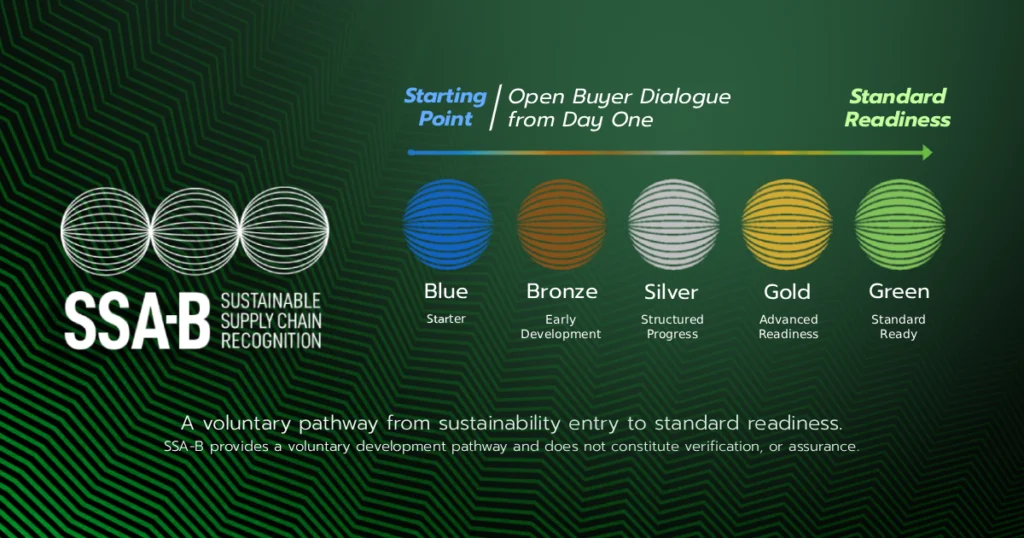
The colour levels under SSA-B do not represent certification, verification, or assurance. They represent the organization’s progressive level of market readiness based on disclosed information, sustainability experience, buyer engagement, and supporting evidence. The levels are designed to serve as a market mechanism that enables enterprises to position themselves, develop progressively, and signal their readiness to buyers and partners in a responsible manner.
Importantly, the colour level is not permanent. It may be reviewed and adjusted annually based on the organization’s actual performance, updated evidence, buyer portfolio, sustainability progress, and continued alignment with the SSA-B development pathway. An organization may advance to a higher level when performance improves and sufficient evidence is provided. Conversely, a level may be revised if performance declines, evidence becomes insufficient, claims are not maintained, or the organization no longer meets the relevant criteria.
| Level | Meaning | Preliminary Criteria |
|---|---|---|
| Blue | Awareness & Commitment | The organization has declared its sustainability intention and can identify basic ESG/SCP issues, responsible persons, preliminary SDG alignment, initial supply-chain mapping, and a buyer-facing impact concept. |
| Bronze | Policy & Documentation Established | The organization has established key policies and basic evidence, including ethics, anti-corruption, human rights, labour standards, supply-chain governance, preliminary ESG KPIs, initial GHG inventory, traceability process, ESG risk register, and sustainable procurement readiness. |
| Silver | Implementation & Operational Control | The organization has started implementing sustainability practices in real operations, including health and safety, ESG training, Scope 1 and Scope 2 inventory, water and waste management, environmental and human rights due diligence, ESG data governance, and sustainability claims control. |
| Gold | Performance & Measurable Outcomes | The organization can demonstrate measurable ESG performance, including at least 12 months of ESG KPIs, complete Scope 1 and Scope 2 data, climate transition plan, energy reduction programme, biodiversity or nature impact assessment, community impact evidence, ESG risk register with CAPA, verification readiness, buyer due diligence package, and investor or finance readiness. |
| Green | Disclosure, Assurance & Market Leadership | The organization has a structured disclosure system and is ready to support buyers, investors, and financial institutions, including tax transparency, relevant Scope 3 inventory, net-zero or climate transition roadmap, inclusive value-chain contribution where applicable, third-party verification or assurance readiness, sustainable buyer linkage evidence, and a complete Climate & ESG Disclosure Package. |
Note: The SSA-B colour level is not a permanent status. It serves as an indicator of the organization’s readiness at the time of review and may be adjusted annually based on the enterprise’s actual performance, disclosed information, submitted evidence, number of sustainability-related cases, buyer or client engagement, and progress toward the CS Standard Pathway under the CSCAP framework.
Strategic Interpretation of Each Colour Level
The SSA-B colour levels are designed not to delay market engagement, but to make buyers and investors confident enough to begin engagement from Day One. Each level provides a transparent signal of where the supplier stands, what evidence is already available, what risks remain, and what improvement pathway should follow. In this sense, SSA-B does not require suppliers to be perfect before entering the market. It enables staged procurement, buyer support, investment dialogue, and supply-chain development based on visible readiness, responsible disclosure, and clearly defined risk boundaries.
Blue — Starting Point
Blue is the entry level for organizations that have declared their sustainability intention, policy direction, or organizational readiness to begin the sustainability pathway. At this stage, the organization may not yet have full implementation evidence, mature ESG data, or proven market cases, but it can demonstrate a responsible starting point.
For buyers, Blue means the supplier can already be considered for early engagement, pilot procurement, supplier development programmes, or responsible sourcing dialogue from Day One. For investors or financial partners, Blue signals an early-stage opportunity where the organization has begun to define its sustainability direction and can be supported toward stronger ESG readiness.
The emphasis at Blue is responsible entry, not full performance. It allows early-stage enterprises and SMEs to enter the sustainable market pathway without being excluded by high entry barriers, while still avoiding unsupported or excessive claims.
Bronze — Policy and Documentation Established
Bronze represents the stage where the organization has moved beyond intention and has begun to establish key policies, basic documentation, and initial evidence. This includes areas such as ethics, anti-corruption, human rights, labour standards, supply-chain governance, preliminary ESG KPIs, initial GHG information, traceability process, and basic risk identification.
For buyers, Bronze provides a stronger basis for pilot purchasing, preferred supplier development, and early sustainable procurement consideration. The supplier has begun to show that its sustainability direction is supported by policies and documents, not only statements.
For investors and financial institutions, Bronze indicates that the organization has begun building the internal foundation required for ESG risk review and future sustainability-linked opportunities.
Silver — Implementation and Operational Control
Silver represents the stage where the organization has begun implementing sustainability practices in real operations. The organization has moved from policy and documentation toward operational control, including health and safety, ESG training, Scope 1 and Scope 2 inventory, water and waste management, environmental due diligence, human rights due diligence, ESG data governance, and sustainability claims control.
For buyers, Silver indicates that the supplier is suitable for more structured procurement engagement because sustainability practices are no longer isolated intentions but are being embedded into actual workflows and operating systems.
For investors, Silver signals that the organization is progressing toward measurable ESG management and is beginning to reduce operational, supply-chain, and disclosure-related risks.
Gold — Performance and Measurable Outcomes
Gold represents advanced readiness. At this level, the organization can demonstrate measurable ESG performance, including at least 12 months of ESG KPIs, complete Scope 1 and Scope 2 data, a climate transition plan, energy reduction measures, biodiversity or nature impact assessment where relevant, community impact evidence, ESG risk register with CAPA, verification readiness, buyer due diligence package, and investor or finance readiness.
For buyers, Gold indicates that the supplier is ready to support responsible procurement, Scope 3-related requirements, ESG reporting, and buyer due diligence with stronger evidence and measurable outcomes.
For investors and financial institutions, Gold provides a clearer basis for investment consideration, transition finance discussion, sustainability-linked finance, or strategic partnership because the organization can demonstrate performance, controls, and risk management.
Green — Disclosure, Assurance, and Market Leadership
Green is the highest readiness level within SSA-B. It applies to organizations that have a structured disclosure system, stronger evidence management, buyer assurance capacity, relevant Scope 3 information, climate or net-zero transition roadmap, tax transparency, sustainable buyer linkage evidence, and a complete Climate and ESG Disclosure Package.
For buyers, Green signals that the supplier is ready for strategic procurement, long-term partnership, buyer ESG reporting support, and higher-level sustainable supply-chain collaboration.
For investors and financial institutions, Green indicates that the organization is closer to market-standard readiness and may be better positioned for sustainable finance, investment review, standard alignment, or international market engagement.
Green does not constitute certification. Rather, it signals that the organization has reached a level of disclosure, evidence, and market readiness that allows buyers and investors to engage with greater confidence, stronger transparency, and lower perceived sustainability risk.
Annual Review and Performance-Based Adjustment
SSA-B levels are performance-sensitive and subject to annual review. The colour level assigned to an organization may change each year based on updated information, actual sustainability performance, buyer engagement, evidence quality, market activity, and continued alignment with the SSA-B pathway.
This annual review mechanism is essential to preserve the integrity of SSA-B as a market mechanism. It ensures that recognition levels remain current, evidence-based, and responsive to the actual development of the enterprise. It also prevents the colour level from being treated as a permanent label or static status. Instead, the level functions as a dynamic signal of current readiness, market experience, and performance.
The annual review may result in advancement, maintenance, or revision of the organization’s level. Advancement may occur where the organization demonstrates stronger performance, additional clients or cases, improved evidence systems, or better alignment with sustainable market standards. Maintenance may occur where performance remains consistent. Revision may occur where evidence is insufficient, performance declines, claims are not maintained, or the organization no longer meets the relevant criteria.
In this way, SSA-B creates an incentive for continuous improvement. Enterprises are encouraged not only to enter the pathway, but to strengthen their systems, deepen buyer confidence, and progressively move toward higher levels of standard readiness.
Legal-Safe Note
SSA-B does not constitute legal certification, third-party verification, assurance, investment endorsement, regulatory approval, or a guarantee of compliance with all applicable laws or standards.
SSA-B does not constitute legal certification, third-party verification, assurance, investment endorsement, regulatory approval, or a guarantee of compliance with all applicable laws or standards. The colour level reflects the preliminary readiness of an organization based on disclosed information, submitted evidence, and applicable SSA-B criteria at the time of review.
The colour level should therefore be understood as a market-readiness indicator within a voluntary development pathway. It does not guarantee commercial results, buyer acceptance, investment outcomes, regulatory compliance, or risk-free supply-chain status. Any sustainability-related claim made by an organization must remain accurate, proportionate, evidence-based, and limited to the scope of available supporting information.
Strategic Summary
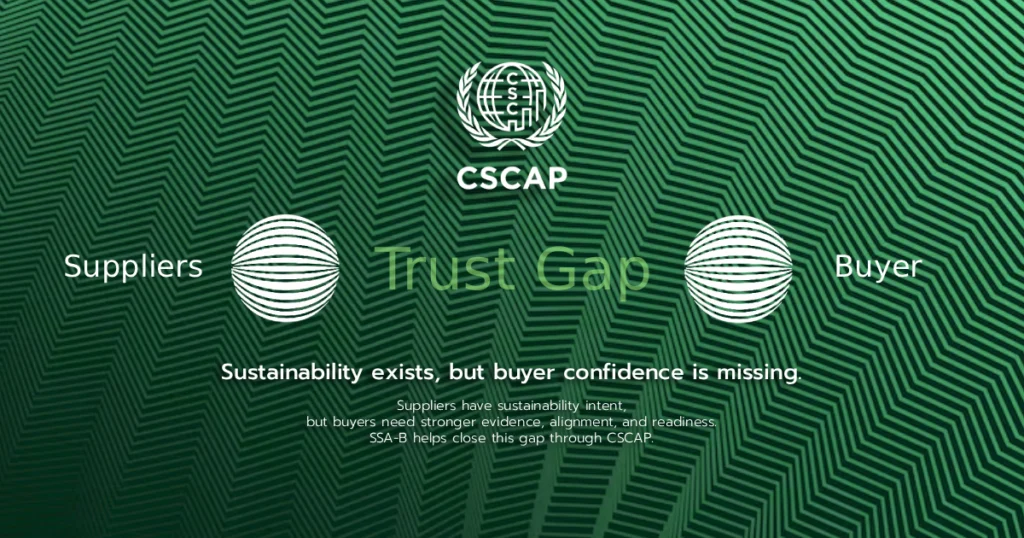
SSA-B functions as a voluntary market mechanism that helps close the Trust Gap between suppliers and buyers. Suppliers may have sustainability intentions or early-stage measures, but may not yet possess sufficient evidence, alignment, or standard readiness for buyers to rely upon. Buyers may be interested in sustainable sourcing, but may not be ready to accept supply-chain risk without credible information.
Through self-assessment, disclosure, alignment, evidence-building, buyer assurance, and annual performance review, SSA-B enables enterprises to enter the sustainable market pathway in a responsible and progressive manner. It allows organizations to begin from where they are, improve year by year, and move toward CS Standard readiness through the CSCAP Sustainable Market Standards Pathway.
In this sense, SSA-B is not merely an internal assessment tool. It is a market mechanism for sustainable supply-chain development, buyer confidence, and long-term competitiveness.
Issued by
Sustainism Initiative (STNSM)
SDG Custodian Support Mechanism under AFMA (FAO–UN ESCAP Intergovernmental Framework)