In this context, Sustainism (STNSM.org) is positioned as a Market Infrastructure Layer that bridges international policy frameworks with real-world market purchasing behavior, through mechanisms that are immediately applicable across supply chains.
Background and Rationale
Within the regional policy context of the United Nations Economic and Social Commission for Asia and the Pacific, the Asia–Pacific region is undergoing a critical transition toward a more sustainable and resilient economic model. This transition is central to the achievement of the United Nations Sustainable Development Goals (SDGs), particularly Goal 12 on Sustainable Consumption and Production (SCP).
Despite the existence of well-defined global frameworks, the operationalization of SCP within the private sector remains constrained by a set of structural challenges that limit effective implementation at scale. These challenges include:
- SME Readiness Gap: A significant proportion of enterprises, particularly small and medium-sized enterprises (SMEs), lack the technical capacity, strategic clarity, and resource allocation required to develop and implement sustainability-aligned business practices.
- Transparency and Data Gap: Insufficient availability of structured, verifiable, and decision-useful data across supply chains continues to hinder traceability, accountability, and comparability in sustainability performance.
- Policy–Implementation Gap: While sustainability policies and ESG frameworks are increasingly adopted at the national and international levels, their translation into actionable business processes—particularly in procurement and supply chain management—remains limited.
As a result, a critical disconnect persists between policy ambition and market behavior. In particular, the absence of effective market mechanisms has constrained the ability of businesses to:
- Translate sustainability commitments into structured and decision-ready data;
- Integrate such data into procurement and supply chain decision-making processes;
- Convert sustainability performance into tangible economic opportunities, including market access, competitiveness, and risk mitigation.
Addressing these gaps requires the development of system-level interventions that bridge policy frameworks with operational and market realities. In this context, artificial intelligence (AI) presents a significant opportunity to function as an enabling technology for sustainability transformation. By enhancing data processing capabilities, improving analytical accuracy, and reducing the cost and time associated with sustainability reporting, AI can facilitate the transition from fragmented information to integrated, decision-support systems.

System Integration
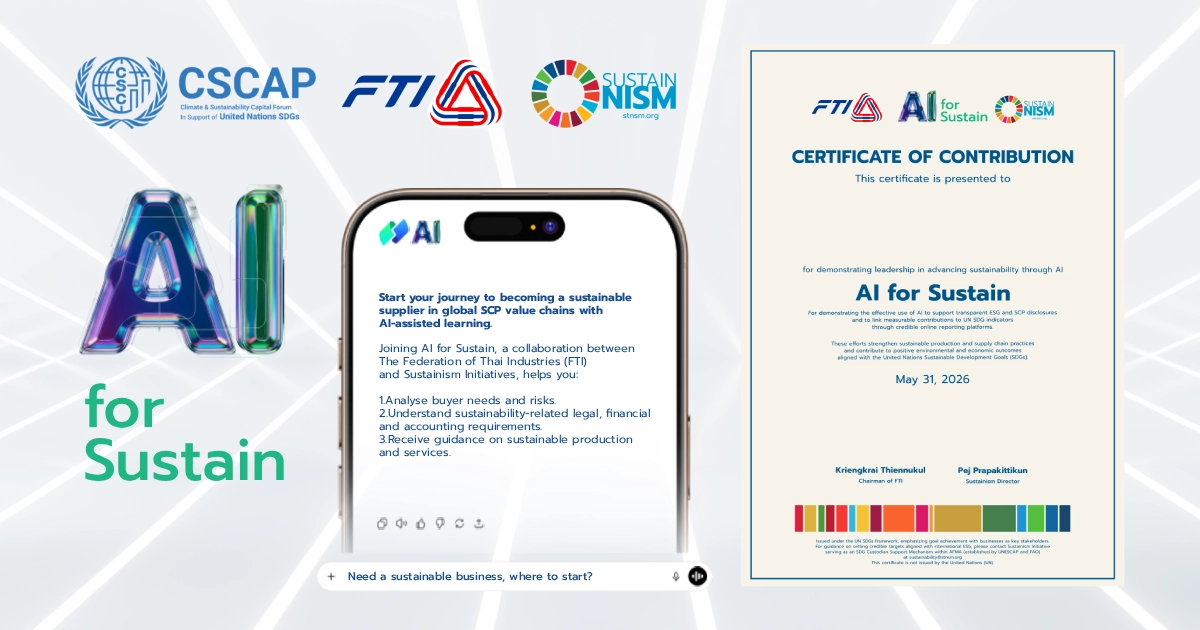
The AI for Sustain Initiative is therefore conceived as a system enabler designed to operationalize SCP within market structures. The initiative aims to bridge the gap between policy and practice by enabling enterprises to transform sustainability from a conceptual commitment into a measurable, data-driven, and market-relevant component of business operations.
In advancing the operationalization of Sustainable Consumption and Production (SCP), the AI for Sustain Initiative is designed to function in alignment with the Sustainability Services & Supply Chains Alliance (SSA) as part of a broader market-oriented ecosystem.
While AI for Sustain focuses on capacity building, data structuring, and policy development, SSA serves as a market-facing mechanism that enables the recognition and visibility of sustainability-aligned suppliers within supply chains.
The integration between the two mechanisms is structured as follows:
- AI for Sustain → Capability Development Layer
Supporting enterprises in developing SCP-aligned sustainability policies, structured disclosures, and AI-enabled data systems - SSA → Market Access and Recognition Layer
Providing a platform for suppliers to present sustainability-related information in a structured and decision-useful format for buyers
Through this linkage, sustainability is translated across three functional stages:
Sustainability → Data → Market Recognition
This integrated approach supports the transformation of sustainability from a compliance-oriented concept into a market-relevant attribute that can influence procurement decisions, enhance transparency, and improve access to sustainable supply chains.
Both AI for Sustain and SSA operate as complementary mechanisms that support SCP implementation, contributing to the development of data-driven, transparent, and inclusive market systems within the Asia–Pacific region.
Implementation Mechanism (Program Architecture)
The AI for Sustain Initiative is implemented through an integrated program architecture designed to translate sustainability frameworks into operational and market-ready business capabilities. The mechanism is structured across four core components:
Capacity Building
This component focuses on strengthening institutional and organizational capacity to understand and operationalize Sustainable Consumption and Production (SCP) within a market context. It includes:
- Knowledge transfer on SCP, ESG frameworks, and global sustainable trade dynamics
- Interpretation of buyer-driven requirements, including procurement standards, supply chain due diligence, and Scope 3 expectations
- Development of strategic understanding linking sustainability to market access, competitiveness, and risk mitigation
Data Structuring
This component addresses the need for structured, verifiable, and decision-useful sustainability data. It includes:
- Development of Sustainability Disclosure frameworks aligned with international standards
- Mapping against widely recognized references such as GRI Standards and ESG materiality frameworks
- Establishment of structured data systems that support traceability, comparability, and procurement decision-making
AI Integration
Artificial Intelligence is deployed as a system enabler to enhance efficiency, accuracy, and scalability of sustainability data management. This includes:
- AI-assisted ESG data processing and analysis
- Automation of sustainability reporting processes
- Reduction in time, cost, and human error
- Development of decision-ready data outputs that can be directly applied in procurement and supply chain contexts
Policy Development
This component supports participating organizations in developing SCP-aligned Sustainability Policies that are operationally relevant and market-oriented. It includes:
- Guided development of organization-level sustainability policies
- Alignment with supply chain requirements and buyer expectations
- Integration of sustainability policy into business operations and procurement positioning
Governance and Partnerships
The implementation of the AI for Sustain Initiative is anchored in a multi-stakeholder partnership model, reflecting the principle that systemic transformation toward Sustainable Consumption and Production (SCP) requires coordinated action across industry, policy, finance, and supply chain actors.
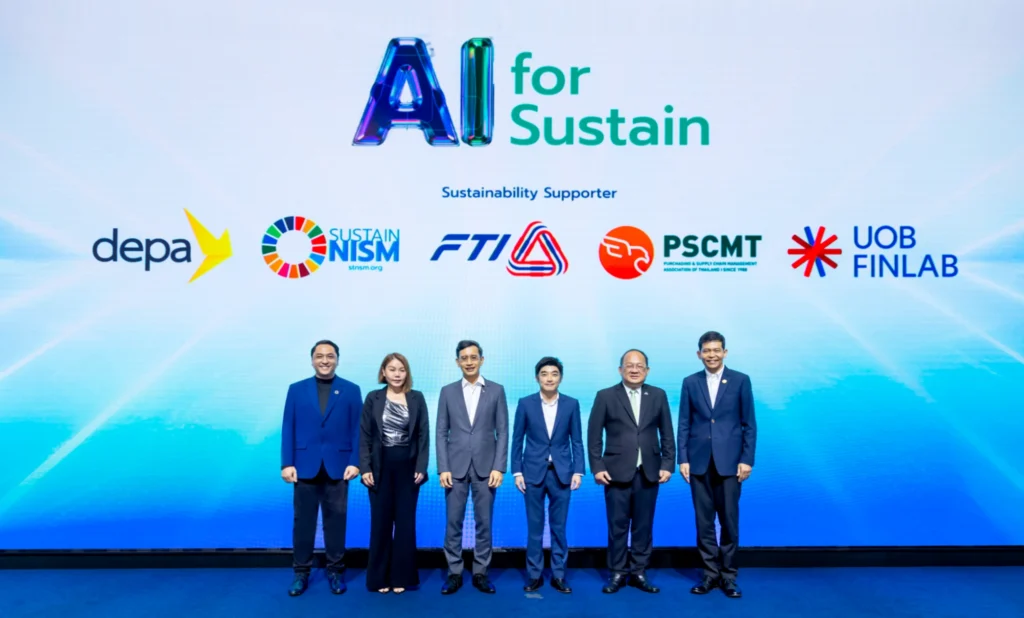
The initiative is carried out in collaboration with:
- Federation of Thai Industries
- Digital Economy Promotion Agency
- Procurement and Supply Chain Management Association of Thailand
- United Overseas Bank




Examples of businesses leveraging AI to support sustainability:
- Melmo integrates ground and satellite data using AI to measure and monitor carbon at the plot level with high precision
- Allied-Tek applies AI to detect machinery degradation, reduce waste, and optimize the use of alternative energy sources
- DinoQ utilizes AI to analyze production data and identify cybersecurity risks in real time



Within this governance structure, O2OESG serves as the Program Operator and Implementation Lead, responsible for the design, coordination, and execution of program activities, as well as ensuring alignment with SCP principles and market-oriented outcomes.
The 6 Executive Briefings (Applied AI Framework)
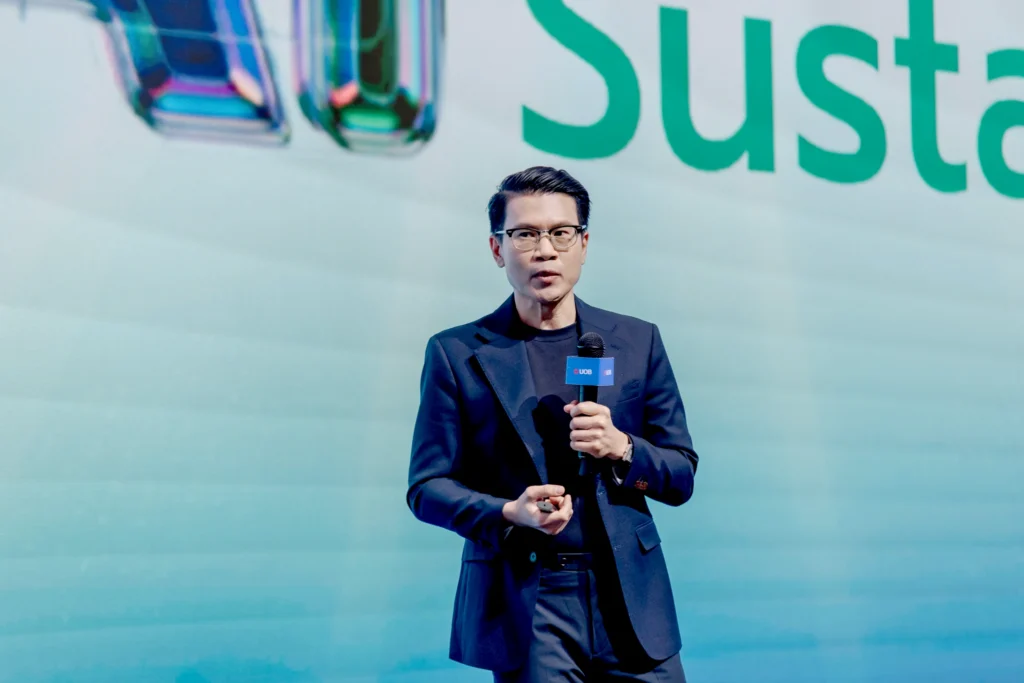
Delivered by Mr. Nattaphon Yongpaiboon, AI Director, O2OESG,
this executive-level module is designed to translate AI capabilities into measurable economic outcomes through sustainability-driven market strategies.
The six briefings include:
- AI Landscape
Understanding the competitive structure, technological trends, and adoption dynamics of AI - AI & ROI Prioritization
Identifying high-impact use cases that generate early financial returns - AI Workflow Transformation
Translating executive strategy into operational workflows across the organization - AI for Sustainability
Leveraging AI to reduce operational costs while enhancing data credibility and ESG performance - AI Visibility (AI-SEO)
Enhancing market visibility and discoverability through AI-enabled digital positioning - AI Agents and Autonomous Systems
Advancing toward AI-driven organizational models capable of automating complex workflows
Recognition Mechanism
The AI for Sustain Initiative adopts a non-certification, process-based recognition approach designed to incentivize participation while maintaining alignment with internationally accepted principles of voluntary disclosure and transparency.
Participating organizations that successfully develop and publicly declare a Sustainability Policy aligned with Sustainable Consumption and Production (SCP) will be awarded:
Certificate of Recognition: AI for Sustain Initiative
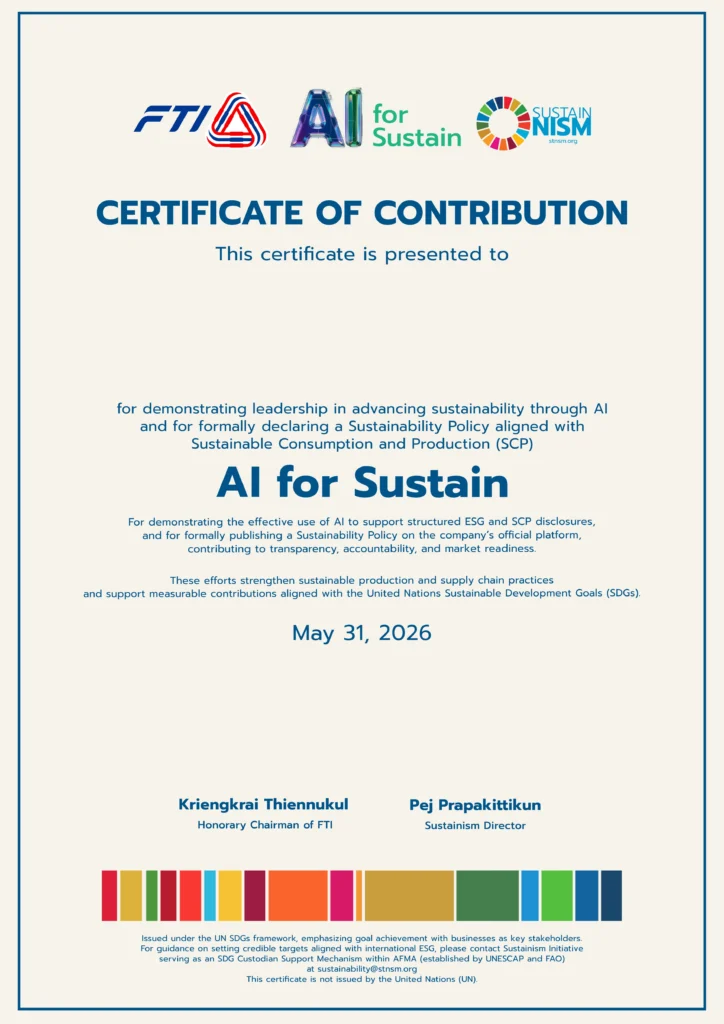
The names of recognized organizations will be formally recorded and published on this website.
Climate Action Integration
In alignment with SDG 13: Climate Action, the initiative incorporates a behavioral-level mechanism to encourage low-emission participation.
Participants who utilize electric rail transportation to attend program activities will be awarded an additional recognition:
Climate Action Supporter Recognition
This recognition reflects a measurable contribution to the reduction of greenhouse gas (GHG) emissions at the individual and organizational level, reinforcing the role of behavioral change as a complementary component of systemic climate action.
SDG Alignment
The AI for Sustain Initiative contributes to the following Sustainable Development Goals:
- SDG 12: Sustainable Consumption and Production
Through the development of sustainability policies and procurement-ready data within supply chains - SDG 13: Climate Action
Through the integration of low-emission behavioral practices and supply chain-related climate considerations - SDG 17: Partnerships for the Goals
Through a multi-stakeholder collaboration model involving industry, government, supply chain actors, and financial institutions
“The transition to a sustainable economy will not be achieved through commitments alone,
but through systems that translate sustainability into data, data into decisions, and decisions into market access.”
Contact at Sustainism Secretariat
Sustainism Initiatives
+66 8298 96869
secretariat@stnsm.org