Global Sustainable Demand-side Mechanism
Mandate
The CSCAP–SSB Initiative operates as a demand-side market alignment mechanism designed to strengthen Sustainable Consumption and Production (SCP) through procurement, sourcing, and supply-chain decisions.
The initiative functions through structured disclosure, supplier alignment, and process-based recognition to support transparency and traceability across supply chains.
It does not constitute certification, accreditation, or endorsement by the United Nations.

Role of Sustainable Procurement within CSCAP
Sustainable procurement is widely recognized as a critical lever for advancing Sustainable Consumption and Production (SCP) and for influencing the environmental and social performance of supply chains at scale.
Within the broader framework of the Climate & Sustainability Capital Forum (CSCAP), procurement functions as a demand-side market instrument that connects purchasing decisions with:
- supply-chain sustainability outcomes
- investment-relevant risk considerations
- supplier behavior and transparency
- market signaling and alignment
The Sustainable Sourcing & Buying Initiative (SSB) is implemented under CSCAP to encourage and recognize organizations that integrate environmental, social, and governance (ESG) considerations into procurement and sourcing practices.
By strengthening the role of buyers and procuring entities, SSB aims to:
- increase the share of procurement aligned with SCP principles
- support transparency and traceability across supply chains
- encourage supplier improvement through demand-side signals
- connect procurement practices with measurable sustainability outcomes
SSB operates as a process-based recognition mechanism informed by structured disclosure and documented procurement practices.
It acknowledges progress in aligning procurement with SCP and ESG considerations while supporting transparency and continuous improvement.
Participation in SSB does not imply certification, accreditation, or endorsement by the United Nations or any UN-affiliated entity.
SSB Recognition Methodology
Supplier Sustainability Integration Ratio (SSB Levels)
SSB recognition levels reflect the degree of integration of Sustainable Consumption and Production (SCP) within an organization’s procurement and supply-chain management.
Levels are determined through a process-based review of disclosed supplier information and represent the proportion of material suppliers assessed as sustainability-aligned.
Scope of Recognition
SSB recognition levels are assigned per product or per service.
Each certificate reflects the supply chain of a specific offering.
Organizations may hold multiple SSB levels across different products or services.
SSB recognition is not assigned at the organization-wide level unless explicitly stated.
Determining a Sustainability-Aligned Supplier
A supplier is considered sustainability-aligned when the company and the review panel mutually agree that the supplier provides sufficient disclosure and allows a reasonable level of traceability in relation to the material aspects of the product or service.
The determination is based on two core principles:
1. Disclosure
Suppliers should provide non-confidential information sufficient to understand origin, production processes, and relevant environmental and social considerations, including:
- type and source of raw materials
- key production processes
- logistics and transport arrangements
- packaging materials and components
- environmental and social policies or practices (where available)
Disclosure Requirement
All recognized entities shall disclose non-confidential supply-chain information on stnsm.org sufficient to demonstrate material supplier transparency and traceability.
2. Traceability
Disclosed information should be traceable at an appropriate level, meaning:
- supporting documents or references exist
- sources or producers can be identified
- disclosures are consistent with actual operations
- the supply-chain pathway of material components can be reasonably explained
Elements Considered (as applicable)
Raw Materials and Inputs
Origin, sourcing practices, and traceability of key materials.
Manufacturing
Basic visibility into production processes and management of environmental and social risks.
Logistics
Identifiable and reasonably verifiable transport pathways.
Packaging
Packaging may be considered sustainability-aligned where:
- material composition is disclosed
- supplier/source can be identified
- recyclability or reduction measures are indicated
- disclosures can be reasonably verified
Core Principle
A supplier is considered sustainability-aligned not solely on environmental claims, but on:
Disclosure + Traceability
This determination reflects a process-based assessment of disclosed practices and supply-chain transparency. It does not constitute certification, audit verification, or endorsement by the United Nations.
Calculation Method
SSB Ratio (%)=Total number of material suppliersNumber of sustainability-aligned material suppliers×100
The resulting percentage determines the recognition level.
SSB Recognition Levels
| Level | Color | Integration Range | Meaning |
|---|---|---|---|
| SSB01 | Blue | ≥1% | Policy Commitment |
| SSB10 | Dark Blue | ≥10% | Entry integration |
| SSB20 | Bronze | ≥20% | Early adoption |
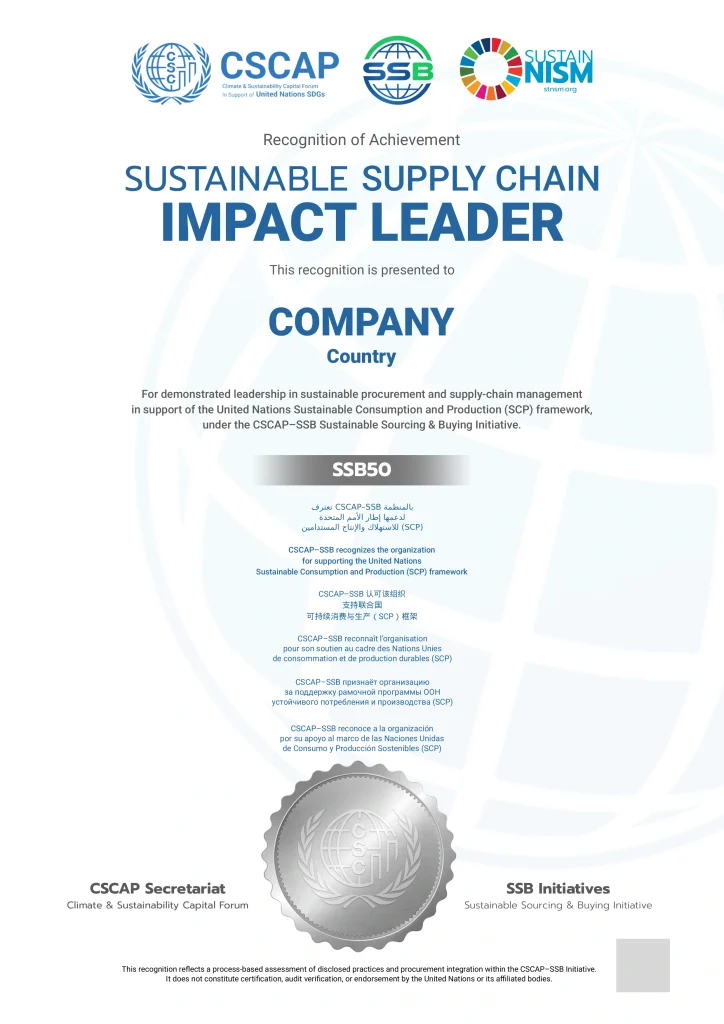
| SSB50 | Silver | ≥50% | Core integration |
| SSB80 | Gold | ≥80% | Advanced |
| SSB100 | Green | ~100% | Full alignment |
Interpretation
- One certificate corresponds to one product or one service
- Calculation is based on material suppliers relevant to that product or service
- Different products may hold different SSB levels
- No overall organizational level is assigned unless explicitly stated
- For all SSB levels, at least one supplier included in the calculation must be an SSA-aligned supplier actively supplying goods or services
SSB functions as the procurement-side mechanism within CSCAP, complementing the SSA supplier framework.
Review Process
- Organization submits structured supplier disclosure
- Material suppliers identified and agreed upon
- Review panel evaluates documentation
- Percentage calculated
- SSB level assigned
- Recognition issued under the CSCAP–SSB framework
Within CSCAP, sustainable procurement under SSB serves as an operational mechanism to translate SCP principles into market practice by leveraging purchasing decisions to influence supply-chain behavior, transparency, and alignment.
Disclaimer
Recognition reflects disclosed practices and review panel consensus. It does not constitute certification, audit verification, or endorsement by the United Nations or its affiliated entities.
Contact at Sustainism Secretariat
Sustainism Initiatives
Ms. Kaninchita Wonganawat
Assistant Director of the Secretariat
+66 8298 96869
secretariat@stnsm.org