


Official Recognition of Grandy Intertrade Co., Ltd. as a Sustainable Supplier under the CSCAP–SSA Framework 2025-2026
Dimension 1: Policy
Introduction
This document serves as a reference for sustainability-oriented purchasers to acknowledge Grandy (Eco Supreme)’s verified contributions and to integrate these impacts into their SSA “Impact Note” procurement disclosures and ESG reports. Where a purchasing activity demonstrates significant advancement of the UN Sustainable Development Goals (SDGs), the buyer is encouraged to nominate itself as a “Sustainable Buyer” for CSCAP recognition in the annual sustainablity impact record.
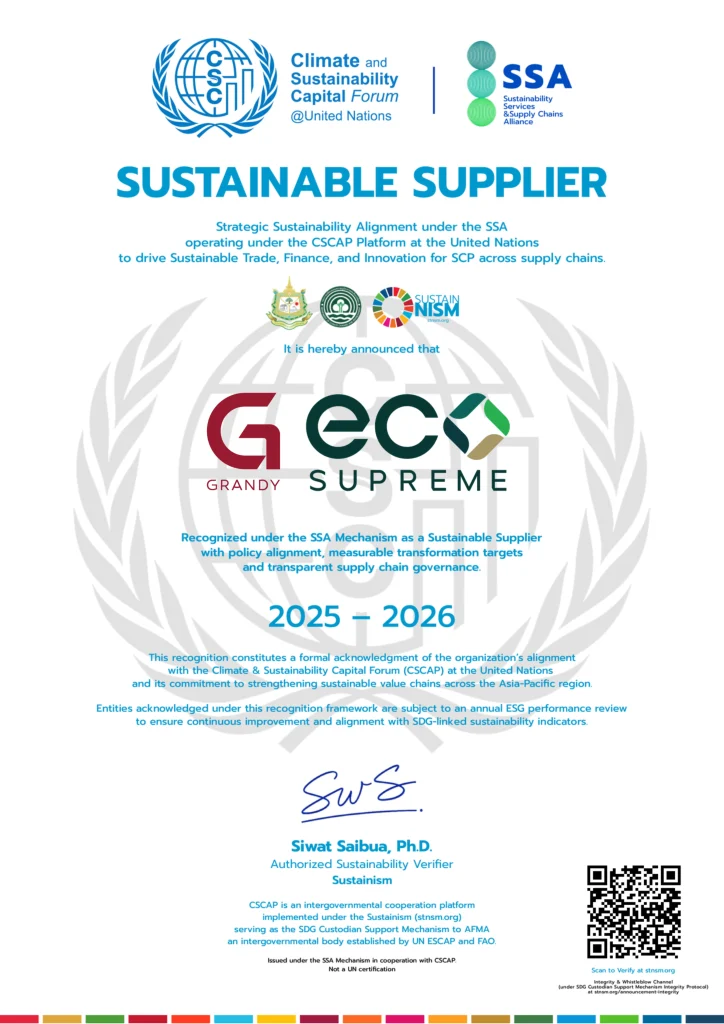

Grandy Intertrade Co., Ltd. – established over 45 years ago as a specialist in corporate uniforms and apparel – launched the Eco Supreme line as a new venture focused on eco-friendly clothing solutions. Grandy is recognized under the CSCAP–SSA framework (2025–2026) for contributing to sustainable supply chains through its innovative low-carbon products and circular textile practices. Eco Supreme’s mission, “A Better Tomorrow Starts Today,” reflects a commitment to drive sustainable growth through innovation, delivering high-quality apparel that minimizes environmental impact and supports a better world for future generations.
Company Sustainability Policy and Mission Statement
Eco Supreme reaffirms its commitment to responsible manufacturing in harmony with environmental stewardship across all operations. The company embraces circular economy principles – using recycled and waste-derived materials, reducing waste generation, and improving energy efficiency in production – to set new standards in sustainable textile production. Under the vision “Leading the way in eco-friendly clothing…to build a better tomorrow for our world,” Eco Supreme integrates sustainability at each stage of the product life cycle, from design and material sourcing to fabrication and end-of-life management. By adopting innovative materials and processes, Grandy strives to minimize its ecological footprint while maintaining product quality and performance. Transparent carbon footprint accounting and third-party product certifications are embedded in its strategy, ensuring alignment with international ESG reporting standards and reinforcing the credibility of its sustainability claims.
Eco Supreme’s core mission also emphasizes collaboration and inspiration: the company works to “inspire and support businesses and communities to make environmentally conscious choices, while building strong partnerships for collaborative growth and a better world for future generations.” In practice, this means Grandy not only produces low-impact products, but also actively shares knowledge and cooperates with stakeholders to amplify sustainable impact. These policies ensure that Grandy’s business growth goes hand-in-hand with environmental and social value creation, exemplifying leadership in Thailand’s green textile movement.
Dimension 2: Goals
Recognized Products and Services
Eco Supreme (a Grandy brand) delivers a portfolio of sustainable apparel products that achieve measurable environmental benefits. Grandy has become Thailand’s pioneer in carbon-footprint-certified clothing, being the first (and currently only) apparel company in the country to earn all three TGO carbon footprint labels for products. In 2024, Eco Supreme obtained a total of 9 carbon footprint certifications across 4 product models, covering the Carbon Footprint of Product (CFO), Carbon Footprint Reduction (CFR), and Carbon Footprint of Circular Economy (CFC) labels. These certifications, issued by the Thailand Greenhouse Gas Management Organization (TGO), validate the lifecycle greenhouse gas emissions of each product and confirm substantial emissions reduction and recycled content, making Eco Supreme’s offerings transparent and trustworthy for corporate ESG reporting needs.
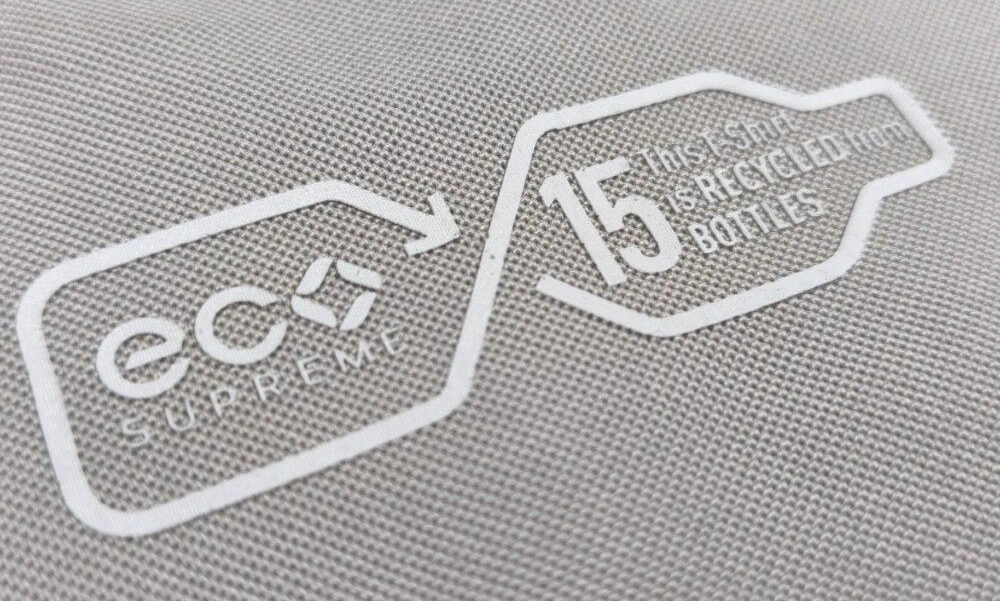
Eco Supreme’s apparel is designed following a “circular fashion” model. The products are manufactured using high percentages of recycled and upcycled materials – including recycled PET plastic bottles, reclaimed textile scraps, agricultural waste, and even repurposed ocean plastics – thereby significantly reducing reliance on virgin resources. For example, the fabric in Eco Supreme polo shirts and T-shirts is made from polyester yarn derived from recycled PET bottles and old garments, while trims and accessories incorporate innovative bio-based or recycled components. Notably, the company has developed unique eco-buttons crafted from coffee grounds, rice husk, and coconut shell, replacing conventional plastic buttons with bio-waste alternatives. These design choices not only divert waste from landfills but also give the products a distinctive sustainable identity. Additionally, Grandy’s production process uses sustainable techniques (such as a special screen-printing method using natural sand in lieu of harsh chemicals) to further reduce environmental impact. Every Eco Supreme garment is tagged with information about its recycled origins – using hang tags made from recycled plastic bottles or textile offcuts – to raise consumer awareness that the product is made from reclaimed materials.
| Product Name | Main Material | CO₂e Footprint (per unit, kg) | Baseline Shirt (kg CO₂e) | CO₂e Reduction (kg) | Reduction (%) |
|---|---|---|---|---|---|
| Polo Shirt – Neo Hybrid | Recycled Polyester + Mesh | 2.43 | 11.5 | 8.87 | 79% |
| Polo Shirt – Eco Mesh | Recycled Polyester | 2.42 | 11.5 | 8.88 | 79% |
| Polo Shirt – Eco Pique | Recycled Cotton + PET | 2.86 | 11.5 | 8.64 | 75% |
| Polo Shirt – Coolmax Version | Recycled PET Bottle Fiber | 2.94 | 11.5 | 8.56 | 74% |
| Polo Shirt – Textile ReGen: Pique | Upcycled Textile Yarn | 4.74 | 11.5 | 6.76 | 59% |
| T-Shirt – PET-TeraTex | Recycled PET | 1.69 | 8.3 | 6.61 | 80% |
| T-Shirt – Eco Pique | Recycled Cotton + PET | 2.29 | 8.3 | 6.01 | 72% |
| T-Shirt – Textile ReGen: Single Jersey | Upcycled Clothing + Circular Yarn | 1.33 | 8.3 | 6.97 | 84% |
CO₂e (Baseline) for polo shirts: 11.5 kgCO₂e
CO₂e (Baseline) for T-shirts: 8.3 kgCO₂e
Each Eco Supreme shirt emits far less CO₂ than conventional alternatives, as a direct outcome of these innovations. A standard cotton polo shirt typically has a cradle-to-grave carbon footprint around 11.5 kg CO₂e, whereas an Eco Supreme polo (made from recycled PET) has a verified footprint of only 2.94 kg CO₂e per shirt, representing an immediate 74% reduction in emissions. This reduction is achieved through material substitution (using recycled fibers that require far less energy and yield fewer emissions than virgin cotton or polyester) and process improvements (e.g. the garments do not require ironing, saving energy in the use phase). The Carbon Footprint Reduction label awarded to Eco Supreme products confirms these emissions savings against baseline products. Moreover, by upcycling plastic waste into apparel, each Eco Supreme shirt helps tackle the plastic pollution problem – effectively turning trash into textile. For instance, an estimated ~10–12 discarded PET bottles are given a second life in every shirt, eliminating that waste and the potential pollution it would cause. The use of reclaimed nylon from discarded fishing nets and even fibers from aquatic plants (like water hyacinth) in some products further extends the environmental benefits to protecting oceans and waterways.
In recognition of its sustainable product excellence, Eco Supreme was also awarded the Thailand Textiles Tag (through DIPROM, Ministry of Industry) – a certification guaranteeing high fabric quality, color durability, and chemical safety in production. This certification (which verifies that materials and processes meet strict standards and are 100% made in Thailand) underscores that Eco Supreme’s green products are not only eco-friendly but also safe and durable for consumers. Together, the multiple carbon labels and the Textiles Tag position Eco Supreme as a leading example of sustainable innovation in Thailand’s textile sector, offering B2B customers a proven way to reduce their Scope 3 carbon footprint and meet sustainable procurement goals. The brand’s sustainable uniforms and merchandise have already been adopted by leading organizations – including major corporations such as PTT, Banpu, and other leading organizations – as part of their sustainability initiatives, demonstrating strong market confidence in Grandy’s eco-friendly solutions.
Alignment with the Sustainable Development Goals (SDGs)
Through its products and practices, Grandy’s Eco Supreme aligns closely with several UN Sustainable Development Goals:
- SDG 8: Decent Work and Economic Growth. Eco Supreme supports SDG 8.5 by strengthening decent employment opportunities through its fully domestic production model and ethical business practices. All garments are made in Thailand under verified and audited conditions, supporting skilled jobs across the national textile supply chain. As a B2B supplier, Grandy maintains transparent procurement standards and ensures fair labor across its upstream and downstream partners. By sourcing agricultural by-products (e.g., rice husks, coconut shells) from local communities for use in eco-buttons and accessories, the company creates added value and income for rural suppliers. These practices reflect a commitment to sustainable economic growth that is inclusive, decent, and locally anchored.
- SDG 9: Industry, Innovation and Infrastructure. Eco Supreme exemplifies SDG 9.4 by integrating textile innovations into production systems that are resource-efficient and low-emission. The company has pioneered the use of recycled PET yarns blended with reclaimed textile fibers, agricultural residues, and even ocean plastics to develop breathable, durable, and climate-smart fabrics. Manufacturing techniques – such as chemical-free sand-based printing and zero-ironing garment designs – further optimize energy and water usage. These innovations demonstrate how industry modernization can reduce environmental impacts while increasing value creation, aligning with national sustainability goals and global industrial transformation objectives.
- SDG 12: Responsible Consumption and Production. By using recycled inputs and transforming waste into wearables, Eco Supreme directly supports SDG 12.5 (reducing waste generation through recycling and reuse). Each garment incorporates post-consumer plastics and other waste materials, which promotes circular resource use and prevents waste from ending up in landfills or incinerators. This approach conserves natural resources and lowers the environmental footprint of clothing production. It also contributes to SDG 12.6 by transparently reporting the products’ environmental impacts via official carbon footprint labels, encouraging broader adoption of sustainable practices in the industry.
- SDG 13: Climate Action. Eco Supreme contributes to climate change mitigation by significantly cutting GHG emissions per product. Using recycled polyester in place of virgin fibers can reduce energy use by ~79% and greenhouse gas emissions by ~70%. Grandy’s data confirm that its recycled PET polo shirts have ~74% lower carbon emissions than conventional shirts, directly advancing SDG 13.2 (integrating climate measures into production) and SDG 13.3 (improving awareness and capacity for climate mitigation). By quantifying and certifying these reductions, Grandy enables client organizations to credibly include the climate benefits in their own carbon accounting and Science-Based Targets.
- SDG 14: Life Below Water. Eco Supreme’s emphasis on repurposing plastic waste supports SDG 14.1, which aims to prevent and reduce marine pollution. The incorporation of recycled PET bottles and discarded fishing nets into fabrics means fewer plastics end up polluting oceans. Every batch of Eco Supreme products effectively removes ocean-bound plastic and puts it to productive use in clothing. Additionally, by eliminating single-use plastic components (for example, using natural-material buttons and recycled packaging), Grandy’s approach helps reduce the flow of new plastic into marine ecosystems. These efforts align with protecting aquatic environments and marine life from debris and microplastic contamination.
Quantitative and Qualitative Impact Outcomes (Eco Supreme)
| SDG Goal | Target | Indicator | Relevance to Eco Supreme | Measured / Estimated Impact |
|---|---|---|---|---|
| SDG 8: Decent Work and Economic Growth | 8.5 – Achieve full and productive employment and decent work for all | 8.5.1 – Employment by economic activity and value-added contribution | Supports domestic production and transparent B2B operations; promotes decent work in Thai textile sector | Local employment secured; ethical sourcing and rural supplier inclusion (e.g. for bio-waste buttons) |
| SDG 9: Industry, Innovation and Infrastructure | 9.4 – Upgrade infrastructure and retrofit industries to make them sustainable | 9.4.1 – CO₂ emissions per unit of value added, resource efficiency improvements | Introduces textile innovation using recycled PET + textile waste; adopts low-impact production processes | Sand-based printing, no-ironing designs, and high-performance fabrics from recycled inputs |
| SDG 12: Responsible Consumption & Production | 12.5 – Reduce waste through prevention, reduction, recycling, reuse | 12.5.1 – Recycling rate, tons of recycled material | Uses 100% recycled/waste-derived materials (e.g. PET bottles, textile waste); reduces need for virgin fibers | ~0.25 kg plastic diverted per shirt (~10–12 bottles); 250 kg per 1,000 shirts |
| SDG 13: Climate Action | 13.2 – Integrate climate action into planning & processes | 13.2.1 – GHG emissions reduction, CO₂e tracking | Products certified for reduced carbon footprint (TGO); supports Scope 3 disclosure for buyers | ~8.5 kg CO₂e avoided per shirt; ~74–84% emissions reduction |
| SDG 14: Life Below Water | 14.1 – Reduce marine pollution from land-based plastics | 14.1.1 – Plastic debris density index | Reuses ocean-bound plastics & nylon nets; avoids plastic tags/buttons | Zero plastic added per shirt; several kg ocean plastic repurposed per batch |
(Reference: All data above are derived from Grandy’s 2024 product assessments and third-party certifications. Assumptions include average conventional shirt impacts and typical material weights; sources include TGO assessments and industry averages.)
Dimension 3: Sustainability Delivery Process
Operational and Sustainability Implementation Process
Grandy has embedded sustainability deep into its operations, ensuring that eco-friendly practices are carried out from material sourcing to product delivery. Key elements of Eco Supreme’s sustainability implementation include:
- Upcycling Agricultural and Natural Waste: Innovative use of organic waste in product components – for example, buttons made from coffee grounds, rice husks, and coconut shells – adds unique eco-character to the garments while reducing plastic use. Even accessory items like hangers are being developed from recycled materials (e.g. oyster shells and even elephant-dung paper) to replace traditional plastics, reflecting a zero-waste design mindset.
- Eco-Friendly Printing and Production Techniques: Traditional textile printing can involve toxic chemicals, so Grandy has developed a more sustainable screen-printing process that uses natural sand as a primary medium instead of chemical plastisol inks. This innovation reduces hazardous waste and exposure, exemplifying how manufacturing processes are rethought for environmental safety. Additionally, the production lines prioritize energy efficiency and water conservation (for instance, by optimizing dyeing processes), further shrinking the environmental footprint of each item produced.
- Consumer Awareness and Transparent Communication: To broaden the impact, every Eco Supreme product carries a story of sustainability. Recycled-material hang tags – made from things like reclaimed plastic bottles or textile off-cuts – are attached to each garment, clearly informing the buyer that the item is made from recycled resources. This messaging raises awareness among end-users and promotes environmentally conscious behavior. The tag also often details the carbon footprint of the product or the number of bottles recycled, translating abstract sustainability data into an understandable message for consumers and corporate buyers alike.
- Extending Impact through Partnerships: Grandy actively shares its low-carbon practices with partner organizations and networks, encouraging others to adopt similar greenhouse-gas reduction strategies. For example, it collaborates with business clients to design uniforms that meet their sustainability targets, and it advises suppliers on using recycled materials. By integrating its approach into partners’ operations (such as encouraging other companies to source recycled fabrics or adopt carbon accounting), Grandy helps scale up climate action beyond its own supply chain. This cooperative approach helps its clients and industry peers collectively move toward sustainable, low-carbon business models.
- Community Engagement and Knowledge Transfer: Eco Supreme is not only a product line but also a platform for education and advocacy. The company invests in training programs, workshops, and forums to transfer knowledge to local communities and other industries about carbon reduction, recycling, and sustainable production. Grandy’s experts have participated in or hosted seminars for textile industry groups and educational institutions, sharing best practices on producing low-carbon clothing. By doing so, the company contributes to building broader capacity for sustainability and inspires a new generation of eco-conscious entrepreneurs and consumers. This focus on continuous improvement and collective learning ensures that Grandy stays at the forefront of sustainable innovation while bringing others along on the journey.
Through the above initiatives, Grandy has operationalized sustainability not as a one-time project but as an ongoing process of innovation and improvement. The company continuously monitors key performance metrics (e.g. energy per garment, water use, waste recycling rate) and seeks new ways to improve. Importantly, Grandy’s sustainability strategy is supported at the executive level, ensuring that adequate resources, training, and internal policies are in place to meet its environmental objectives. Regular internal reviews and stakeholder feedback loops are used to refine processes, keeping Eco Supreme agile and effective in delivering on its green promises.
ESG Relevance and Supply Chain Integration
Grandy’s approach to sustainability is closely aligned with broader ESG (Environmental, Social, Governance) criteria and is designed to integrate seamlessly into customers’ sustainable supply chains. Several aspects highlight this alignment:
- Carbon Accounting and Transparency: All Eco Supreme products come with quantified carbon footprint data certified by TGO, which means that organizations purchasing these products can easily account for the associated emissions reductions in their Scope 3 (supply chain) inventories. This is highly relevant for companies working toward science-based climate targets or facing carbon-related regulations. In particular, Grandy’s solution helps exporters prepare for policies like the EU’s Carbon Border Adjustment Mechanism (CBAM) by providing low-carbon inputs (uniforms/merchandise) that reduce the overall carbon intensity of their operations. The availability of verified emissions data simplifies integration into corporate ESG reporting frameworks (e.g. GRI, CDP), as the impact is pre-validated and traceable.
- Supply Chain Localization and Traceability: Grandy’s production is entirely domestic (Thailand-based) and has attained the Thailand Textiles Tag certification, which attests to both quality and responsible production (including verification that materials and processes meet standards and are “Made in Thailand”). This localization has two ESG benefits: it supports local economies and decent work (social dimension) and it provides traceability and supply chain transparency (governance dimension). Clients can be assured that the uniforms are produced under regulated conditions and without harmful chemicals, aligning with their own responsible sourcing policies. Supply chain integration is further enhanced by Grandy’s willingness to undergo third-party audits and certifications, ensuring that ESG criteria are met at each step of the product’s journey.
- Multi-Stakeholder Collaboration: Grandy actively works with government and industry bodies to stay aligned with the latest sustainability guidelines and to contribute to policy objectives. For example, through the collaboration with OSMEP and DIPROM, Grandy not only improved its own operations but also fed into national-level sustainability programs for SMEs. This means that when a purchaser engages with Grandy, they are indirectly supporting these wider initiatives and benefiting from a supplier that is in sync with government sustainability agendas. Grandy also participates in forums and alliances (like Sustainism’s SSA platform) where it shares data and progress openly, exemplifying good ESG governance through transparency and stakeholder engagement.
- Continuous Improvement Commitments: Sustainability at Grandy is treated as an evolving process with concrete future targets. The company has publicly stated goals to expand its certified product range – for instance, aiming to secure 10 additional carbon footprint labels for new or existing products in 2025. This forward-looking commitment signals to purchasers that Grandy will continue to deliver improvements (such as lower emissions, more recycled content, or better resource efficiency) over time. In ESG terms, this demonstrates a robust management approach and long-term vision, which purchasers can count on for ongoing supply chain sustainability. Grandy’s progress is documented through updates (e.g., new certifications, awards) which can be followed and verified by stakeholders annually.
- Social and Ethical Practices: Although primarily highlighted for its environmental impact, Grandy’s Eco Supreme also adheres to social and ethical standards that are integral to ESG. The company ensures fair labor practices in its factories and engages local communities for certain material sourcing (for example, obtaining agricultural by-products for buttons from farming communities, providing them additional income). These efforts, while less quantifiable, are part of the ESG relevance as they contribute to SDGs on decent work and community development. For purchasers with a keen eye on ESG, Grandy’s holistic approach (covering environmental impact, product safety, and social responsibility) makes it a well-rounded sustainable supplier.
In summary, Grandy (Eco Supreme) functions not just as a vendor of eco-friendly products, but as an integrated sustainability partner. Its certifications and data facilitate easy incorporation of its products into any buyer’s sustainability strategy; its local, transparent supply chain adds credibility; and its continuous improvement ethos ensures that the partnership will yield increasing ESG value over time.
for Buyers
Purchaser Impact Note Process (4 Steps)
Add a clear four-step process to guide purchasers on how to request their Impact Note, including contact and reference details:
- Purchase
Complete your purchase of Grandy Intertrade Co., Ltd. or related services through an authorized distributor. - Submit Proof
After receiving goods or services in full, send the required documents to impactnote@stnsm.org. - Review and Record
The CSCAP–SSA Secretariat reviews all submitted information for completeness and records the purchase in the SSA Registry. - Receive Impact Note
The purchaser receives a unique Impact Note ID (e.g. SSA-IN-2025-XXXX), confirming that the transaction has been officially documented within the CSCAP–SSA system.
Purchaser Submission Requirements
Include a concise table summarizing the documents required for submission:
| Item | Details Required |
|---|---|
| Purchase invoice or receipt | Show product quantity and date of purchase |
| Delivery confirmation | Proof of goods or service completion (delivery note or photo) |
| Purchaser contact information | Full name, position, phone number, and e-mail address of the purchaser |
Claimable Outcomes (Organized by ESG Materiality Themes)
Reorganize the quantitative impact data into five ESG material themes for easier disclosure alignment with major sustainability frameworks:
| Material Theme | Impact Description | Estimated Outcome | Relevant SDGs |
|---|---|---|---|
| Climate Change & Emissions | Certified carbon footprint reduction enables Scope 3 disclosures; supports CBAM/Net Zero alignment | ~74–84% CO₂e reduction per product; ~8.5 kg CO₂e avoided per shirt | SDG 13, SDG 12.6, SDG 9.4 |
| Circular Economy & Resource Use | Uses 100% recycled/upcycled materials in core products; avoids virgin resource extraction | ~0.25 kg recycled content per item (~10–12 bottles); 100% recycled textile fiber | SDG 12.2 |
| Waste & Marine Pollution | Removes ocean-bound plastic (e.g. fishing nets); avoids single-use plastic in trims and packaging | 0 plastic packaging; several kg ocean plastic reused per production batch | SDG 14.1, SDG 12.5 |
Impact Note Claim Period
Impact Notes may be requested and recorded within 30 days from the date the purchaser has received the goods or services in full. Submissions received after this period may be reviewed in the following reporting cycle under the CSCAP–SSA Mechanism.
Important Disclaimer
This document is issued under the SDG Custodian Support Mechanism for the purpose of sustainability reference and transparency. It does not constitute an official endorsement or certification by the United Nations (UN).
The information contained herein is based on data publicly disclosed by the company and has not been independently verified or certified by Sustainism. Accordingly, it carries no legal effect or binding recognition under any formal certification system.
Any concerns regarding inaccuracies, misrepresentation, or conduct that may constitute SDG or Greenwashing violations should be reported confidentially via: whistleblower@stnsm.org
Contact at Sustainism Secretariat
Sustainism Initiatives
Ms. Kaninchita Wonganawat
Assistant Director of the Secretariat
+66 8298 96869
secretariat@stnsm.org


