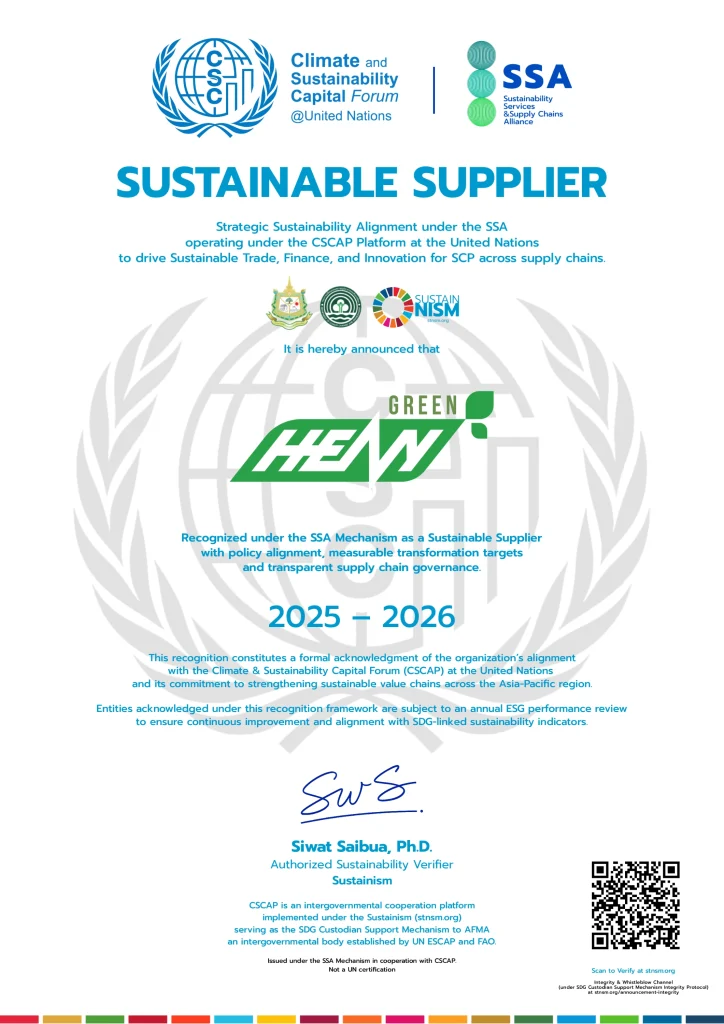
Official Recognition of Heavy Organizer Co., Ltd. as a Sustainable Supplier under the CSCAP–SSA Framework 2025-2026
Dimension 1: Policy
Introduction
Heavy Green is formally recognized under the CSCAP–SSA Framework (2025–2026) as a sustainability-driven music festival organizer operating in forest-adjacent community environments.
Heavy Green specializes exclusively in organizing music festivals with attendance ranging from 1,000 to 5,000 participants, located within community-managed forest areas surrounded by natural forest ecosystems.
The company operates under a strict Non-Encroachment Policy, which ensures:
- No deforestation
- No permanent land conversion
- No removal of native trees
- No ecosystem disturbance
- Full post-event site recovery
All environmental performance metrics are standardized and calculated per 1,000 participants to ensure transparency, comparability, and alignment with international ESG and SDG reporting standards.
Heavy Green is committed to demonstrating that large-scale music festivals can operate within forest-adjacent areas without ecological degradation.

Company Sustainability Policy and Mission Statement
Heavy Green operates under the vision:
“Culture in Harmony with Nature.”
The organization is committed to becoming a leading sustainable festival organizer in forest environments, integrating environmental protection, circular economy principles, and climate responsibility into every stage of event production.
Heavy Green’s sustainability model prioritizes:
Circular Resource Use (SDG 12)
- 100% temporary and removable infrastructure
- 90% reusable materials
- Elimination of single-use plastics
- On-site waste segregation systems
- Direct partnerships with certified recycling operators
All waste generated during festivals is sorted, documented, and transferred to recycling facilities. No waste is left on-site.
Energy and Emissions Management (SDG 13)
- Renewable energy prioritization where feasible
- Energy tracking and documentation
- Carbon footprint calculation aligned with GHG Protocol
- Emission reduction planning per event
Heavy Green integrates climate measures directly into operational planning.
Biodiversity Protection and Restoration (SDG 15)
- Zero forest encroachment
- No land conversion
- Temporary modular installations
- Soil and vegetation inspection post-event
- Restoration support where necessary
Every event is designed to ensure the surrounding forest ecosystem remains intact.
Sustainable Sponsor Integration
Heavy Green actively partners with sustainability-oriented brands whose products align with environmental responsibility, circular economy, and low-carbon production.
The festival platform serves as:
- A sustainability showcase for ESG-aligned brands
- A marketing ecosystem driven by measurable environmental outcomes
- A data-backed ESG engagement opportunity
This positioning ensures that brands seeking credible sustainability alignment actively pursue partnership with Heavy Green.
Dimension 2: Goals
Recognized Products and Services
Heavy Green is recognized for organizing:
- Zero-waste forest-adjacent music festivals
- Low-carbon outdoor concerts
- Circular economy-based event operations
- Community-based sustainable cultural events
Each festival integrates structured waste recovery systems and ecological safeguards.
Alignment with the Sustainable Development Goals (SDGs)
SDG 12 – Responsible Consumption and Production
Heavy Green contributes to:
- Target 12.5 – Reduce waste generation
- Indicator 12.5.1 – Recycling rate
Per 1,000 participants:
- ≈ 3,000 kg total waste baseline
- ≈ 90% diversion rate
- ≈ 1,000 kg diverted from landfill
- ≈ 20,000 plastic items avoided
Waste is transferred to recycling operators and documented.
SDG 13 – Climate Action
Heavy Green contributes to:
- Target 13.2 – Climate integration in planning
- Indicator 13.2.1 – GHG reduction alignment
Per 1,000 participants:
- ≈ 10 tCO₂e avoided through energy efficiency and operational optimization
SDG 15 – Life on Land
Heavy Green contributes to:
- Target 15.1 – Conservation of terrestrial ecosystems
- Indicator 15.1.1 – Forest area protected
Per 1,000 participants:
- 0 forest encroachment
- 0 tree removal
- 0 land conversion
- 0.4 ha ecological monitoring zone maintained
Quantitative and Qualitative Impact Outcomes (Key Performance Indicators – adjusted per 1,000 participants)
| SDG Goal | Target | Indicator | Relevance to Heavy Green | Measured / Estimated Impact (per 1,000 participants) |
|---|---|---|---|---|
| SDG 12 – Responsible Consumption and Production | 12.5 – Substantially reduce waste generation through prevention, reduction, recycling, and reuse | 12.5.1 – National recycling rate, tons of material recycled | Zero-waste music festival operations with structured waste segregation, on-site sorting, and certified recycling transfer in forest-adjacent areas | ≈ 1 ton of waste diverted from landfill (90% diversion rate from 3,000 kg baseline) |
| SDG 12 – Responsible Consumption and Production | 12.2 – Achieve sustainable management and efficient use of natural resources | 12.2.1 – Material footprint per capita | 90% reusable temporary infrastructure; elimination of single-use plastics; refill water systems | ≈ 20,000 single-use plastic items avoided |
| SDG 13 – Climate Action | 13.2 – Integrate climate change measures into policies and planning | 13.2.1 – GHG emissions aligned with climate strategy | Carbon-accounted event model aligned with GHG Protocol; renewable energy prioritization; optimized logistics | ≈ 10 tCO₂e avoided |
| SDG 15 – Life on Land | 15.1 – Ensure conservation of terrestrial ecosystems | 15.1.1 – Forest area as a proportion of total land area | Non-encroachment policy in community forest zones; temporary removable infrastructure | 0 forest loss / 0 tree removal |
| SDG 15 – Life on Land | 15.3 – Combat land degradation | 15.3.1 – Proportion of land degraded over total land area | Post-event site recovery, soil inspection, ecological monitoring | ≈ 0.4 hectares ecological protection zone maintained |
Supporting Assumptions (Per 1,000 Participants)
- Baseline waste generation: 3 kg/person
- Total baseline waste: 3,000 kg
- Diversion rate: ≈ 90%
- Landfill reduction: ≈ 1,000 kg
- Forest encroachment: 0%
- Event size range: 1,000–5,000 participants
Dimension 3: Sustainability Delivery Process
Operational and Sustainability Implementation Process
Heavy Green applies a structured five-phase sustainability protocol:
Phase 1 – Ecological Site Verification
Pre-event ecological assessment confirms non-encroachment and forest boundary integrity.
Phase 2 – Circular Infrastructure Setup
Temporary modular structures designed for complete removal and reuse.
Phase 3 – Zero-Waste Operations
- Segregation stations (organic, recyclable, residual)
- Waste ambassadors
- On-site monitoring
- Data logging per waste category
Phase 4 – Carbon Monitoring
- Energy usage documentation
- Transport route optimization
- Emission calculations
Phase 5 – Post-Event Recovery
- 100% waste removal
- Soil and vegetation inspection
- Ecological validation
This process operationalizes SDG 12, 13, and 15 in measurable form.
ESG Relevance and Supply Chain Integration
Heavy Green integrates ESG principles across its sponsor and supplier ecosystem:
- Sustainable product sponsors prioritized
- Plastic-free vendor clauses
- Local sourcing ≥30%
- Waste contractor certification
- Transparent impact disclosure
The Heavy Green model creates a sustainability-driven festival platform where:
- Brands benefit from measurable ESG outcomes
- Sponsors gain verified sustainability data
- Buyers receive documented impact alignment
This ecosystem strengthens SDG 12 (circular economy), SDG 13 (climate integration), and SDG 15 (forest protection).
Dimension 4: for Buyer
Purchaser Impact Note Process (4 Steps)
A clear four-step process guides purchasers on how to request their Impact Note, including contact and reference details:
- Purchase
Complete your purchase of Heavy Green–recognized event services or related packages through an authorized partner or contracting channel. - Submit Proof
After receiving goods or services in full, send the required documents to: impactnote@stnsm.org. - Review and Record
The CSCAP–SSA Secretariat reviews all submitted information for completeness and records the purchase in the Sustainism Registry. - Receive Impact Note
The purchaser receives a unique Impact Note ID (e.g. SSA-IN-2025-XXXX), confirming that the transaction has been officially documented within the CSCAP–SSA system.
Purchaser Submission Requirements
Include a concise table summarizing the documents required for submission:
| Item | Details Required |
|---|---|
| Purchase invoice or receipt | Show product quantity and date of purchase |
| Delivery confirmation | Proof of goods or service completion (delivery note or photo) |
| Purchaser contact information | Full name, position, phone number, and e-mail address of the purchaser |
Claimable Outcomes (Organized by ESG Materiality Themes)
Reorganize the quantitative impact data into five ESG material themes for easier disclosure alignment with major sustainability frameworks:
| Material Theme (FTSE-aligned) | Impact Description (Sponsor-Relevant) | Estimated Outcome (per 1,000 participants) | Relevant SDGs / Indicators |
|---|---|---|---|
| Pollution & Resources | Zero-waste music festival operations with structured waste segregation, on-site sorting, and certified recycling transfer in forest-adjacent areas. Sponsors align with measurable circular economy performance. | ≈ 1 ton of waste diverted from landfill (90% diversion from 3,000 kg baseline) | SDG 12.5.1 |
| Pollution & Resources | 90% reusable temporary infrastructure; elimination of single-use plastics; refill water systems integrated into event design. | ≈ 20,000 single-use plastic items avoided | SDG 12.2.1 |
| Climate Change | Carbon-accounted event model aligned with GHG Protocol; renewable energy prioritization and optimized logistics planning. | ≈ 10 tCO₂e avoided | SDG 13.2.1 |
| Biodiversity | Non-encroachment policy in community forest zones; temporary removable infrastructure ensuring no ecosystem disturbance. | 0 forest loss / 0 tree removal | SDG 15.1.1 |
| Biodiversity | Post-event site recovery, soil inspection, and ecological monitoring integrated into event protocol. | ≈ 0.4 hectares ecological protection zone maintained | SDG 15.3.1 |
Impact Note Claim Period
Impact Notes may be requested and recorded within 30 days from the date the purchaser has received the goods or services in full. Submissions received after this period may be reviewed in the following reporting cycle under the CSCAP–SSA Mechanism.
Important Disclaimer
This document is issued under the SDG Custodian Support Mechanism for the purpose of sustainability reference and transparency. It does not constitute an official endorsement or certification by the United Nations (UN).
The information contained herein is based on data publicly disclosed by the company and has not been independently verified or certified by Sustainism. Accordingly, it carries no legal effect or binding recognition under any formal certification system.
Any concerns regarding inaccuracies, misrepresentation, or conduct that may constitute SDG or Greenwashing violations should be reported confidentially via: whistleblower@stnsm.org
Contact at Sustainism Secretariat
Sustainism Initiatives
Ms. Kaninchita Wonganawat
Assistant Director of the Secretariat
+66 8298 96869
secretariat@stnsm.org