
Sustainability Supply Alliance for Responsible Buyer Mechanism for Sustainable Consumption and Production
Introduction

On 27 October 2025, the SSAB for SCP — Sustainability Supply Alliance for Responsible Buyer Mechanism for Sustainable Consumption and Production was formally introduced at the CSCAP forum held at the United Nations Conference Centre, Bangkok, as a voluntary mechanism to support the progressive transition of businesses towards more responsible production, procurement and supply chains. Its broader purpose is to help connect sustainability performance with market participation, responsible procurement, business opportunity and improved readiness for finance and investment.
SSAB for SCP was developed in response to a practical challenge confronting many businesses, particularly SMEs, small-scale producers, cooperatives and enterprises operating within supply chains. In many cases, these enterprises do not lack commitment to sustainability. Rather, a gap remains between what they are already doing and what buyers, investors, financial institutions and sustainability frameworks increasingly require in the form of policies, due diligence processes, data, evidence, traceability and credible, demonstrable outcomes.



At the same time, buyers and large corporations worldwide are increasingly seeking information relating to ESG performance, supply-chain due diligence, climate change, human rights, labour standards, governance, traceability and responsible procurement. These expectations are progressively transmitted through supply chains to producers, suppliers and business partners in different countries, including across Asia and the Pacific. Enterprises that are unable to organise and present the necessary information and evidence may therefore face increasing barriers to market participation, even where their products, quality and production capabilities remain competitive.
SSAB for SCP was therefore not developed as a new sustainability standard, nor as a replacement for existing international or market-specific standards. It is intended to serve as an inclusive transition and readiness mechanism, enabling organisations at different levels of maturity to begin from their current capabilities, organise existing policies and evidence within a common structure, identify remaining gaps, and progressively strengthen their readiness according to their risks, operational context, buyer expectations and relevant market requirements.
A central principle of SSAB is that sustainability should be accessible to organisations at different levels of readiness. Not every enterprise is expected to begin from the same point, nor to possess advanced systems from the outset. SSAB therefore seeks not to lower sustainability expectations, but to reduce unnecessary barriers to entering the sustainability transition, while maintaining essential safeguards and encouraging continuous improvement.
The mechanism follows a progressive pathway:
Policy Commitment → Risk-based Due Diligence → Evidence → Buyer Readiness → Market Outcomes → Measurable Performance
Organisations are not expected to have all elements fully developed from the outset. Areas that are not yet in place are treated as development gaps that can be addressed through a structured improvement pathway. At the same time, fundamental safeguards relating to labour rights, human rights, health and safety, environmental protection, anti-corruption and the integrity of information remain essential and cannot be disregarded, offset by commercial success or substituted by progress in other areas.
The central purpose of SSAB is therefore not simply to determine whether an organisation has “passed” or “failed”. Rather, it is to help an organisation answer three practical questions:
Where are we today?
What remains to be developed?
What additional business, market and sustainability opportunities may become available as we progress?
To support this progression, SSAB establishes five development and recognition levels: BLUE, BRONZE, SILVER, GOLD and GREEN. These levels reflect an organisation’s progression from initial commitments and policy direction towards structured evidence, risk-based due diligence, stronger management systems, increased buyer readiness, demonstrated buyer participation and, ultimately, measurable and appropriately supported outcomes.
Each level should therefore be understood not merely as a status, but as a stage in the development of organisational capability, progressively strengthening the organisation’s ability to engage with responsible buyers, supply chains, markets and, where relevant, finance and investment.
SSAB Recognition does not constitute certification and does not replace applicable laws, buyer requirements, product standards or recognised sustainability standards. Rather, it provides a structured means of demonstrating readiness, progress and evidence within a defined scope and period.
From a broader perspective, SSAB for SCP seeks to contribute to the development of a more inclusive sustainability-based economy, in which environmental, social and governance responsibility is progressively integrated into procurement decisions, supplier development, lending, investment and the allocation of economic resources.
In this sense, SSAB seeks to support the practical implementation of Sustainable Consumption and Production (SCP) and contribute to progress towards SDG 12: Responsible Consumption and Production, by helping organisations translate sustainability commitments into responsible business practices, credible evidence, market participation and measurable outcomes.
The mechanism is intended to support the practical implementation of SCP through the real economy, complementing broader CSCAP efforts to connect policy, standards, markets, supply chains, finance and investment.
Why SSAB for SCP Is Needed

The transition towards sustainable markets is increasingly changing the way organisations are evaluated.
For producers and suppliers, competitiveness is no longer determined only by price, quality, delivery and production capacity. Buyers increasingly need information concerning where materials come from, how workers are treated, how environmental risks are managed, how sustainability claims are substantiated, and whether suppliers can respond to due diligence requirements.
For buyers, this creates a parallel challenge. Responsible procurement requires more information, more supplier assessment and more follow-up. Where every buyer uses different questionnaires, evidence requirements and assessment processes, transaction costs increase across the entire supply chain.
The result can be a structural mismatch:
suppliers may be willing to improve but unable to organise the evidence required by buyers; while buyers may be willing to procure responsibly but face high costs in identifying and developing suitable suppliers.
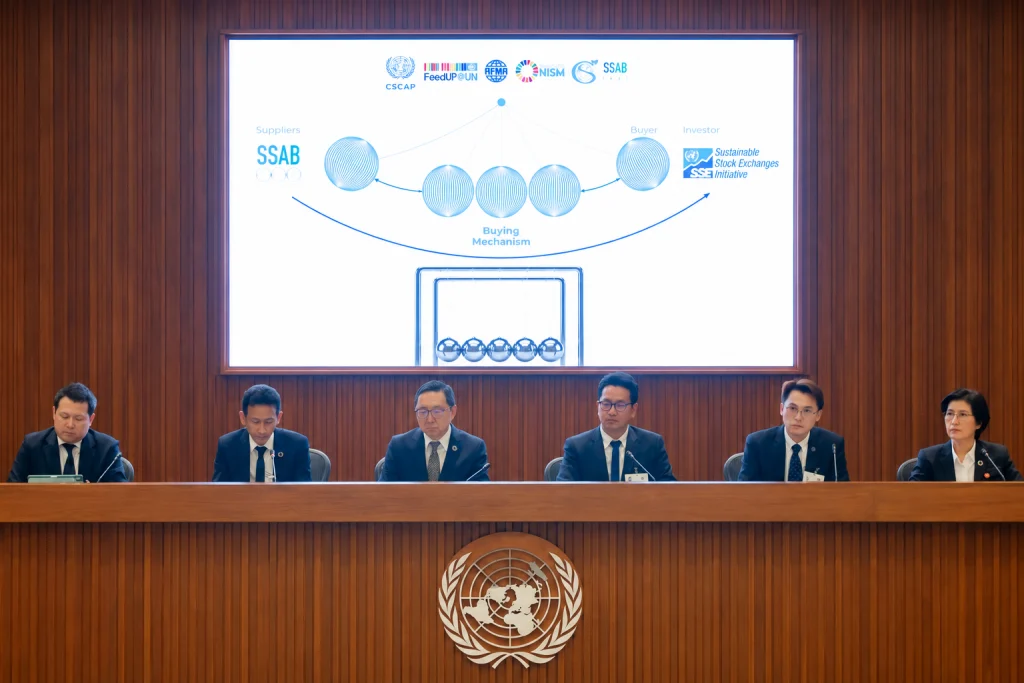
SSAB seeks to reduce this gap.
Its role is to provide a common development structure through which enterprises can organise sustainability commitments, identify risks, develop credible evidence and progressively improve buyer readiness, while allowing buyers to engage suppliers according to proportional risk and maturity.
The objective is not to remove buyer-specific requirements. Nor is it to guarantee that information accepted by one buyer will automatically be accepted by another.
Rather, SSAB seeks to reduce unnecessary duplication by making sustainability information more structured, reusable, traceable and decision-useful.
A Transition and Readiness Pathway, Not Another Standard
A defining feature of SSAB is that businesses are not expected to be fully prepared from the outset.
This principle is consistent with the logic of risk-based due diligence, which recognises that enterprises operate under different conditions, levels of exposure, business relationships and degrees of preparedness. The objective is therefore not to require every organisation to address every sustainability issue at the same level and at the same time, but to ensure that material risks and impacts are identified, prioritised and progressively managed in accordance with their severity, likelihood, relevance and operational context.
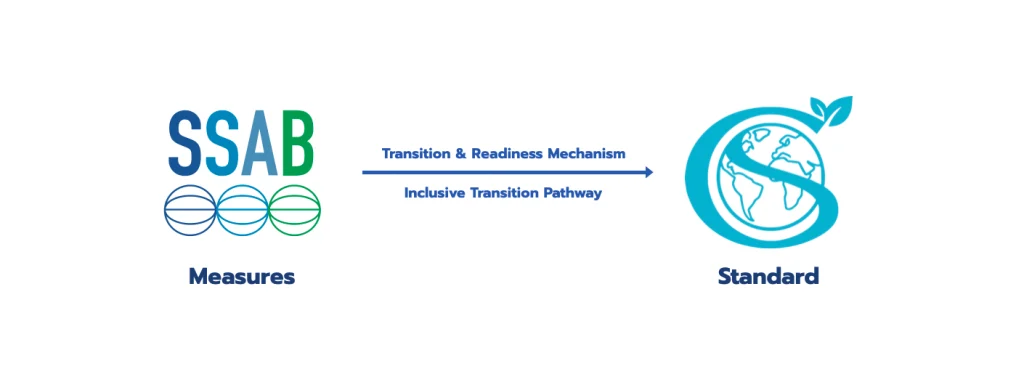
SSAB applies this principle directly to organisational and business development.
What an organisation already has becomes the starting point. Existing policies, procedures, records, data and evidence are organised within a common structure. What is not yet in place is identified as a Development Gap, and the next priority for improvement is translated into a practical pathway towards stronger due diligence, better evidence and greater buyer readiness.
In this way, a gap does not automatically mean failure. It may instead represent an identified area for improvement within a structured development pathway.
This staged approach is particularly important for SMEs, small-scale producers, cooperatives and other enterprises that may already have relevant policies, operational practices, supplier information or records, but do not yet possess the systems, resources or documentation required to meet more advanced buyer, regulatory or certification requirements.
SSAB enables such enterprises to organise existing evidence, identify priority gaps, strengthen due diligence processes and progressively develop the information required for buyer assessment, supplier qualification and responsible procurement, rather than being excluded at the first stage of evaluation.
Flexibility, however, does not mean lowering fundamental responsibilities.
SSAB maintains Critical Safeguards for serious issues including child labour and forced labour, severe human-rights impacts, serious occupational health and safety risks, severe environmental harm, corruption and bribery, falsification or misrepresentation of information, serious or systematic sustainability misclaims, obstruction and retaliation.
These safeguards cannot be treated as ordinary development gaps, cannot be offset by commercial success, buyer participation, finance, investment or market outcomes, and cannot be compensated for by achievement at a higher recognition level.
SSAB therefore does not lower existing standards to make participation easier, nor does it seek to create a competing sustainability standard. Its role is to reduce unnecessary barriers to entering the sustainability transition while preserving essential responsibilities and progressively strengthening organisational capability.
The pathway can be expressed simply as:
Start with what exists — identify what is missing — strengthen due diligence — develop credible evidence — improve buyer readiness — demonstrate outcomes — progress towards relevant standards and market requirements.
Strategically, SSAB serves as a bridge between SMEs and standards, evidence and buyers, responsible business conduct and procurement, and sustainability and economic opportunity.
Its purpose is not merely to determine whether an enterprise is compliant today, but to provide a credible and structured pathway through which enterprises can progressively strengthen their capability to meet the expectations of buyers, markets, finance and internationally recognised sustainability frameworks.
The OECD’s risk-based due diligence approach similarly recognises that enterprises are not expected to address everything everywhere at once, but should identify, prioritise and address their most significant adverse impacts over time.
From Sustainability Commitment to Business Readiness and Market Outcomes
SSAB for SCP is designed as a progressive business development and readiness pathway, rather than a one-time assessment that simply determines whether an organisation “passes” or “fails”.
The mechanism begins by organising what an organisation already has—policies, management systems, operational data, ESG information, product information, supplier records and supply-chain evidence—within a common structure so that the organisation can clearly understand:
What is already in place — What remains to be developed — What should be strengthened next to improve buyer readiness and expand business opportunities.
A central principle of SSAB is that enterprises are not expected to have every element fully developed from the outset. Instead, organisations may begin at a level appropriate to their current capabilities and progressively strengthen their readiness through:
Commitment → Risk-based Due Diligence → Evidence → Buyer Readiness → Market Outcomes → Measurable Performance
This progression is intended to help organisations move from policy intention towards more structured management, credible evidence, greater transparency and stronger capacity to respond to buyer, market and sustainability requirements.
The SSAB pathway therefore consists of two principal stages:
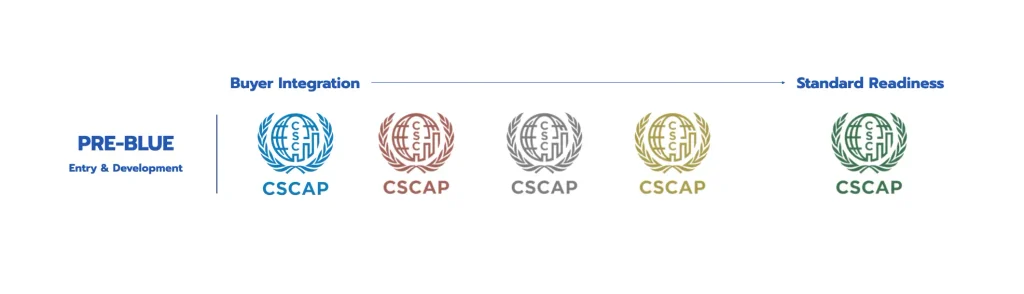
Pre-BLUE — a development stage that helps organisations establish the foundations required to enter the formal SSAB Recognition pathway; and
BLUE–GREEN — the formal progression through which organisations strengthen policy commitments, due diligence processes, evidence, buyer readiness and, ultimately, measurable sustainability and market outcomes.
Pre-BLUE does not constitute SSAB Recognition. Formal Recognition begins at BLUE.

The 5 Core Components of SSAB for SCP
SSAB for SCP is structured around five interconnected components.
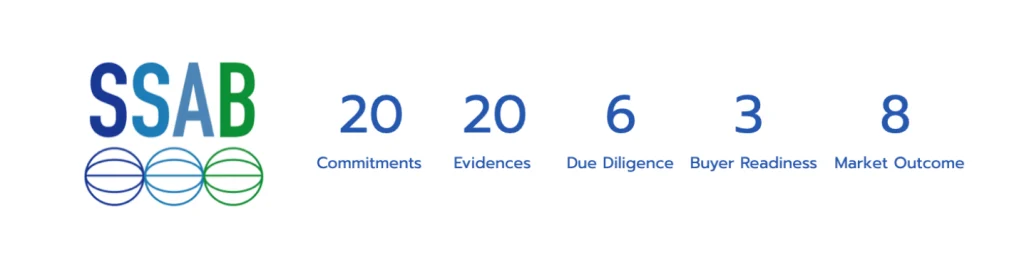
Foundational Policy Commitments — C1–C20
The Foundational Policy Commitments establish the principal areas of responsibility that organisations should progressively address according to their business activities, impacts, risks and market context.
C1 — Biodiversity & Ecosystems
C2 — Climate Action / Climate Change
C3 — Pollution, Waste & Resource Efficiency
C4 — Environmental Responsibility in Supply Chain
C5 — Water Stewardship / Water Security
C6 — Customer & Product Responsibility
C7 — Occupational Health & Safety
C8 — Human Rights & Community
C9 — Labour Standards
C10 — Social Responsibility in Supply Chain
C11 — Anti-Corruption & Anti-Bribery
C12 — Corporate Governance
C13 — Enterprise Risk Management
C14 — Tax Transparency
C15 — ESG, RBC & SCP Integration
C16 — Business Ethics, Fair Competition & Responsible Policy Engagement
C17 — Traceability & Origin Transparency
C18 — Sustainable Procurement & Supplier Development
C19 — Just Transition, Local Development & Benefit Sharing
C20 — Product Transparency & Responsible Sustainability Claims
These policy commitments are not intended to imply that every issue has equal materiality for every organisation. Their application should be proportionate to business context, risks, impacts, products, services and supply-chain relationships.
Risk-based Due Diligence Process — DD1–DD6
SSAB uses a 6-stage due diligence backbone to connect policy commitments with actual implementation.
DD1 — Embed Responsible Business Conduct in Policies and Management Systems
DD2 — Identify and Assess Actual and Potential Impacts
DD3 — Cease, Prevent or Mitigate Adverse Impacts
DD4 — Track Implementation and Results
DD5 — Communicate How Impacts Are Addressed
DD6 — Provide for or Cooperate in Remediation Where Appropriate
The process is conceptually aligned with the six-step OECD Due Diligence Guidance for Responsible Business Conduct. This alignment is used as a process reference and does not imply OECD certification, endorsement or confirmation of compliance.
Evidence Packages — E1–E20
Each Foundational Policy Commitment is linked to a corresponding Evidence Package:
C1 → E1 through C20 → E20
Evidence may include, as applicable:
- governance arrangements and assigned responsibilities;
- policies and procedures;
- risk and impact assessments;
- implementation records;
- prevention and corrective actions;
- operational and performance data;
- supplier information;
- traceability records;
- stakeholder engagement;
- grievance and remediation records;
- monitoring results;
- public disclosure and communication.
The purpose of Evidence Packages is not simply to collect documents, but to establish whether commitments are being translated into credible, traceable and reviewable implementation.
Buyer Readiness Criteria — B1–B3
Buyer Readiness Criteria assess the extent to which an organisation’s sustainability information and management processes can support engagement with responsible buyers.
The criteria progressively examine whether the organisation can provide information that is sufficiently structured and reliable to support activities such as:
- supplier screening;
- supplier questionnaires;
- buyer due diligence;
- supplier qualification;
- sustainable procurement;
- corrective action;
- supplier development;
- commercial trials;
- longer-term buyer collaboration.
Buyer readiness does not imply that a buyer is required to procure from the organisation, nor does it replace a buyer’s own qualification, technical, quality, compliance or commercial requirements.
Market and Impact Outcomes — MO1–MO8
SSAB also recognises that sustainability should ultimately connect to real economic and developmental outcomes.
The Market and Impact Outcomes are:
MO1 — Market Visibility
MO2 — Buyer Process Entry
MO3 — Supplier Development
MO4 — Commercial Trial
MO5 — Agreement
MO6 — Actual Transaction
MO7 — Finance / Capital Access
MO8 — Market Expansion
Market outcomes do not replace due diligence, evidence or Critical Safeguards.
Commercial success cannot compensate for serious sustainability failures, and market outcomes should not be interpreted as evidence that all sustainability risks have been addressed.
Pre-BLUE (Mechanics 1-3) : Preparing an Organisation to Enter the SSAB Pathway
Pre-BLUE is designed for organisations that wish to begin developing sustainability readiness but are not yet prepared to enter formal SSAB Recognition.
Its purpose is to make sustainability development accessible to organisations at different levels of maturity. An organisation may already have certain sustainability policies, activities or records in place, but these may still be limited, fragmented or not yet systematically connected to its products, services, commercial activities or revenue generation.
Pre-BLUE therefore allows each organisation to begin from its current capability, organise what already exists, identify what remains missing and establish a practical pathway for progressive improvement.
The pathway consists of three development mechanics:
| Mechanics | Key Action | Development and Business Significance |
|---|---|---|
| 1. COMMITMENT | Establish sustainability intentions, relevant policy commitments, responsibilities and an initial direction for improvement. | Creates an accountable starting point for organisations that may have only limited policies or sustainability activities in place. |
| 2. REGISTRY | Define the relevant legal entity, products, services, facilities, operational boundaries and role within the supply chain. | Establishes a clear Business Sustainability Identity and Scope for risk assessment, evidence mapping, future buyer engagement and review. |
| 3. DISCLOSURE | Organise existing policies, operational information, sustainability data and supporting evidence in a structured and traceable form. | Identifies what already exists, supports initial risk scoping, clarifies Development Gaps and prepares the organisation for the formal BLUE–GREEN Recognition pathway. |
Pre-BLUE is a development pathway only. It does not constitute SSAB Recognition, certification, verification or confirmation that the organisation has met BLUE requirements. Formal SSAB Recognition begins at BLUE.
COMMITMENT — Establishing Responsibility
COMMITMENT represents the early entry point into sustainability development.
At this stage, an organisation may have only a limited number of sustainability-related policies, commitments or activities. These may still operate separately from the organisation’s core business, products, services or commercial strategy.
SSAB does not require the organisation to begin by producing a large volume of new documentation. The first requirement is to establish a meaningful, accountable and proportionate starting point.
The organisation should begin by identifying the sustainability issues relevant to its activities, products, services and supply-chain relationships; determining who is responsible for addressing them; and establishing an initial direction for improvement.
This stage provides the first connection to the relevant Foundational Policy Commitments under SSAB, while recognising that different organisations will have different levels of materiality, risk and preparedness.
COMMITMENT does not signify that the organisation has achieved sustainability. It demonstrates that the organisation has recognised its responsibilities, established internal ownership and begun moving from intention towards organised action.
This is the point at which sustainability intention begins to become institutional responsibility.
REGISTRY — Establishing a Clear Business and Sustainability Scope

The Registry stage defines precisely what is entering the SSAB development pathway.
This should identify, as applicable:
Legal Entity
Business Unit or Facility
Product or Service
Operational Boundary
Supply-chain Role
Market or Buyer Context
Reporting or Evidence Period
This distinction is important because a broad statement that an organisation is “sustainable” is not sufficiently precise for responsible procurement, due diligence or business decision-making.
Buyers and other stakeholders need to understand which entity, operations, products, services and supply-chain relationships are covered by the information and evidence presented, and where those boundaries begin and end.
The Registry therefore establishes a defined Business Sustainability Identity and Scope, enabling the organisation to be understood and progressively developed within a clearly stated boundary.
A clear Registry also provides the foundation for later risk assessment, evidence mapping, traceability and Buyer Readiness, because sustainability information can only be meaningfully evaluated when its scope is understood.
Registration itself does not constitute certification, verification of sustainability performance or SSAB Recognition.
DISCLOSURE — Turning Existing Practices into Structured and Usable Information
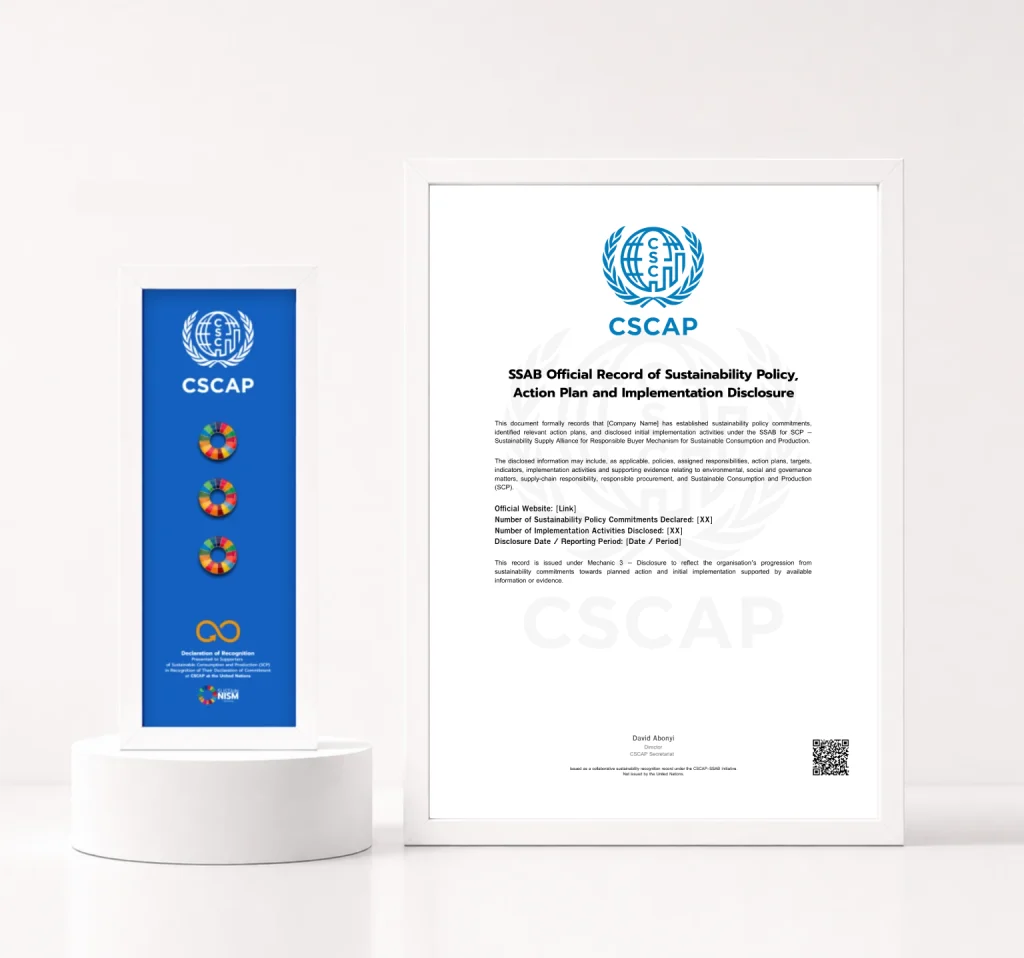
Disclosure is the stage at which an organisation begins to make practical use of what it already has.
This may include existing policies, procedures, management records, KPIs, environmental and resource data, waste information, labour and human-rights records, health and safety information, supplier documentation, raw-material information, production records, traceability evidence, grievance records and other information relevant to the organisation’s sustainability risks and responsibilities.
The objective is not to maximise the number of documents created. Rather, it is to organise existing information so that it becomes structured, traceable and usable for future due diligence, buyer assessment and business development.
Where relevant, information should progressively identify:
What the information relates to
Where it originates
Which period it covers
Who is responsible for it
How it was generated or calculated
What limitations apply
The organisation should then begin to answer five practical questions:
Has the declared policy or commitment been translated into action?
What evidence supports that implementation?
What risks or impacts are beginning to emerge?
Can the source, scope and boundary of the information be traced?
What Development Gaps remain to be addressed?
At this stage, existing information may begin to be mapped against the relevant Foundational Policy Commitments and Evidence Packages, providing the basis for initial risk scoping and the later development of the SSAB Risk-based Due Diligence Process.
Disclosure within SSAB does not necessarily mean that all information must be made publicly available. The appropriate level of disclosure should take account of confidentiality, commercial sensitivity, legal obligations, buyer requirements and the intended use of the information.
Once these foundations have been sufficiently organised, the organisation is better positioned to enter the formal BLUE–GREEN Recognition pathway, where the emphasis progressively shifts from early commitment and information readiness towards due diligence, evidence quality, Buyer Readiness, market participation and measurable performance.
Completion of the Disclosure stage does not itself constitute SSAB Recognition. Formal Recognition begins at BLUE.
BLUE–GREEN (Mechanic 4-5) : From Policy Commitment to Buyer Readiness and Market Outcomes
SSAB establishes five progressive recognition levels:
BLUE → BRONZE → SILVER → GOLD → GREEN
These levels reflect the progressive development of an organisation from initial policy commitments and commercial readiness, through risk-based due diligence, structured evidence and increasingly systematic management, towards stronger buyer readiness, demonstrated buyer participation and measurable sustainability and market outcomes.
The levels should not be understood simply as indications that an organisation possesses more policies, documents or data. Rather, they reflect the extent to which sustainability commitments are being translated into credible processes, evidence and business capability that can support buyer engagement, responsible procurement, supplier development and relevant market requirements.
As organisations progress through the levels, sustainability information is expected to become increasingly structured, traceable, decision-useful and capable of supporting buyer assessment, qualification and due diligence. At the same time, sustainability should become progressively more connected to the organisation’s products, services, commercial activities and market engagement.
At the higher levels, the emphasis shifts from readiness alone towards demonstrated buyer participation, measurable performance, effectiveness and appropriately supported outcomes that may strengthen trade opportunities, market expansion, long-term business relationships and readiness for sustainable finance and investment.

The overall progression can be expressed as:
Policy → Evidence → Due Diligence Readiness → Buyer Readiness → Business Opportunity → Measurable Outcomes
| Level | Main Transition | What It Signals to Buyers | Business Value |
|---|---|---|---|
| BLUE | From policy commitment to initial commercial sustainability readiness | The organisation has established relevant sustainability policies and responsibilities, and is beginning to integrate sustainability considerations into its products, services, sales activities or buyer engagement. | Creates a credible entry point for responsible business development and begins connecting sustainability with products, customers and revenue-generating activities. |
| BRONZE | From commercial intention to initial evidence and risk identification | Initial evidence demonstrates that sustainability commitments are being translated into business practices, while relevant risks and impacts are beginning to be identified and assessed. | Strengthens credibility for supplier screening, preliminary due diligence and early buyer engagement. |
| SILVER | From evidence to structured management and due diligence | Sustainability information, evidence and management processes are increasingly structured, traceable and usable for buyer assessment and due diligence. | Improves readiness for supplier qualification, substantive buyer engagement and supplier-development processes. |
| GOLD | From structured systems to responsible procurement readiness | The organisation can demonstrate broad evidence coverage, functioning due diligence processes and readiness to engage with responsible buyers, including demonstrated buyer participation. | Strengthens opportunities to enter procurement processes, commercial trials, supplier-development programmes and longer-term buyer relationships. |
| GREEN | From procurement readiness to measurable performance and outcomes | The organisation can demonstrate measurable performance, trends, effectiveness and appropriately supported sustainability and supply-chain outcomes. | Strengthens buyer confidence, market positioning and market expansion, while improving readiness for sustainable finance, investment and long-term business relationships. |
BLUE — From Policy Commitment to Initial Commercial Sustainability Readiness

BLUE represents the point at which sustainability begins to move beyond general intention or isolated activities and becomes more clearly connected to the organisation’s business direction, products, services, sales activities or buyer engagement.
At this level, the organisation should have relevant sustainability policies and responsibilities in place and should be able to demonstrate that sustainability considerations are beginning to influence how the organisation develops, positions, offers or sells its products and services.
From a buyer perspective, BLUE indicates that the organisation has established a credible foundation for responsible business conduct and is beginning to integrate sustainability into its commercial activities and market relationships.
BLUE should normally demonstrate relevant policy commitments, assigned responsibility, an initial action plan, preliminary risk scoping and the applicable initial Buyer Readiness requirement.
The value of BLUE does not lie in declaring that the organisation is already “sustainable”. Rather, it signals that sustainability has begun to move from organisational commitment towards business application, creating a foundation for further due diligence, evidence development and buyer engagement.
BRONZE — From Initial Business Application to Evidence and Risk Identification
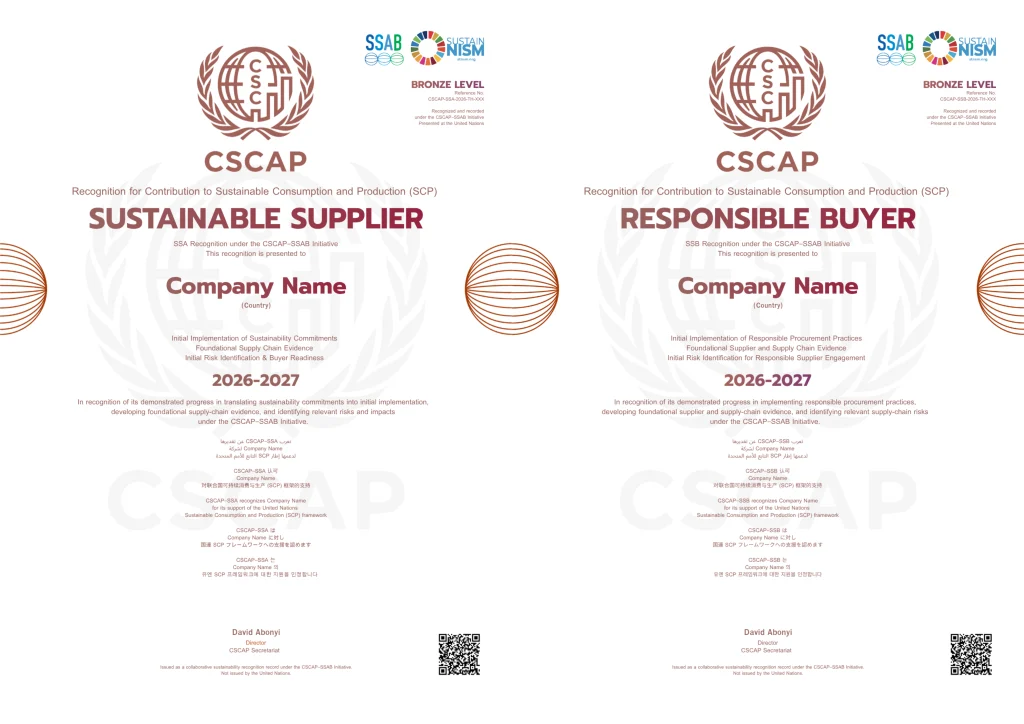
BRONZE marks the transition from policy and early business application towards demonstrable implementation, initial evidence and risk identification.
At this level, the central question begins to move from:
“Has the organisation established its commitments?”
to:
“Can the organisation demonstrate that those commitments are being implemented, and can it identify the most relevant risks and impacts associated with its operations and supply chain?”
Relevant commitments should increasingly be supported by initial Evidence Packages, while the organisation begins establishing a preliminary risk and impact register and developing the early stages of risk-based due diligence.
For example, a labour commitment should increasingly be supported by employment-related information, records and responsible management practices. An environmental commitment should begin to be supported by relevant operational data such as resource use, waste, emissions, water or environmental controls, depending on the nature and materiality of the business.
BRONZE therefore begins to distinguish between an organisation that states its intentions and one that can begin to demonstrate implementation through evidence and risk-based assessment.
At this stage, information becomes increasingly useful for supplier screening, preliminary due diligence and early buyer engagement.
Critical Safeguards remain mandatory and cannot be offset by progress in other areas.
SILVER — From Evidence to Structured Management and Buyer-Usable Due Diligence
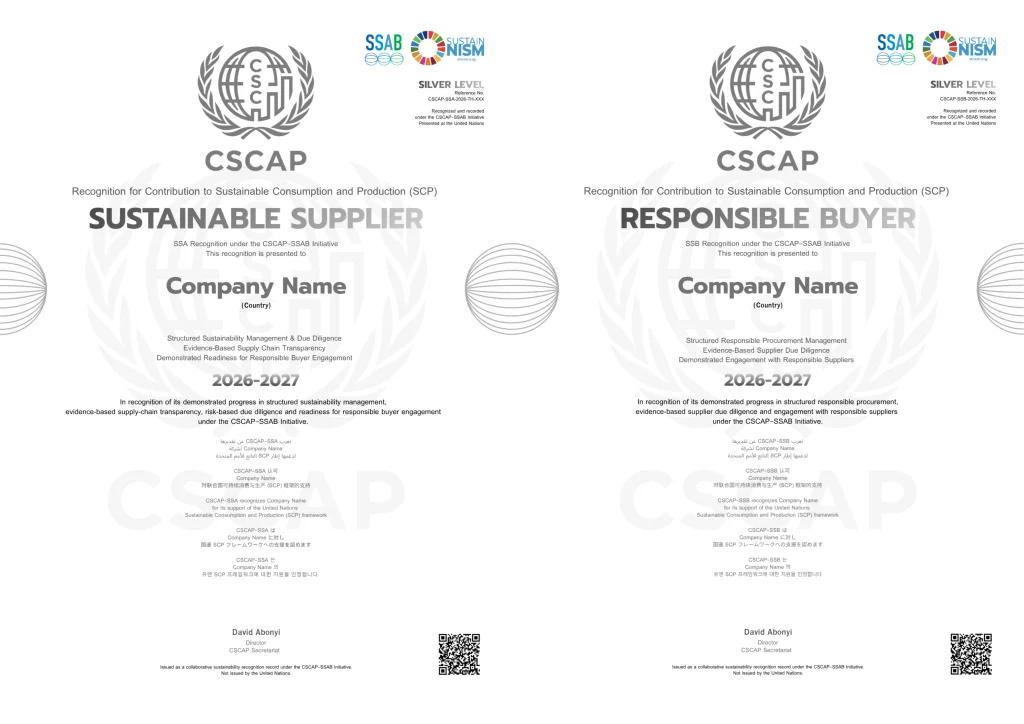
At SILVER, the objective is no longer simply to accumulate additional documents or evidence. The priority is to make sustainability information and management processes systematic, connected, traceable and reusable.
The organisation should increasingly be able to explain where information originates, who is responsible for it, the period it covers, the methodology applied, its limitations, and how identified risks or impacts are prevented, mitigated, monitored and followed up.
The relationship therefore becomes more structured around:
Policy, Risk, Action, Evidence, Monitoring and Follow-up
SILVER should demonstrate broader evidence coverage, stronger Buyer Readiness and substantive progress through DD1–DD4 of the SSAB Risk-based Due Diligence Process.
This is particularly relevant to buyer due diligence because buyers require not only statements of commitment, but information that can be understood, assessed, traced and used within procurement and risk-management processes.
SILVER therefore represents the stage at which sustainability information moves from being primarily internal organisational information towards becoming buyer-usable information capable of supporting supplier assessment, qualification, due diligence and development.
GOLD — From Structured Systems to Responsible Procurement Readiness and Buyer Participation

GOLD represents a higher level of organisational maturity, evidence coverage and due diligence readiness, where sustainability information can be effectively connected with procurement, supplier qualification and commercial engagement.
At this level, the organisation should be able to demonstrate comprehensive evidence across applicable sustainability commitments, functioning DD1–DD6, stronger Buyer Readiness, appropriate monitoring and remediation mechanisms, and readiness to respond to more advanced buyer requirements.
This may include participation in processes such as:
Supplier Qualification
Buyer Due Diligence
Sustainable Procurement
Supplier Development
Product or Commercial Trials
Buyer Collaboration
Commercial Agreements or Transactions
A defining feature of GOLD is demonstrated buyer participation.
Buyer participation should be supported by evidence of at least one relevant form of engagement, such as an existing business relationship, entry into a procurement process, supplier-development activity, commercial trial, agreement or transaction.
Buyer participation does not constitute buyer certification or endorsement of SSAB, nor does it indicate that the buyer has confirmed that the organisation is free from sustainability risks.
The commercial significance of GOLD is not that purchase orders, contracts or investment are guaranteed. Rather, it demonstrates that the organisation is better prepared to participate in responsible procurement and partnership processes with buyers applying more advanced sustainability, traceability and due diligence requirements.
At this stage, sustainability increasingly becomes part of the organisation’s competitiveness and credibility as a business partner.
GREEN — From Procurement Readiness to Measurable Performance, Effectiveness and Outcomes
GREEN changes the central question from:
“Does the organisation have the required systems and evidence?”
to:
“What measurable outcomes have those systems produced, and how effectively are they working?”
At this level, the organisation should be able to demonstrate performance data, trends, effectiveness and measurable outcomes, together with an appropriate level of validation or verification where relevant to the significance, risk and nature of the information concerned.
For example, having a waste-reduction policy is no longer sufficient by itself. The organisation should increasingly be able to demonstrate how waste generation, recovery, reuse or disposal has changed over time.
Similarly, climate-related commitments should progressively be supported by defined boundaries, methodologies, data, targets and performance information before quantitative claims are made.
GREEN also places greater emphasis on supply-chain implementation and outcomes. Where applicable, the organisation should be able to demonstrate supplier and supply-chain evidence across relevant C1–C20 policy areas, together with measurable improvements or evidence of effectiveness.
Where adverse impacts have occurred, relevant remediation evidence should also be available where appropriate.
GREEN therefore represents the stage at which sustainability performance has greater potential to support:
Buyer Confidence
Market Expansion
Long-term Business Relationships
Sustainable Finance Readiness
Investment Readiness
Demonstrated Supply-chain and Sustainability Outcomes
The value of GREEN lies not merely in having more advanced systems, but in demonstrating that those systems are producing credible, measurable and appropriately supported results, strengthening market confidence and contributing to long-term value creation.
Critical Safeguards
The progressive nature of SSAB must not be interpreted as permitting serious risks or impacts to be deferred indefinitely.
Critical Safeguards apply across the mechanism and include, among other matters:
- child labour;
- forced labour and trafficking;
- severe human-rights impacts;
- serious occupational health and safety risks;
- severe environmental harm;
- corruption and bribery;
- serious misconduct;
- falsification or misrepresentation of information;
- serious or systematic sustainability misclaims;
- obstruction of review processes;
- retaliation against affected persons, complainants or whistleblowers.
Critical Safeguards cannot be treated as ordinary Development Gaps where the issue is relevant.
They cannot be offset by:
- higher recognition levels;
- buyer participation;
- commercial transactions;
- market expansion;
- access to finance;
- investment;
- or other positive Market Outcomes.
Responsible Buyer Pathway — SSB
SSAB for SCP recognises that sustainable supply chains cannot be created by suppliers alone.
Buyers play a decisive role in determining what is produced, how suppliers are selected, which risks are prioritised and whether sustainability becomes a real market condition.
SSAB therefore includes a Responsible Buyer pathway, recognising organisations that progressively integrate responsible procurement into their purchasing and supply-chain management practices.
Buyer-side development focuses on:
- Responsible Procurement commitments;
- supply-chain transparency;
- supplier screening;
- supplier due diligence;
- risk-based supplier assessment;
- supplier development;
- responsible sourcing;
- corrective action;
- engagement with responsible suppliers;
- measurable procurement and supply-chain outcomes.
The SSB pathway follows the same progressive philosophy as supplier-side development:
BLUE — Commitment and Initial Readiness
BRONZE — Initial Implementation and Evidence
SILVER — Structured Responsible Procurement and Due Diligence
GOLD — Integrated Responsible Procurement and Supplier Development
GREEN — Measurable Procurement and Supply-chain Outcomes
SSB Recognition does not imply that all suppliers within a buyer’s supply chain are sustainable, nor does it replace buyer-specific due diligence obligations.
Its purpose is to recognise and strengthen the buyer-side capability required to create demand for responsible production.
From SSAB to CS Standard
SSAB for SCP provides an inclusive entry and development pathway.
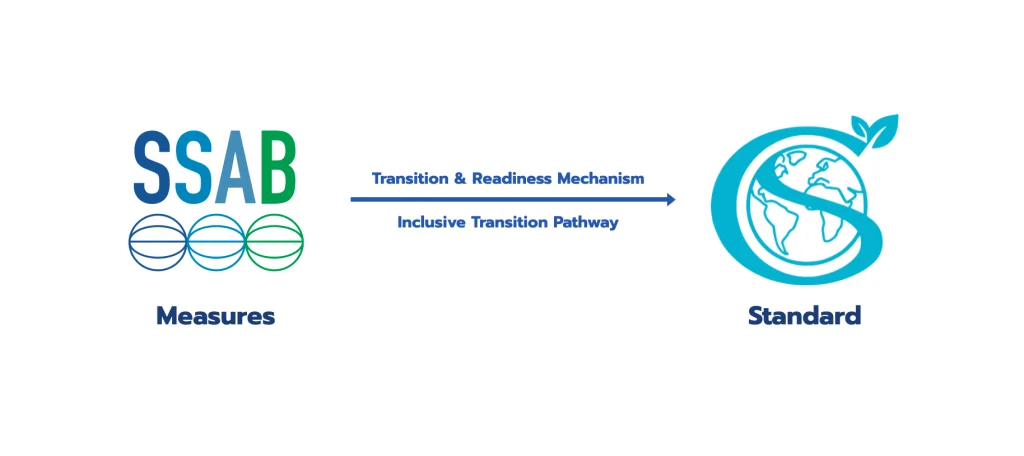
Organisations may begin at a level appropriate to their capabilities and progressively strengthen their ESG policies, due diligence processes, evidence, traceability, buyer readiness and performance.
Within SSAB, Environmental, Social and Governance (ESG) dimensions serve as the principal operating framework for identifying commitments, risks, actions, evidence and performance. These ESG dimensions are then connected, where relevant, to the Sustainable Development Goals (SDGs) in order to translate organisational action into broader sustainability outcomes.
For organisations seeking a more advanced pathway, SSAB can support preparation towards the CS Standard, subject to the applicable requirements and assessment process. Under the CS Standard architecture, ESG performance and evidence may be further mapped to relevant SDGs to strengthen the connection between business responsibility, supply-chain performance and sustainable development outcomes.
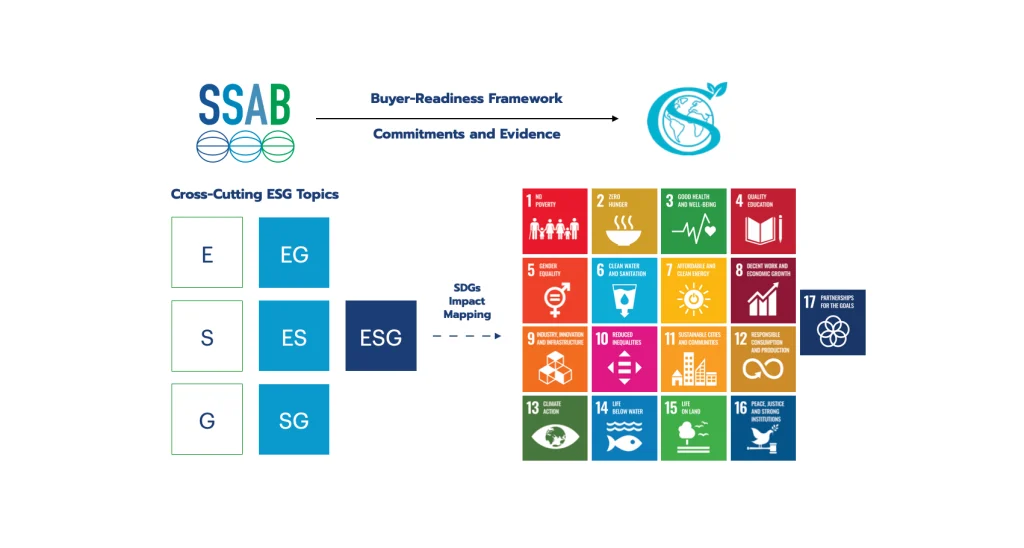
Within this framework, AFMA may serve as the SDG Custodian for the CS Standard architecture, supporting the consistency of SDG mapping, interpretation and reporting within the Standard. This use of the term “SDG Custodian” refers specifically to the role defined within the CS Standard framework and does not imply designation as a United Nations SDG Indicator Custodian Agency.
SSAB is therefore best understood as a transition bridge rather than the endpoint of standardisation:
ESG Commitments → Due Diligence → Evidence → Buyer Readiness → SDG-linked Performance → Standard Readiness
SSAB participation or Recognition does not constitute:
- CS Standard certification;
- equivalence with the CS Standard;
- automatic acceptance under the CS Standard;
- automatic acceptance by buyers; or
- confirmation that an organisation complies with every applicable sustainability requirement.
This relationship is consistent with the broader STNSM positioning of SSAB as a voluntary ESG-based transition and buyer-readiness pathway, supporting organisations in progressing from sustainability commitments towards evidence-based performance, SDG-linked outcomes and greater readiness for the CS Standard.
International Reference Architecture
SSAB is designed as a practical development mechanism rather than a substitute for internationally recognised standards or frameworks.
Its policy, due diligence and evidence architecture draws on concepts commonly used across responsible business conduct, ESG assessment, human rights, sustainable procurement, corporate disclosure and SCP.
Relevant reference areas include:
OECD Responsible Business Conduct and Due Diligence
SSAB DD1–DD6 uses the OECD six-step due diligence process as an important cross-cutting process reference.
OECD alignment does not constitute OECD certification or endorsement.
ESG and Capital-market Assessment
The C1–C20 architecture includes themes that correspond to major areas examined in ESG and capital-market sustainability assessment, including climate, pollution and resources, water, supply-chain issues, customer responsibility, labour, human rights, anti-corruption, governance, risk management and tax transparency.
FTSE Russell’s ESG Data Model, for example, has historically structured assessment across Environmental, Social and Governance pillars, thematic exposure and indicator-level information, with a strong emphasis on materiality and data.
Such references are used for alignment and contextual relevance only. SSAB Recognition does not constitute an FTSE Russell or LSEG rating, score, assessment or endorsement.
Human Rights and Labour
SSAB incorporates human rights, labour standards, health and safety, supply-chain responsibility, grievance mechanisms and remediation as core areas of responsible business conduct.
Sustainable Consumption and Production and SDG 12
SSAB is designed to support practical implementation of Sustainable Consumption and Production, especially by connecting responsible production with responsible procurement and market demand.
This contributes to the broader objectives of SDG 12: Responsible Consumption and Production.
Disclosure, Evidence and Market Use
The SSAB approach emphasises structured and reviewable evidence because sustainability information increasingly needs to support real decision-making by buyers, lenders, investors and other market actors.
The purpose is not to reproduce any single external framework, but to help organisations develop information that can be progressively adapted to relevant market and standards requirements.
Evidence Integrity and Responsible Sustainability Claims
SSAB places particular importance on the integrity of sustainability information.
Organisations should progressively ensure that claims relating to ESG, climate, carbon, responsible sourcing, traceability, circularity, human rights, sustainable products or other sustainability attributes are supported by evidence appropriate to the nature and significance of the claim.
Information should clearly identify, where relevant:
- scope;
- boundaries;
- source;
- methodology;
- reporting period;
- responsible party;
- assumptions;
- limitations;
- and verification or validation status.
Participation in SSAB does not authorise organisations to make sustainability claims beyond the evidence available.
Recognition should not be represented as:
- certification of a product;
- proof that an organisation has no adverse impacts;
- confirmation of compliance with every sustainability standard;
- endorsement by buyers;
- endorsement by investors;
- or endorsement by the United Nations.
Market Outcomes and Economic Opportunity
A defining objective of SSAB is to help sustainability progress become relevant to the real economy.
The mechanism therefore seeks to connect sustainability capability with:
responsible procurement, supplier development, trade, market access, finance and investment readiness.
This does not mean that participation guarantees any commercial or financial result.
Rather, stronger policies, due diligence, evidence and performance may reduce information gaps and make organisations better positioned to participate in market processes.
For suppliers, this may mean greater ability to respond to buyer questionnaires, qualification processes and sustainability requirements.
For buyers, it may mean more structured information for identifying, assessing and developing responsible suppliers.
For financial institutions and investors, increasingly credible sustainability information may improve the quality of information available for relevant financing or investment processes.
The purpose of SSAB is therefore to help translate sustainability from an isolated compliance exercise into business capability and economic participation.
Accelerating Sustainable Consumption and Production
SSAB for SCP is ultimately intended to support a broader transition.
Sustainable Consumption and Production cannot be accelerated solely through policy declarations or standards development.
It requires participation across the real economy.
Producers need practical pathways to improve.
Buyers need credible information to procure responsibly.
Suppliers need access to markets.
Financial institutions and investors need decision-useful sustainability information.
And sustainability progress must be capable of generating incentives for organisations to continue improving.
SSAB seeks to contribute to this process by making the sustainability transition more accessible, structured, evidence-based and connected to economic opportunity.
In this sense, SSAB is intended to serve as another practical mechanism for accelerating Sustainable Consumption and Production (SCP) and supporting progress towards SDG 12.
Regional Development Direction
The longer-term direction of SSAB is to develop from an enterprise-readiness mechanism into a broader regional enabling infrastructure for responsible procurement and sustainable supply-chain development.
This includes progressively strengthening:
- common policy and evidence architecture;
- risk-based due diligence;
- supplier and buyer readiness;
- structured sustainability disclosure;
- traceability;
- responsible sustainability claims;
- buyer participation;
- market outcomes;
- cross-border dialogue;
- standard-readiness pathways;
- and connections between sustainability, trade, finance and investment.
The intention is not to create automatic mutual recognition between countries or markets.
Rather, the objective is to promote dialogue around common evidence, shared expectations and greater interoperability, so that credible sustainability information can be reused and adapted more efficiently across different market processes.
Such development may help reduce duplicated assessments, lower unnecessary transaction costs and support more inclusive participation by SMEs and smaller producers in sustainable supply chains.
Policy Conclusion
SSAB for SCP is founded on a simple principle:
sustainability should be ambitious, but the pathway to sustainability should be accessible.
If sustainability begins only at the point of advanced certification, many enterprises—particularly SMEs and small producers—may be excluded before they have the opportunity to develop.
SSAB therefore starts from the organisation’s current capability and progressively strengthens policy, responsibility, due diligence, evidence, buyer readiness and measurable outcomes.
It does not lower the expectations of sustainable markets.
It seeks to lower the unnecessary barriers to entering them.
It does not replace recognised standards.
It helps organisations prepare for them.
It does not guarantee procurement, finance or investment.
It seeks to make sustainability information more credible and usable within those processes.
And it does not define sustainability solely as compliance.
It seeks to connect sustainability with responsible production, responsible procurement, market participation and long-term economic value.
SSAB does not create another standard. It creates a structured pathway towards standards, responsible markets and sustainable economic opportunity.
Through this approach, SSAB for SCP seeks to help accelerate Sustainable Consumption and Production, strengthen responsible supply chains and expand inclusive economic participation across Asia and the Pacific.
Institutional Disclaimer
SSAB for SCP is a voluntary transition, readiness and recognition mechanism.
Participation or Recognition does not constitute certification, regulatory approval, investment approval, product certification, buyer endorsement or confirmation of full compliance with any third-party standard.
References to OECD, FTSE Russell/LSEG, the United Nations Sustainable Development Goals or other international frameworks are made solely for alignment, learning and contextual purposes and do not imply endorsement, partnership, certification or approval by those organisations.
Where SSAB activities, Recognition or related CSCAP activities are presented at the United Nations Conference Centre, Bangkok, use of the venue or participation in an event held there does not in itself constitute recognition, certification or endorsement by the United Nations.
Contact at Sustainism Secretariat
Sustainism Initiatives
+66 8298 96869
secretariat@stnsm.org