Transforming Sustainability into Revenue, Investment and Economic Resilience across Asia and the Pacific
CSCAP 2026 is positioned as a regional cooperation platform connecting Governments, international organizations, diplomatic missions, policymakers, buyers, suppliers, financial institutions, investors and enterprises to translate sustainability principles into practical, measurable and economically viable mechanisms.
Under the theme “Sustainable Supply Chains for SCP, Green Finance and Investment: From ESG Readiness to Sustainability-Linked Capital,” CSCAP 2026 will advance an integrated approach linking international standards, sustainable supply chains, responsible procurement, finance and investment.
In 2026, representatives of more than 40 embassies are expected to participate as observers. This broad international presence reflects growing interest in sustainable supply chains, responsible business conduct, green finance and sustainability-linked investment across Asia and the Pacific. It will also create opportunities for participating organizations to establish cross-border connections, better understand the requirements of international markets and explore new pathways into regional and global value chains.
At the centre of CSCAP 2026 is a clear proposition:
Sustainability must move beyond reporting and compliance. It must be translated into revenue, investment, market access and long-term economic resilience.
When sustainability is effectively connected to markets, it becomes more than an organizational responsibility. It becomes an economic asset—a foundation for competitiveness, trade resilience, responsible investment and inclusive economic growth.
From an Annual Forum to a Continuous Regional Cooperation Mechanism
CSCAP 2026 will move beyond the conventional model of an annual conference. It will serve as a continuous cooperation mechanism operating before, during and after the Forum.
This mechanism will connect the full sustainability transformation pathway, including:
- policy dialogue and international cooperation;
- development and alignment of standards;
- ESG and SCP readiness assessments;
- evidence and traceability development;
- buyer–supplier connectivity;
- access to green and sustainability-linked finance; and
- monitoring of market and development outcomes.
The strength of CSCAP will therefore not be measured solely by the number of participants or institutional partners. It will be assessed by its ability to transform dialogue into practical cooperation, supplier-development programmes, responsible procurement, investment opportunities and traceable business transactions.
Across Asia and the Pacific, economies differ considerably in their regulatory structures, productive capacity and levels of enterprise readiness. CSCAP will provide a common platform through which these differences can be addressed, the gap between international requirements and enterprise capacity can be reduced, and SMEs, farmers, cooperatives and community enterprises can progressively enter sustainable regional value chains.
Key direction:
From dialogue to implementation. From cooperation to measurable outcomes.
Advancing an Internationally Aligned Framework to Reduce Audit Costs and Duplication
CSCAP 2026 will support the development of a common evidence framework aligned with internationally recognized principles relating to:
- Environmental, Social and Governance performance;
- Sustainable Consumption and Production;
- responsible business conduct;
- human rights and environmental due diligence;
- supply-chain traceability;
- climate action;
- sustainable finance; and
- sustainability-related disclosure.
This direction is aligned with the OECD approach to Responsible Business Conduct and Risk-Based Due Diligence, which emphasizes the identification, prevention, mitigation, tracking and communication of actual and potential adverse impacts throughout value chains.
CSCAP does not seek to create another isolated standard or an additional layer of compliance. Its purpose is to build a common language through which one structured body of evidence can respond to multiple buyer, investor, financial institution and market requirements.
Prepare evidence once. Use it across markets.
This approach is intended to:
- reduce repetitive supplier assessments;
- lower verification and compliance costs;
- minimize duplicated documentation;
- improve data consistency and traceability;
- support interoperability among different standards and buyer requirements; and
- enable buyers and financial institutions to make more informed decisions.
The long-term objective is to advance a framework that Governments, buyers, suppliers, investors and financial institutions can recognize and apply across markets, without weakening the integrity of international standards and without leaving smaller enterprises behind.
Key direction:
Standard alignment, evidence interoperability and reduced verification costs.
Establishing Sustainable Supply-Chain Connectivity across Asia and the Pacific
CSCAP 2026 will seek to transform sustainability standards from documentary requirements into enabling market infrastructure.
The objective is to allow buyers to identify, assess and engage suppliers whose sustainability readiness is supported by structured and traceable evidence. At the same time, suppliers will be supported in presenting their sustainability performance in a form that responds to the requirements of buyers, investors and financial institutions.
The principal mechanisms include:
- the Sustainable Buyer Registry, connecting buyers committed to responsible procurement;
- the Trust Chain SME ID, strengthening the identity, credibility and supply-chain readiness of SMEs;
- the SSAB – Sustainability Supply Alliance for Responsible Buyers, connecting buyers and suppliers through structured sustainability evidence;
- innovation and Business Development Services supporting enterprise transformation; and
- pathways from ESG readiness to green finance and sustainability-linked capital.
The participation of representatives from more than 40 embassies as observers will further expand CSCAP’s role from a national platform to a regional and international connectivity mechanism. Participating enterprises will be able to present their capabilities to a wider network, understand destination-market expectations and explore potential cooperation with buyers, investors and supply-chain partners across borders.
The purpose is not merely to increase the number of companies producing ESG reports. It is to increase the number of enterprises capable of entering sustainable supply chains, securing responsible procurement opportunities and generating measurable revenue from sustainability performance.
Enabling buyers to procure with confidence—and enabling sustainable suppliers to convert evidence into revenue.
Key direction:
From supply-chain compliance to sustainable market connectivity.
Transforming Sustainability into Revenue and a Pillar of Economic Resilience
CSCAP 2026 recognizes sustainability as an economic strategy, not solely as an environmental or corporate-responsibility agenda.
Evidence relating to environmental performance, labour practices, human rights, governance, climate action and supply-chain traceability is increasingly becoming a condition for international trade, procurement, finance and investment.
When sustainability actions are converted into credible and decision-useful information, they can generate economic value through:
- increased buyer confidence;
- access to new markets and value chains;
- retention of buyers with strengthened ESG requirements;
- reduced audit and transaction costs;
- access to green finance and sustainability-linked capital;
- attraction of responsible investors and strategic partners;
- improved resource efficiency and operational resilience; and
- development of sustainable products, services and business models.
At the macroeconomic level, a strong base of sustainability-ready enterprises can support exports, attract quality investment, reduce exposure to evolving market regulations and strengthen the resilience of regional supply chains.
Sustainability must therefore be developed as a pillar supporting the competitiveness, stability and long-term resilience of economies across Asia and the Pacific.
Sustainability must generate economic value.
Economic value must contribute to resilient and inclusive development.
Key direction:
From sustainability commitments to economic value creation.
Why Participate in CSCAP 2026?
CSCAP 2026 will provide participants with access to knowledge, networks, enabling mechanisms and market opportunities within a single regional platform.
Participants will have opportunities to:
- understand emerging international standards and OECD-aligned responsible business expectations;
- gain insight into buyer, investor and financial institution requirements across Asia and the Pacific;
- assess organizational readiness and identify gaps affecting access to sustainable value chains;
- learn how to translate sustainability activities into structured, traceable and decision-useful evidence;
- connect with buyers, suppliers, banks, investors, policymakers and international organizations;
- engage with an international network observed by representatives of more than 40 embassies;
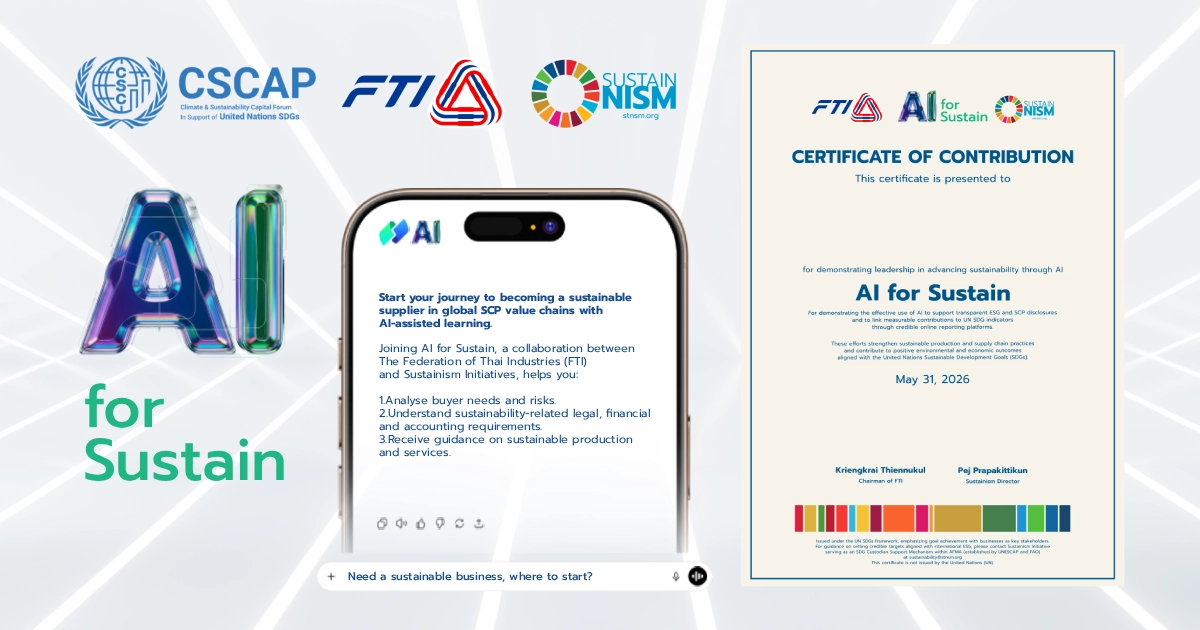
- access the Sustainable Buyer Registry, Trust Chain SME ID and SSAB network;
- explore buyer–supplier matching, supplier development and cross-border cooperation;
- progress from ESG readiness towards responsible procurement, green finance and sustainability-linked capital; and
- pursue recognition based on documented and verifiable performance.
Participation is particularly important because sustainability requirements are reshaping the conditions of international competition. Organizations that begin developing evidence, market readiness and strategic partnerships now will be better positioned to enter emerging value chains and influence future market direction.
Those that wait until such requirements become mandatory may face higher transition costs, limited access to buyers and a loss of competitiveness.
Key direction:
Prepare early. Connect internationally. Compete sustainably.
Recognition: Converting Evidence into Credibility and Market Opportunity
Recognition under CSCAP is an evidence-based process for organizing, reviewing and communicating an organization’s actual sustainability actions and outcomes.
It is designed to translate existing policies, activities and results into structured information aligned with ESG, SCP, OECD-related responsible business principles, or the specific requirements of buyers and destination markets.
The Recognition process comprises five principal stages:
- Collection of empirical evidence
Policies, action plans, procurement records, transaction documents, traceability records, performance indicators, assessment results and other relevant documentation are assembled. - Evidence and traceability review
Evidence is reviewed for completeness, source, period, organizational responsibility and its relationship to the activity or outcome being claimed. - Alignment with relevant frameworks
Evidence is organized according to material ESG and SCP themes, responsible business conduct principles, buyer requirements and relevant market expectations. - Preparation of a Recognition Report or Profile
The report explains what the organization has undertaken, what evidence is available, what outcomes have been achieved, what limitations remain and what further development may be required. - Public recognition within the verified scope
Recognition is announced only in relation to the activities, status or performance supported by the available evidence.
Recognition is therefore not an award based on organizational image or unsubstantiated claims. Nor should it be interpreted as certification of the organization’s entire sustainability performance where a full conformity-assessment or certification process has not been undertaken.
It is a structured acknowledgement of evidence-supported action and readiness within a clearly defined scope.
Recognition serves as a bridge between what an organization has already accomplished and what markets need to see. It enables organizations to:
Convert action into evidence;
evidence into credibility;
credibility into procurement; and
procurement into revenue and investment.
Key direction:
Trust through evidence. Recognition within a verifiable scope.
The Intended Outcome of CSCAP 2026
CSCAP 2026 aims to establish an enabling regional ecosystem in which:
- international standards can be translated into practical business action;
- enterprises can reduce the cost of duplicated assessments;
- buyers can identify credible and sustainability-ready suppliers;
- financial institutions can access more structured and decision-useful information;
- SMEs can enter regional and global value chains through progressive development pathways; and
- sustainability can be converted into trade, revenue, investment and economic resilience.
With representatives of more than 40 embassies expected to participate as observers, alongside public-sector institutions, international organizations, buyers, financial institutions, investors and enterprises, CSCAP 2026 will represent more than a forum for declarations of intent.
It will advance a practical architecture for:
Asia-Pacific Sustainable Supply Chain Connectivity
This architecture will connect standards, evidence, suppliers, buyers, finance and investment within a common regional direction.
The ultimate objective is to ensure that sustainability does not end with reporting. It must become a driver of responsible trade, a source of enterprise revenue, a pathway to sustainable capital and a durable pillar of economic resilience across Asia and the Pacific.