Sustainability Services & Supply Chains Alliance (SSA)
Accelerating the Transition to Sustainable Consumption and Production (SCP) through the Integration of Suppliers, Buyers, and Financial Systems
Important Clarification
The SSA mechanism, CSCAP platform, and related activities do not constitute certification, accreditation, endorsement, or approval by the United Nations, UN ESCAP, FAO, or any UN body. All recognition referenced herein relates to participation in a multi-stakeholder cooperation and disclosure framework aligned with the SDGs and SCP principles.
A Market Infrastructure for Sustainable Procurement Transition
As the global economy transitions toward more sustainable production and consumption systems, supply chains increasingly serve as the primary channel through which sustainability commitments translate into real economic activity.
Yet across many markets, sustainable procurement faces structural barriers, including information asymmetry, transition risk, and limited disclosure from suppliers that are in the process of improving sustainability practices.
These factors often create a procurement gap—a situation where buyers hesitate to engage with suppliers that are moving toward sustainability but lack structured visibility into their practices.
The SSA Impact Chain is designed to help address this challenge.
It functions as a voluntary market infrastructure and cooperation framework that connects sustainability-oriented suppliers with buyers that intentionally source from them, supported by structured disclosure and multi-stakeholder collaboration.
Scope of Operation
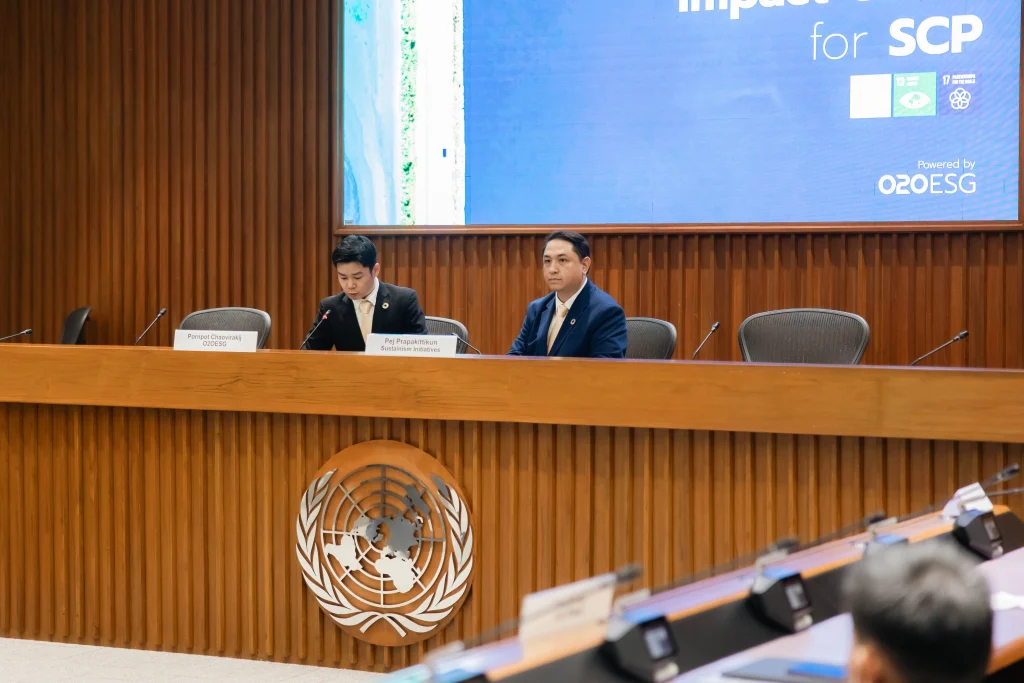
The SSA Impact Chain operates exclusively within procurement relationships where both parties voluntarily participate in the SSA mechanism.
It applies only when:
- a supplier participates in the SSA process, and
- a buyer intentionally procures from that supplier within the SSA framework.
The mechanism therefore does not apply to general market transactions and does not extend to suppliers or buyers outside the SSA participation structure.
Addressing Market Friction in Sustainable Procurement
The framework focuses on suppliers that articulate sustainability-related policies, goals, products, or services, particularly those demonstrating improvements in responsible production, resource efficiency, and environmental or social practices.
These suppliers often represent important nodes within the supply chains of larger buyers, yet may still be operating within transitional stages of sustainability alignment.
In conventional markets, such transitional suppliers can face limited procurement opportunities due to uncertainty and insufficient disclosure.
The SSA Impact Chain helps address these structural barriers by providing a cooperation framework that promotes:
- structured sustainability disclosure
- greater transparency and traceability across supply chains
- clearer communication of sustainability practices between suppliers and buyers
Through these mechanisms, SSA helps reduce market friction and procurement hesitation, enabling buyers to engage more confidently with suppliers that are improving sustainability practices.
Strengthening Sustainable Market Transition
By connecting suppliers, buyers, and relevant stakeholders through a structured cooperation mechanism, the SSA Impact Chain helps expand practical opportunities for sustainable procurement.
This contributes to strengthening:
- SDG 12 — Sustainable Consumption and Production
- SDG 17 — Partnerships for the Goals
More broadly, the SSA Impact Chain supports the gradual development of more transparent, resilient, and sustainability-aligned supply chains.
In doing so, the mechanism helps transform sustainability commitments into real economic relationships, accelerating the transition toward responsible production and sustainable consumption.
Role in the Emerging Sustainable Market Economy
Within the broader sustainability transition, the SSA Impact Chain can be understood as a market-confidence mechanism that helps align information, incentives, and collaboration across supply chains.
By reducing procurement uncertainty and improving visibility of sustainability practices, the framework helps create conditions in which buyers are more willing to engage with suppliers that are advancing responsible production practices.
Over time, such mechanisms contribute to the emergence of more efficient and sustainability-aligned market systems, where responsible production and sustainable sourcing become increasingly integrated into mainstream economic activity.
Recognition within the CSCAP–SSA Mechanism
Organizations referenced as participating or recognized within the CSCAP–SSA framework have engaged in voluntary cooperation, disclosure, or project-based activities aligned with SCP principles.
Such recognition:
- reflects participation in a cooperation and disclosure mechanism
- does not constitute UN certification or approval
- does not imply compliance with any UN-mandated standard
- should not be represented as endorsement by UN ESCAP, FAO, or the United Nations
Participating organizations may include companies across Thailand and the Asia-Pacific region that have engaged in SCP-aligned collaboration, disclosure preparation, or supply-chain initiatives.
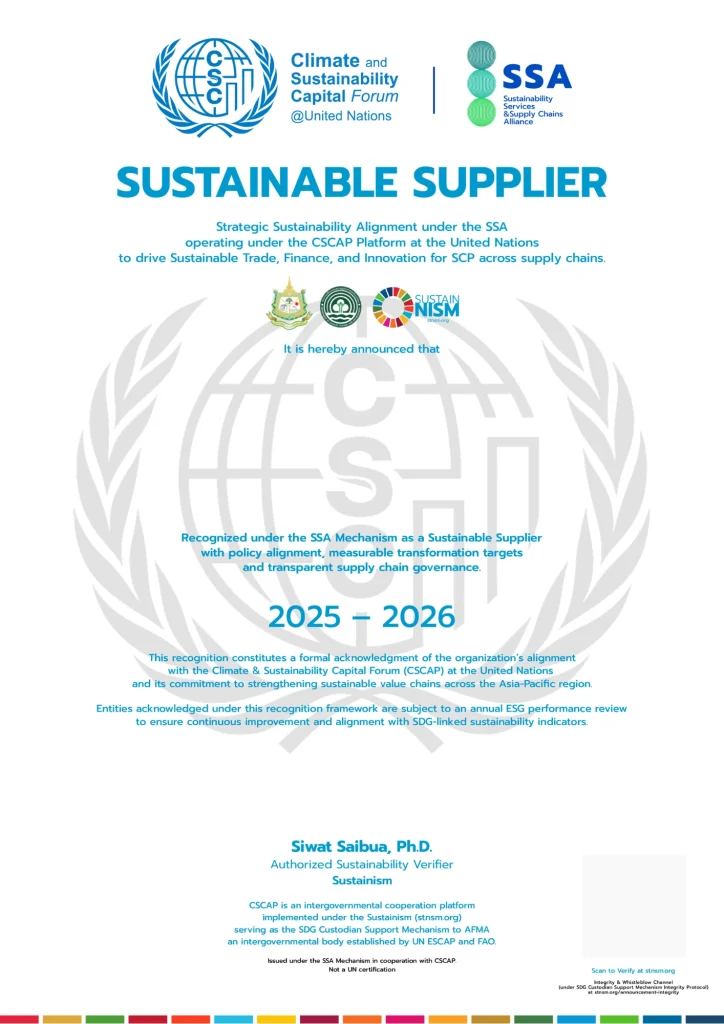
Their participation demonstrates that sustainability practices can support:
- transparency
- investment readiness
- market access
- supply-chain credibility
within voluntary cooperation and disclosure-based frameworks.
These references apply only to activities and procurement relationships conducted within the SSA participation structure and should not be interpreted as certification, endorsement, or validation of the organizations’ overall operations.
Organizations Participating in the SSA Cooperation Framework
(Asia–Pacific / South East Asia)
The following organizations have engaged in voluntary cooperation, disclosure preparation, or supply-chain activities within the SSA framework:
- Heavy Green – Heavy Organizer Co., Ltd.
- Greenery – Creative Move Co., Ltd.
- Clean Mahanakorn Co., Ltd.
- Dr.EX – Demetex Solution Co., Ltd.
- BTT – Ball Technic (Thailand) Co., Ltd.
- GET Solutions (Thailand) Co., Ltd.
- DinoQ AI – Enterprise Laboratory Co., Ltd.
- Eco Supreme – Grandy Intertrade Co., Ltd.
- Corsair Bangkok Co., Ltd.
- Allied-Tek (Thailand) Co., Ltd.
- Locol Co., Ltd.
- Carbon Edge Co., Ltd.
- Agewell – P Plus V international Co., Ltd.
These organizations are referenced in connection with their participation in SSA-related activities, disclosure processes, or SSA-linked supply-chain cooperation.
Such references:
- apply only within the SSA participation context
- relate to specific cooperative activities or procurement linkages
- do not constitute certification or approval
- do not imply endorsement by the United Nations, UN ESCAP, FAO, or any UN body
Participation reflects engagement in a voluntary cooperation and disclosure mechanism intended to strengthen transparency and Sustainable Consumption and Production (SCP) practices across participating supplier–buyer relationships.
Tangible Outcomes of the SSA Mechanism
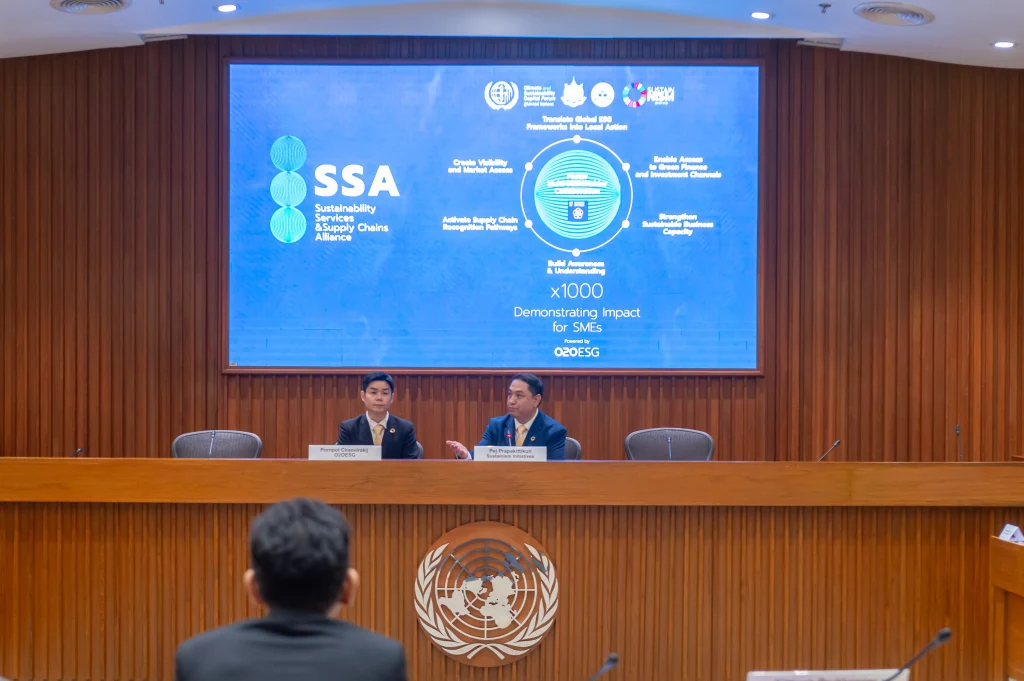
The CSCAP–SSA mechanism functions as a structured linkage system designed to increase buyer confidence to procure from sustainability-oriented suppliers. By improving transparency, visibility, and structured sustainability disclosure within SSA-participating relationships, the mechanism reduces information gaps and transition risks that often cause buyers to hesitate. As a result, buyers are better able to confidently source from suppliers that demonstrate responsible production practices, helping transform sustainability commitments into actual procurement decisions and supporting the practical advancement of Sustainable Consumption and Production (SCP).
Conclusion
The SSA Impact Chain provides a collaborative model linking suppliers, buyers, and financial actors to support Sustainable Consumption and Production through structured disclosure and multi-stakeholder cooperation.
It offers a transparent pathway for organizations to engage in SDG-aligned practices and to communicate sustainability efforts within regional and international dialogue platforms.
However, participation, recognition, or listing within the CSCAP–SSA framework does not constitute endorsement, accreditation, certification, or approval by the United Nations or any UN body.
The mechanism should be understood as a voluntary cooperation and disclosure platform designed to strengthen sustainable supply chains and responsible economic transition.
Official Disclaimer
The CSCAP–SSA mechanism and all related activities are voluntary cooperation and disclosure initiatives aligned with Sustainable Development Goal (SDG) frameworks. They do not constitute certification, accreditation, endorsement, or approval by the United Nations, UN ESCAP, FAO, or any UN-affiliated body.
Any reference to the United Nations reflects alignment with internationally recognized sustainability frameworks and participation in multi-stakeholder dialogue only.
Contact in Thailand (Coordinator and Operations)
O2OESG
Mr. Pornpot Chaovirakij
Director, O2OESG for CSCAP-SSA
+66 9703 44225
Contact at Sustainism Secretariat
Sustainism Initiatives
Ms. Kaninchita Wonganawat
Assistant Director of the Secretariat
+66 8298 96869
secretariat@stnsm.org