Intergovernmental Mandate & Strategic Role of Sustainable Production and Trade Network for the SDGs Association (STNSM)
Sustainism Initiatives (STNSM) is instituted under the Agricultural and Food Marketing Association for Asia and the Pacific (AFMA)—an intergovernmental organization founded by the United Nations Economic and Social Commission for Asia and the Pacific (UN ESCAP) and the Food and Agriculture Organization of the United Nations (FAO). As a collaborative mechanism advancing the Sustainable Development Goals (SDGs) across the Asia–Pacific region, STNSM strengthens trade, finance, procurement, and innovation partnerships to accelerate region-wide sustainable transformation.
Strategic Institutional Mandate
AFMA has formally designated Sustainism as its Strategic Partner, entrusting the organization with a central role in advancing regional climate and sustainability cooperation. To reinforce this institutional mandate, AFMA has appointed the Director of Sustainism to serve concurrently as Director, Climate and Sustainability (AFMA)—positioning Sustainism at the heart of AFMA’s intergovernmental programmes, policy execution, and coordination across member states.
In addition, Sustainism operates as AFMA’s SDG Custodian Support Mechanism, providing analytical, technical, and governance support to strengthen SDG implementation, monitoring, and alignment with UN frameworks across AFMA’s mandate areas.
Secretariat Functions at CSCAP
Sustainism serves as the Secretariat for both the Climate & Sustainability Capital Forum (CSCAP) convened at the United Nations, providing integrated leadership across technical coordination, policy harmonization, and knowledge governance. In this capacity, Sustainism also oversees the Secretariat functions for all cooperative instruments, agreements, and Memoranda of Understanding (MOUs) arising from these two platforms, ensuring that all outcomes remain institutionally coherent, evidence-based, and aligned with internationally recognized standards and multilateral mechanisms.
Private-Sector Transformation Mandate
STNSM is committed to equipping the private sector with the capability to internalize, operationalize, and disclose sustainability performance in accordance with the SDGs—anchoring sustainable transformation as a core principle of corporate governance and long-term competitiveness.
Bridge Between UN Institutional Mechanisms and the Private Sector
Through its strategic partnership with AFMA, Sustainism functions as an institutional bridge, linking private-sector leadership with United Nations–aligned policy frameworks. This strengthens coherence between sustainable business practices and global development objectives, ensuring that the private sector contributes meaningfully to shared regional and multilateral goals.
Regional Platforms for Systemic Transformation
This collaboration is advanced through the Climate & Sustainability Capital Forum (CSCAP) and the Climate Action Forum (CAF), both convened at the United Nations. These platforms elevate regional cooperation in sustainable trade, finance, procurement, and climate action. CAF is currently being elevated as a flagship intergovernmental–private sector mechanism, supporting integrated economic transition and climate-aligned development across the Asia–Pacific region.
The AFMA document affirms that AFMA provides formal support and endorsement to the Sustainism Initiative (stnsm.org).
The Agricultural and Food Marketing Association for Asia and the Pacific (AFMA Asia), an intergovernmental organization in association with the Food and Agriculture Organization of the United Nations (UN FAO), underscores the critical role of the private sector in advancing and accelerating the efficient attainment of the United Nations Sustainable Development Goals (UN SDGs). AFMA Asia emphasizes the imperative to strengthen know/edge, foster comprehensive understanding, and institutionalize collaborative frameworks to propel sustainable development efforts.
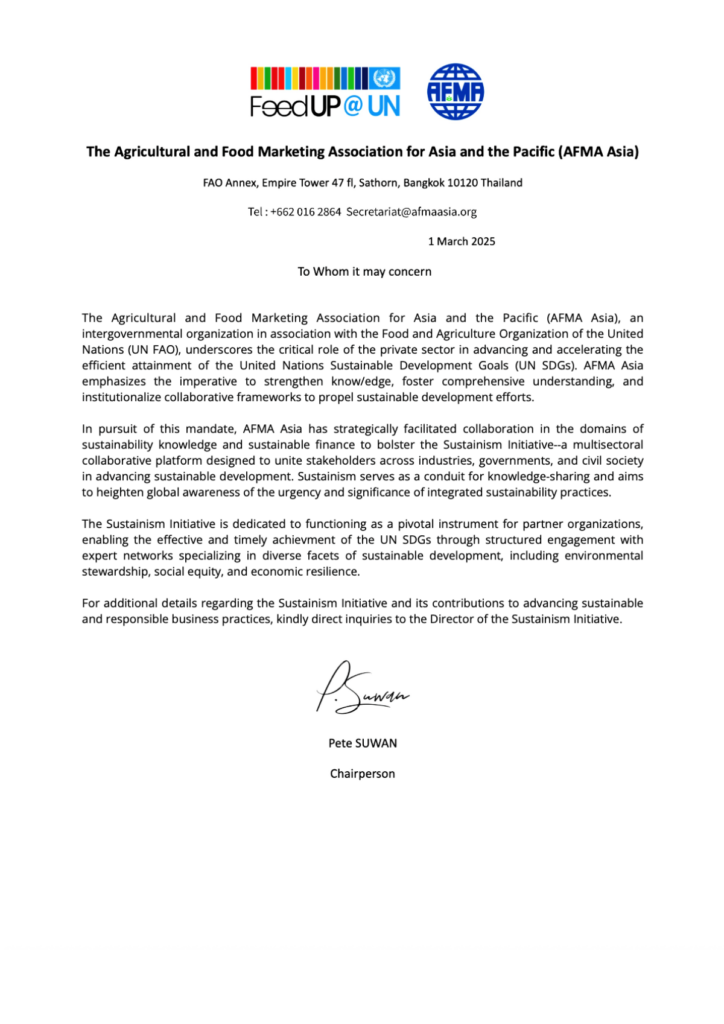
In pursuit of this mandate, AFMA Asia has strategically facilitated collaboration in the domains of sustainability knowledge and sustainable finance to bolster the Sustainism Initiative–a multisectoral collaborative platform designed to unite stakeholders across industries, governments, and civil society in advancing sustainable development. Sustainism serves as a conduit for knowledge-sharing and aims to heighten global awareness of the urgency and significance of integrated sustainability practices.
The Sustainism Initiative is dedicated to functioning as a pivotal instrument for partner organizations, enabling the effective and timely achievment of the UN SDGs through structured engagement with expert networks specializing in diverse facets of sustainable development, including environmental stewardship, social equity, and economic resilience.
For additional details regarding the Sustainism Initiative and its contributions to advancing sustainable and responsible business practices, kindly direct inquiries to the Director of the Sustainism Initiative.
At the heart of Sustainism’s mission lies SDG 17: Partnerships for the Goals, reaffirming the principle that no nation, organization, or community can achieve sustainability alone.
Through inclusive partnerships among governments, businesses, academia, and civil society, Sustainism Initiatives (STNSM) translates the global sustainability agenda into tangible and measurable economic action across the Asia-Pacific region.
STNSM focuses on three core missions that are fully aligned with United Nations principles and globally recognized sustainability frameworks, serving as a driving mechanism for transformative action across the Asia–Pacific region.
Scope of the SDG Custodian Support Mechanism
Advancing Sustainable Consumption and Production (SCP) Through SDG-Aligned Disclosure, Traceability, and Responsible Procurement
Purpose
The SDG Custodian Support Mechanism serves as a sustainability support and coordination function designed to help organizations—particularly private-sector actors, supply chains, procurement networks, and institutional partners—align their operations, disclosures, and sustainability actions with the principles of Sustainable Consumption and Production (SCP) under the United Nations Sustainable Development Goals framework.
The mechanism supports organizations in structuring, measuring, disclosing, and improving sustainability performance in ways that are SDG-linked, evidence-based, traceable, and decision-useful for procurement, finance, investment, and responsible market participation. Particular emphasis is placed on strengthening transparency, due diligence, traceability, responsible sourcing, and sustainability integrity across supply chains and economic systems.
The overall objective is to support the transition toward more responsible production systems, sustainable procurement practices, transparent supply chains, and measurable sustainability outcomes consistent with the global ambitions of SDG 12: Responsible Consumption and Production, while also supporting broader SDG, ESG, and sustainable finance expectations.
6 Pillars
(Integrated with Announcement, Recognition, Publication, and SCP Readiness)
A) SDG Alignment, SCP Integration & Indicator Mapping
Translate projects, products, services, procurement activities, and supply chain practices into relevant SDG Goals, Targets, SCP-related priorities, and UNSD-aligned indicators to improve comparability, traceability, and accountability.
Establish a clear results logic linking:
activities → outputs/outcomes → measurable indicators → sustainability relevance → economic relevance
This provides the technical foundation for sustainability declarations, responsible procurement disclosures, recognition systems, SCP reporting, and SDG-linked market communication.
B) Announcement: Voluntary Declarations, SCP Disclosure & Evidence Packaging
Facilitate voluntary sustainability and SCP-related declarations under the SDG Custodian Support Mechanism, enabling organizations to align policies, goals, procurement practices, and reporting structures with UNSD methodologies and internationally recognized frameworks such as GRI, ISSB, TNFD, SBTi, and Responsible Procurement principles.
Produce standardized Disclosure Packs—including table of contents, KPIs, evidence references, traceability information, and calculation notes—that function as transparent and measurable Statements of Commitment for sustainability and SCP alignment.
Build an Evidence Chain linking:
action → proof → metrics → procurement relevance → financial relevance
to support responsible market use and reduce risks associated with SDG-washing and greenwashing.
C) Data Readiness, Traceability & Interoperability
Provide templates and technical structures to support sustainability data readiness, SCP disclosure consistency, and interoperability across procurement systems, ESG evaluations, reporting systems, financial institutions, and buyer requirements.
Promote minimum data standards and metadata definitions—including reporting boundaries, methodologies, units, traceability scope, and evidence references—to improve consistency, comparability, and responsible disclosure practices aligned with SCP and UNSD indicator expectations.
D) Capacity Building & Technical Assistance for SCP Readiness
Deliver training, coaching, and practical guidance to strengthen organizational readiness in sustainability measurement, SCP implementation, basic MRV practices, traceability, due diligence, and auditable KPI development aligned with international expectations.
Provide practical tools, readiness checklists, governance guidance, and integrity safeguards to reduce risks related to SDG-washing, greenwashing, misleading sustainability claims, and weak sustainability disclosure practices.
E) Integrity, Governance, Due Diligence & Grievance
Establish governance and integrity safeguards including:
- transparency requirements,
- code of conduct principles,
- disclosure integrity expectations,
- conflict-of-interest controls,
- traceability expectations,
- and responsible communication requirements
to protect the credibility of declarations, recognitions, procurement-related disclosures, and SCP-linked publications.
Operate mechanisms to receive concerns, whistleblower submissions, requests for correction, or integrity-related complaints, including review, suspension, limitation, or withdrawal procedures where appropriate, in order to safeguard the integrity and public credibility of sustainability declarations and recognition systems.
F) Recognition, Partnership Recognition & SCP Market Linkage (Value Realization)
Conduct independent evaluations and formal recognitions for organizations seeking recognition as Sustainable Suppliers, Sustainable Buyers, or SCP-aligned partners under the CSCAP–SSA Framework, implemented in collaboration with relevant institutional partners, sustainability experts, and recognized governance mechanisms to support alignment with internationally accepted ESG, SDG, SCP, and Responsible Procurement expectations.
Provide Institutional Partnership Recognition for government agencies, public institutions, academic institutions, and civil society organizations entering structured cooperation to advance sustainability, SCP implementation, traceability, responsible procurement, and SDG-linked economic participation.
Convert sustainability disclosures into procurement-ready and finance-ready narratives by supporting:
- buyer readiness,
- responsible sourcing communication,
- finance readiness,
- supply chain transparency,
- and sustainability value articulation
including measurable value propositions such as:
- revenue opportunities,
- sustainable procurement access,
- risk reduction,
- supply chain resilience,
- operational efficiency,
- and responsible market positioning.
Organizations committed to advancing Sustainable Consumption and Production (SCP), responsible business practices, transparent supply chains, and measurable sustainability outcomes are warmly invited to engage with Sustainism Initiatives (STNSM) for technical guidance, partnership collaboration, and participation opportunities under this evolving sustainability and SCP support framework.
AFMA Official Endorsement for Sustainism Initiative (STNSM)
This document confirms the formal endorsement issued by the Agricultural & Food Marketing Association for Asia and the Pacific (AFMA), recognizing STNSM as a designated SDGs Custodian Support Mechanism within the Asia-Pacific region.
Director: Mr. Pej Prapakittikun
Contact at Sustainism Secretariat
Sustainism Initiatives
Ms. Kaninchita Wonganawat
Assistant Director of the Secretariat
+66 8298 96869
secretariat@stnsm.org
For coordination and project implementation in Thailand, please contact:
Pornpot Chaovirakij : +66 97 034 4225
Nichakorn Veerakul : +66 97 034 3220